Institute of Enzymology, Research Centre for Natural Sciences, Budapest, Hungary.
School of Ph.D. Studies, Semmelweis University, Budapest, Hungary.
Nucleic Acids Res. 2021 Apr 6;49(6):e31. doi: 10.1093/nar/gkaa1220.
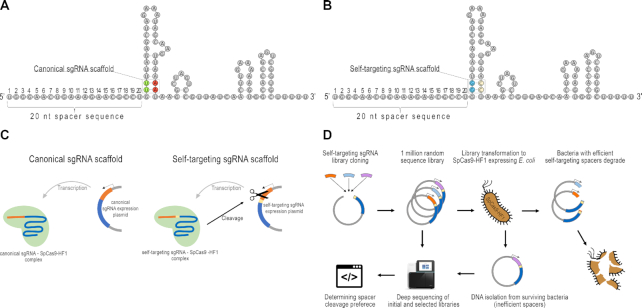
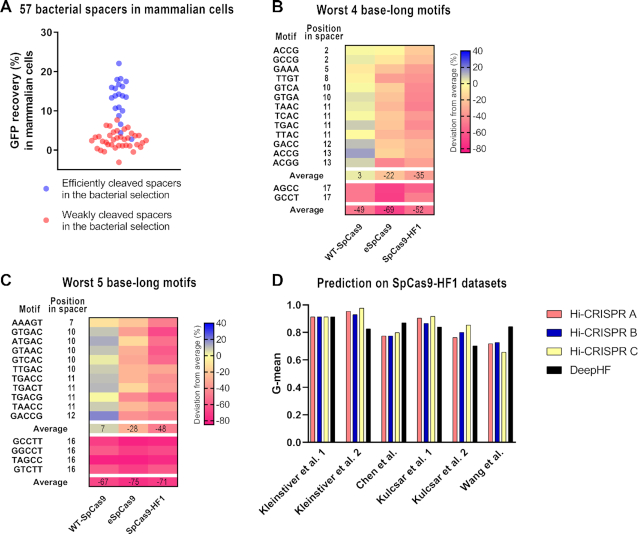
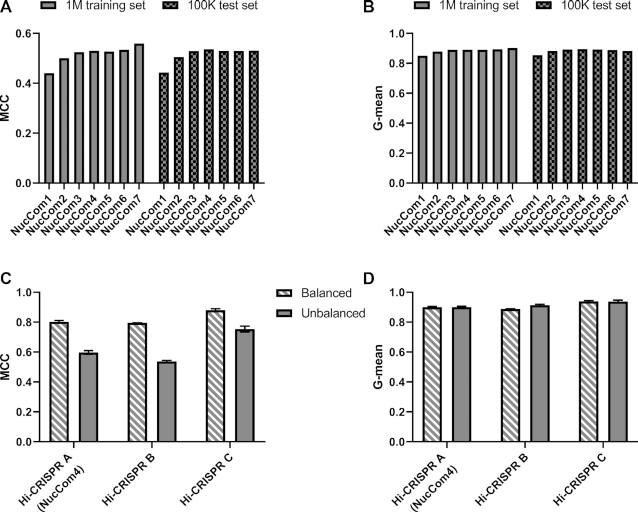
Detailed target-selectivity information and experiment-based efficacy prediction tools are primarily available for Streptococcus pyogenes Cas9 (SpCas9). One obstacle to develop such tools is the rarity of accurate data. Here, we report a method termed 'Self-targeting sgRNA Library Screen' (SLS) for assaying the activity of Cas9 nucleases in bacteria using random target/sgRNA libraries of self-targeting sgRNAs. Exploiting more than a million different sequences, we demonstrate the use of the method with the SpCas9-HF1 variant to analyse its activity and reveal motifs that influence its target-selectivity. We have also developed an algorithm for predicting the activity of SpCas9-HF1 with an accuracy matching those of existing tools. SLS is a facile alternative to the much more expensive and laborious approaches used currently and has the capability of delivering sufficient amount of data for most of the orthologs and variants of SpCas9.
详细的靶标选择性信息和基于实验的疗效预测工具主要可用于化脓性链球菌 Cas9(SpCas9)。开发此类工具的一个障碍是准确数据的稀缺性。在这里,我们报告了一种称为“自我靶向 sgRNA 文库筛选”(SLS)的方法,用于使用自我靶向 sgRNA 的随机靶标/sgRNA 文库来检测 Cas9 核酸酶在细菌中的活性。利用超过一百万种不同的序列,我们展示了该方法在 SpCas9-HF1 变体中的应用,以分析其活性并揭示影响其靶标选择性的基序。我们还开发了一种用于预测 SpCas9-HF1 活性的算法,其准确性与现有工具相当。SLS 是目前使用的昂贵且繁琐方法的一种简单替代方法,并且具有为大多数 SpCas9 的同源物和变体提供足够数量数据的能力。