Laboratoire de Biométrie et Biologie Évolutive, Université de Lyon, Université Lyon 1, CNRS, UMR5558, Villeurbanne, France.
Department of Biological Engineering, Massachusetts Institute of Technology, Cambridge, MA, USA.
Mol Biol Evol. 2021 May 4;38(5):1761-1776. doi: 10.1093/molbev/msaa312.
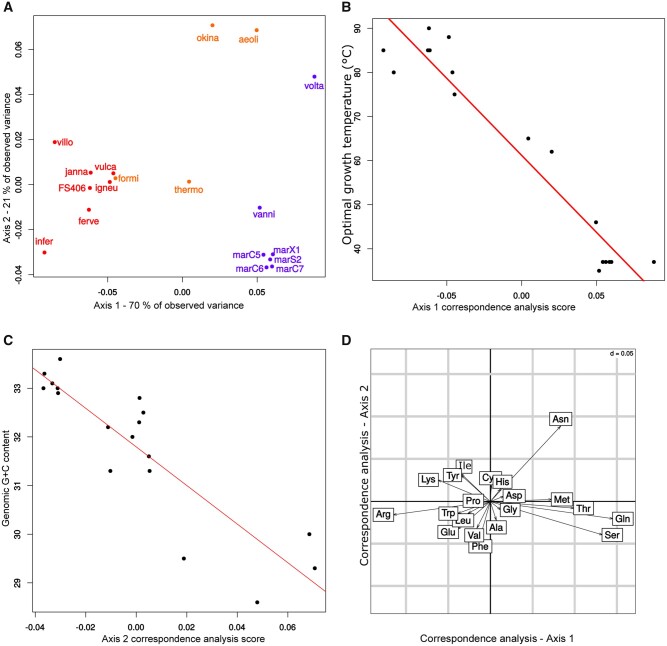
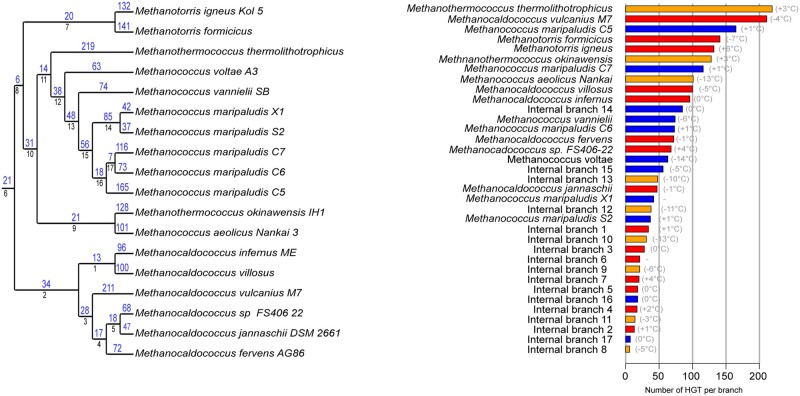
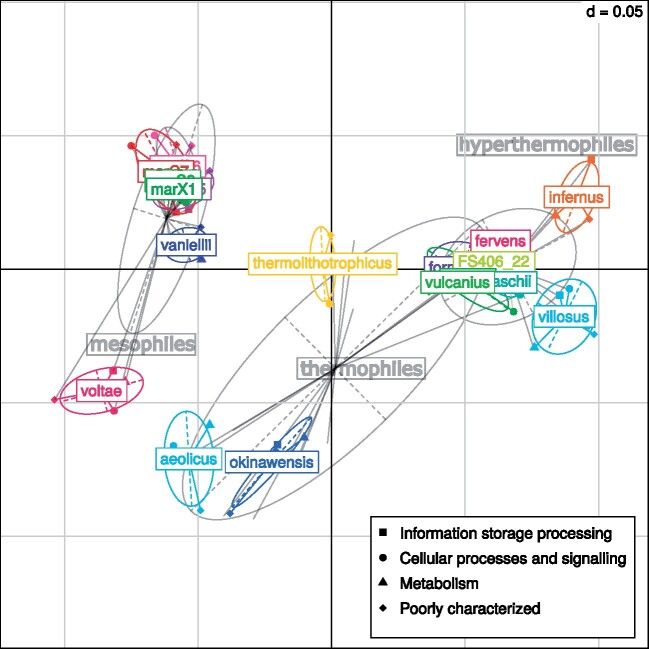
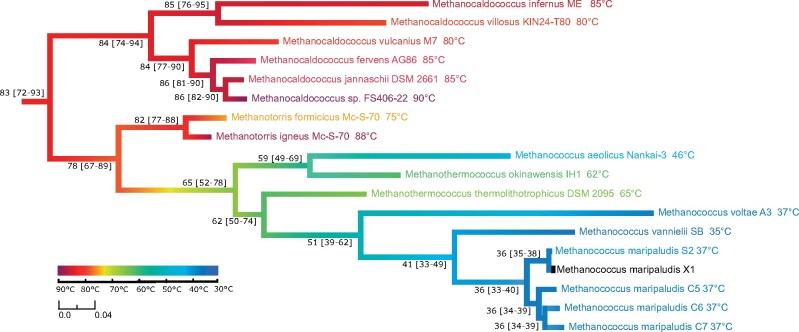
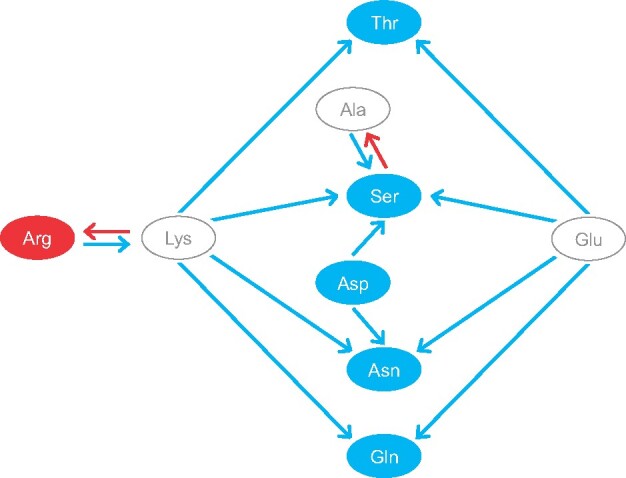
Previous reports have shown that environmental temperature impacts proteome evolution in Bacteria and Archaea. However, it is unknown whether thermoadaptation mainly occurs via the sequential accumulation of substitutions, massive horizontal gene transfers, or both. Measuring the real contribution of amino acid substitution to thermoadaptation is challenging, because of confounding environmental and genetic factors (e.g., pH, salinity, genomic G + C content) that also affect proteome evolution. Here, using Methanococcales, a major archaeal lineage, as a study model, we show that optimal growth temperature is the major factor affecting variations in amino acid frequencies of proteomes. By combining phylogenomic and ancestral sequence reconstruction approaches, we disclose a sequential substitutional scheme in which lysine plays a central role by fine tuning the pool of arginine, serine, threonine, glutamine, and asparagine, whose frequencies are strongly correlated with optimal growth temperature. Finally, we show that colonization to new thermal niches is not associated with high amounts of horizontal gene transfers. Altogether, although the acquisition of a few key proteins through horizontal gene transfer may have favored thermoadaptation in Methanococcales, our findings support sequential amino acid substitutions as the main factor driving thermoadaptation.
先前的研究表明,环境温度会影响细菌和古菌的蛋白质组进化。然而,目前尚不清楚耐热性主要是通过连续积累替换、大规模的水平基因转移还是两者兼而有之来实现。由于影响蛋白质组进化的环境和遗传因素(如 pH 值、盐度、基因组 G+C 含量)也会产生混淆,因此测量氨基酸替换对耐热性的实际贡献具有挑战性。在这里,我们使用产甲烷菌作为主要的古菌谱系作为研究模型,表明最适生长温度是影响蛋白质组中氨基酸频率变化的主要因素。通过结合系统基因组学和祖先序列重建方法,我们揭示了一种连续替换方案,其中赖氨酸通过微调精氨酸、丝氨酸、苏氨酸、谷氨酰胺和天冬酰胺的库发挥核心作用,这些氨基酸的频率与最适生长温度强烈相关。最后,我们表明,对新热生境的殖民化与大量的水平基因转移无关。总之,尽管通过水平基因转移获得少数关键蛋白可能有利于产甲烷菌的耐热性,但我们的研究结果支持连续的氨基酸替换是驱动耐热性的主要因素。