
发展和评估一种免疫-MALDI-TOF 质谱分析方法用于复杂食品基质中相思豆毒素的定量分析。
Development and Evaluation of an Immuno-MALDI-TOF Mass Spectrometry Approach for Quantification of the Abrin Toxin in Complex Food Matrices.
机构信息
CEA, INRAE, Département Médicaments et Technologies pour la Santé (DMTS), Université Paris Saclay, SPI, 91191 Gif-sur-Yvette, France.
Biological Toxins, Centre for Biological Threats and Special Pathogens, Robert Koch Institute, 13353 Berlin, Germany.
出版信息
Toxins (Basel). 2021 Jan 13;13(1):52. doi: 10.3390/toxins13010052.
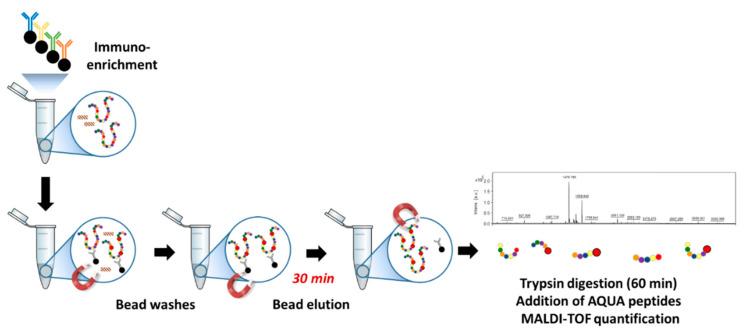
The toxin abrin found in the seeds of has attracted much attention regarding criminal and terroristic misuse over the past decade. Progress in analytical methods for a rapid and unambiguous identification of low abrin concentrations in complex matrices is essential. Here, we report on the development and evaluation of a MALDI-TOF mass spectrometry approach for the fast, sensitive and robust abrin isolectin identification, differentiation and quantification in complex food matrices. The method combines immunoaffinity-enrichment with specific abrin antibodies, accelerated trypsin digestion and the subsequent MALDI-TOF analysis of abrin peptides using labeled peptides for quantification purposes. Following the optimization of the workflow, common and isoform-specific peptides were detected resulting in a ~38% sequence coverage of abrin when testing ng-amounts of the toxin. The lower limit of detection was established at 40 ng/mL in milk and apple juice. Isotope-labeled versions of abundant peptides with high ionization efficiency were added. The quantitative evaluation demonstrated an assay variability at or below 22% with a linear range up to 800 ng/mL. MALDI-TOF mass spectrometry allows for a simple and fast (<5 min) analysis of abrin peptides, without a time-consuming peptide chromatographic separation, thus constituting a relevant alternative to liquid chromatography-tandem mass spectrometry.
在过去十年中,人们对存在于蓖麻种子中的毒素——相思豆毒素的犯罪和恐怖主义滥用引起了极大关注。对于在复杂基质中快速、明确地识别低浓度相思豆毒素的分析方法的进展至关重要。在这里,我们报告了一种 MALDI-TOF 质谱方法的开发和评估,用于快速、灵敏和稳健地鉴定、区分和定量复杂食品基质中的相思豆毒素同工型。该方法结合了免疫亲和富集与特异性相思豆毒素抗体、加速胰蛋白酶消化以及随后使用标记肽进行 MALDI-TOF 分析,以进行定量目的。在优化工作流程后,检测到常见和同工型特异性肽,当测试纳克级毒素时,导致相思豆毒素的序列覆盖率约为 38%。在牛奶和苹果汁中的检测下限为 40 ng/mL。添加了具有高离子化效率的丰富肽的同位素标记版本。定量评估表明,在 22%或以下的检测范围内具有可变性,线性范围高达 800 ng/mL。MALDI-TOF 质谱允许简单快速(<5 分钟)分析相思豆毒素肽,无需耗时的肽色谱分离,因此构成了与液相色谱-串联质谱的相关替代方法。



 Zotero 插件