de Vincenzi Giovanni, Micarelli Primo, Viola Salvatore, Buffa Gaspare, Sciacca Virginia, Maccarrone Vincenzo, Corrias Valentina, Reinero Francesca Romana, Giacoma Cristina, Filiciotto Francesco
Consiglio Nazionale delle Ricerche-Istituto per le Risorse Biologiche e le Biotecnologie Marine, Messina (IRBIM-CNR)-Spianata S. Raineri, 86, 98122 Messina (ME), Italy.
Dipartimento di Scienze della Vita e Biologia dei Sistemi, Università degli Studi di Torino, 10123 Torino (TO), Italy.
Animals (Basel). 2021 Jan 13;11(1):174. doi: 10.3390/ani11010174.
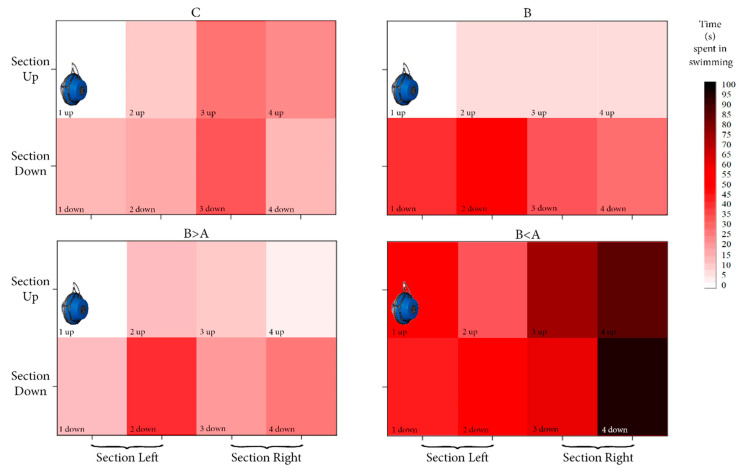
Despite the growing interest in human-made noise effects on marine wildlife, few studies have investigated the potential role of underwater noise on elasmobranch species. In this study, twelve specimens of small-spotted catshark () were exposed to biological and anthropogenic sounds in order to assess their behavioural changes in response to prey acoustic stimuli and to different amplitude levels of shipping noise. The sharks, individually held in aquariums, were exposed to four experimental acoustic conditions characterized by different spectral (Hz) components and amplitude (dB re 1 µPa) levels. The swimming behaviour and spatial distribution of sharks were observed. The results highlighted significant differences in swimming time and in the spatial use of the aquarium among the experimental conditions. When the amplitude levels of biological sources were higher than those of anthropogenic sources, the sharks' swimming behaviour was concentrated in the bottom sections of the aquarium; when the amplitude levels of anthropogenic sources were higher than biological ones, the specimens increased the time spent swimming. Moreover, their spatial distribution highlighted a tendency to occupy the least noisy sections of the aquarium. In conclusion, this study highlighted that anthropogenic noise is able to affect behaviour of catshark specimens and the impact depends on acoustic amplitude levels.
尽管人们对人为噪声对海洋野生动物的影响越来越感兴趣,但很少有研究调查水下噪声对软骨鱼类的潜在作用。在本研究中,12只小斑猫鲨标本被暴露于生物声音和人为声音中,以评估它们对猎物声学刺激和不同幅度水平的船舶噪声的行为变化。这些鲨鱼被单独饲养在水族箱中,暴露于四种实验声学条件下,这些条件具有不同的频谱(赫兹)成分和幅度(相对于1微帕的分贝)水平。观察了鲨鱼的游泳行为和空间分布。结果突出显示了实验条件之间在游泳时间和水族箱空间利用方面的显著差异。当生物声源的幅度水平高于人为声源时,鲨鱼的游泳行为集中在水族箱底部区域;当人为声源的幅度水平高于生物声源时,标本增加了游泳时间。此外,它们的空间分布突出显示出占据水族箱中噪声最小区域的趋势。总之,本研究突出表明人为噪声能够影响猫鲨标本的行为,且这种影响取决于声学幅度水平。