Department of Emergency Medicine, University of Colorado Denver, School of Medicine, Anschutz Medical Campus, 12631 E 17th Ave, Room 2612, MS C326, Aurora, CO, 80045, USA.
Division of Emergency Medicine, University of Cape Town, Department of Surgery, Cape Town, South Africa.
BMC Emerg Med. 2021 Jan 15;21(1):8. doi: 10.1186/s12873-021-00406-6.
The South African Triage Scale (SATS) is a validated in-hospital triage tool that has been innovatively adopted for use in the prehospital setting by Western Cape Government (WCG) Emergency Medical Services (EMS) in South Africa. The performance of SATS by EMS providers has not been formally assessed. The study sought to assess the validity and reliability of SATS when used by WCG EMS prehospital providers for single-patient triage.
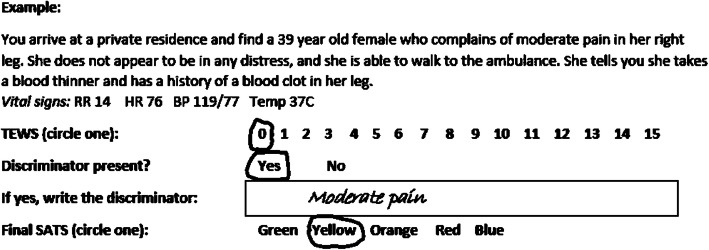
This is a prospective, assessment-based validation study among WCG EMS providers from March to September 2017 in Cape Town, South Africa. Participants completed an assessment containing 50 clinical vignettes by calculating the three components - triage early warning score (TEWS), discriminators (pre-defined clinical conditions), and a final SATS triage color. Responses were scored against gold standard answers. Validity was assessed by calculating over- and under-triage rates compared to gold standard. Inter-rater reliability was assessed by calculating agreement among EMS providers' responses.
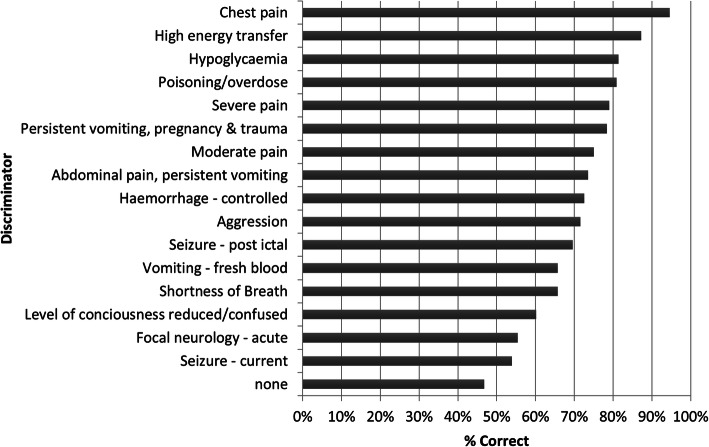
A total of 102 EMS providers completed the assessment. The final SATS triage color was accurately determined in 56.5%, under-triaged in 29.5%, and over-triaged in 13.1% of vignette responses. TEWS was calculated correctly in 42.6% of vignettes, under-calculated in 45.0% and over-calculated in 10.9%. Discriminators were correctly identified in only 58.8% of vignettes. There was substantial inter-rater and gold standard agreement for both the TEWS component and final SATS color, but there was lower inter-rater agreement for clinical discriminators.
This is the first assessment of SATS as used by EMS providers for prehospital triage. We found that SATS generally under-performed as a triage tool, mainly due to the clinical discriminators. We found good inter-rater reliability, but poor validity. The under-triage rate of 30% was higher than previous reports from the in-hospital setting. The over-triage rate of 13% was acceptable. Further clinically-based and qualitative studies are needed.
Not applicable.
南非分诊量表(SATS)是一种经过验证的院内分诊工具,已被西开普省政府(WCG)的急诊医疗服务(EMS)创新性地采用于院前环境中。WCG EMS 提供者使用 SATS 的性能尚未经过正式评估。本研究旨在评估 SATS 在 WCG EMS 院前提供者用于单一患者分诊时的有效性和可靠性。
这是 2017 年 3 月至 9 月在南非开普敦进行的一项前瞻性、基于评估的 WCG EMS 提供者验证研究。参与者通过计算三个组成部分 - 分诊预警评分(TEWS)、鉴别器(预先定义的临床情况)和最终 SATS 分诊颜色来完成包含 50 个临床病例的评估。响应结果与金标准答案进行评分。通过与金标准相比计算过度和不足分诊率来评估有效性。通过计算 EMS 提供者响应之间的一致性来评估组内一致性。
共有 102 名 EMS 提供者完成了评估。最终 SATS 分诊颜色在 56.5%的病例中准确确定,29.5%的病例分诊不足,13.1%的病例分诊过度。TEWS 在 42.6%的病例中正确计算,在 45.0%的病例中计算不足,在 10.9%的病例中计算过度。鉴别器仅在 58.8%的病例中被正确识别。TEWS 组成部分和最终 SATS 颜色的组内一致性和金标准一致性都很高,但临床鉴别器的组内一致性较低。
这是首次对 EMS 提供者用于院前分诊的 SATS 进行评估。我们发现,SATS 作为一种分诊工具的性能普遍较差,主要是由于临床鉴别器。我们发现组内一致性良好,但有效性较差。30%的分诊不足率高于之前在院内环境中的报告。13%的分诊过度率是可以接受的。需要进一步进行基于临床的定性研究。
不适用。