Clinical Institute of Urology and Renal Transplantation, Cluj-Napoca, Romania.
Transplant Institute, Sahlgrenska University Hospital, Gothenburg, Sweden; Institute for Clinical Sciences, Department of Surgery, Sahlgrenska Academy, University of Gothenburg, Gothenburg, Sweden.
Int J Infect Dis. 2021 Mar;104:426-432. doi: 10.1016/j.ijid.2021.01.023. Epub 2021 Jan 13.
The lack of effective treatments for coronavirus disease 2019 (COVID-19) has mandated the repurposing of several drugs, including antiretrovirals and remdesivir (RDV). These compounds may induce acute kidney injury and are not recommended in patients with poor renal function, such as kidney transplant (KTx) recipients.
The records of 42 KTx recipients with COVID-19 were reviewed. Some of them were receiving antiretrovirals (n = 10) or RDV (n = 8) as part of COVID-19 management. Most patients were male (71%) and their median age was 52 years. The median glomerular filtration rate in these patients was 56 ml/min. Regarding disease severity, 36% had mild disease, 19% had moderate disease, 31% had severe disease, and 12% had critical disease. Subgroups, i.e., patients receiving antiretrovirals, RDV, or no antivirals, were comparable in terms of patient age, comorbidities, and immunosuppression.
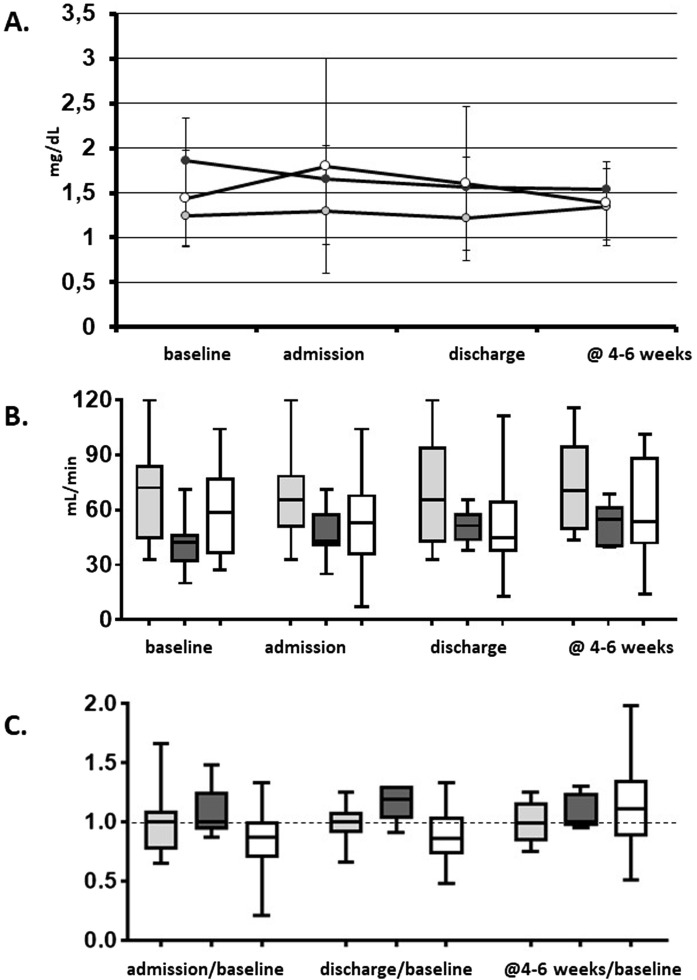
Seven patients (16.6%) died during hospitalization. Acute kidney injury was found in 24% of KTx recipients at admission. Upon discharge, estimated glomerular filtration rate (eGFR) increased in 32% and decreased in 39% of the KTx recipients compared with the admission rate. The decrease was more prevalent in the RDV group (80%) compared with KTx recipients without any antiviral treatment (29%) (p < 0.05). Most patients (62%) returned to baseline eGFR values within 1 month of discharge. The proportion was similar between the patients receiving antiviral treatment and those not receiving this treatment.
KTx recipients run a high risk of COVID-19-related renal impairment. Antivirals appear to be safe for use without major risks for kidney injury.
由于缺乏针对 2019 年冠状病毒病(COVID-19)的有效治疗方法,因此需要重新使用几种药物,包括抗逆转录病毒药物和瑞德西韦(RDV)。这些化合物可能会引起急性肾损伤,并且不建议在肾功能不佳的患者中使用,例如肾移植(KTx)受者。
回顾了 42 名患有 COVID-19 的 KTx 受者的记录。其中一些患者正在接受抗逆转录病毒药物(n=10)或 RDV(n=8)作为 COVID-19 治疗的一部分。大多数患者为男性(71%),中位年龄为 52 岁。这些患者的中位肾小球滤过率为 56ml/min。就疾病严重程度而言,36%的患者患有轻度疾病,19%的患者患有中度疾病,31%的患者患有严重疾病,12%的患者患有危重病。接受抗逆转录病毒药物、RDV 或无抗病毒药物的患者在患者年龄、合并症和免疫抑制方面相似。
住院期间有 7 名患者(16.6%)死亡。入院时,有 24%的 KTx 受者出现急性肾损伤。与入院时相比,出院时 32%的 KTx 受者的估算肾小球滤过率(eGFR)增加,39%的 KTx 受者的 eGFR 降低。与未接受任何抗病毒治疗的 KTx 受者(29%)相比,接受 RDV 治疗的 KTx 受者(80%)的下降更为普遍(p<0.05)。大多数患者(62%)在出院后 1 个月内恢复到基线 eGFR 值。接受抗病毒治疗的患者和未接受抗病毒治疗的患者的比例相似。
KTx 受者感染 COVID-19 相关肾脏损害的风险很高。抗病毒药物的使用似乎是安全的,不会对肾脏造成重大损害。