Iwersen-Bergmann S, Plattner S, Hischke S, Müller A, Andresen-Streichert H, Jungen H, Erb R, Beer-Sandner B
Department of Legal Medicine, University Medical Centre Hamburg-Eppendorf, Hamburg, Germany.
Institute of Legal Medicine, Innsbruck Medical University, Innsbruck, Austria.
Int J Legal Med. 2021 Mar;135(2):473-482. doi: 10.1007/s00414-021-02502-5. Epub 2021 Jan 17.
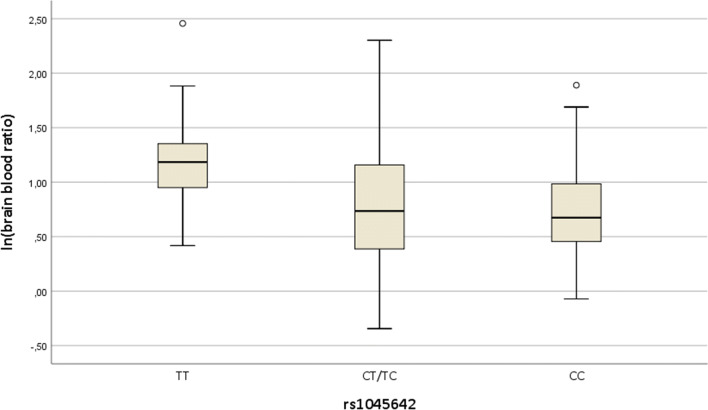
Methadone is an opioid that often leads to fatalities. Interpretation of toxicological findings can be challenging if no further information about the case history is available. The aims of this study were (1) to determine whether brain/blood ratios can assist in the interpretation of methadone findings in fatalities; (2) to examine whether polymorphisms in the gene encoding the P-glycoprotein (also known as multidrug resistance protein 1 (MDR1) or ATP-binding cassette sub-family B member 1 (ABCB1)), which functions as a multispecific efflux pump in the blood-brain barrier, affect brain/blood ratios of methadone. Femoral venous blood and brain tissue (medulla oblongata and cerebellum) from 107 methadone-related deaths were analysed for methadone by gas chromatography-mass spectrometry. In addition, all the samples were genotyped for three common ABCB1 single nucleotide polymorphisms (SNPs rs1045642, rs1128503, and rs2032582) using ion-pair reversed-phase high-performance liquid chromatography-electrospray ionization mass spectrometry (ICEMS). In nearly all cases, methadone concentrations were higher in the brain than in the blood. Inter-individual brain/blood ratios varied (0.6-11.6); the mean ratio was 2.85 (standard deviation 1.83, median 2.35). Moreover, significant differences in mean brain/blood ratios were detected among the synonymous genotypes of rs1045642 in ABCB1 (p = 0.001). Cases with the T/T genotype had significantly higher brain/blood ratios than cases with the other genotypes (T/T vs. T/C difference (d) = 1.54, 95% CI [1.14, 2.05], p = 0.002; T/T vs. C/C d = 1.60, 95% CI [1.13, 2.29], p = 0.004). Our results suggest that the rs1045642 polymorphisms in ABCB1 may affect methadone concentrations in the brain and its site of action and may be an additional factor influencing methadone toxicity.
美沙酮是一种常导致死亡的阿片类药物。如果没有关于病例史的进一步信息,毒理学结果的解读可能具有挑战性。本研究的目的是:(1)确定脑/血比值是否有助于解读美沙酮致死病例的结果;(2)研究编码P-糖蛋白(也称为多药耐药蛋白1(MDR1)或ATP结合盒亚家族B成员1(ABCB1))的基因中的多态性是否会影响美沙酮的脑/血比值,该蛋白在血脑屏障中起多特异性外排泵的作用。通过气相色谱-质谱法分析了107例与美沙酮相关死亡病例的股静脉血和脑组织(延髓和小脑)中的美沙酮。此外,使用离子对反相高效液相色谱-电喷雾电离质谱法(ICEMS)对所有样本进行三种常见ABCB1单核苷酸多态性(SNPs rs1045642、rs1128503和rs2032582)的基因分型。在几乎所有病例中,脑中的美沙酮浓度高于血液中的浓度。个体间的脑/血比值各不相同(0.6 - 11.6);平均比值为2.85(标准差1.83,中位数2.35)。此外,在ABCB1中rs1045642的同义基因型之间检测到平均脑/血比值存在显著差异(p = 0.001)。T/T基因型的病例脑/血比值显著高于其他基因型的病例(T/T与T/C差异(d) = 1.54,95%可信区间[1.14, 2.05],p = 0.002;T/T与C/C d = 1.60,95%可信区间[1.13, 2.29],p = 0.004)。我们的结果表明,ABCB1中的rs1045642多态性可能会影响脑中的美沙酮浓度及其作用部位,可能是影响美沙酮毒性的一个额外因素。