Recarey-Rama Sheila, Gómez-Trigo Jesús, Gil-Rodriguez Almudena, Dominguez Eduardo, Sánchez-Martínez Inés, Riveiro-Recimil Ángela, Barral-Raña Alba, de Leon Jose, Rodriguez-Viyuela Ana, Arrojo Manuel, Carracedo Angel, Maroñas Olalla
Genomic Medicine Group, Center for Research in Molecular Medicine and Chronic Diseases (CiMUS), University of Santiago de Compostela, 15782 Santiago de Compostela, Spain.
Pharmacogenomics and Drug Discovery Group (GenDeM), Health Research Institute of Santiago de Compostela (IDIS), 15706 Santiago de Compostela, Spain.
Pharmaceuticals (Basel). 2025 Apr 25;18(5):623. doi: 10.3390/ph18050623.
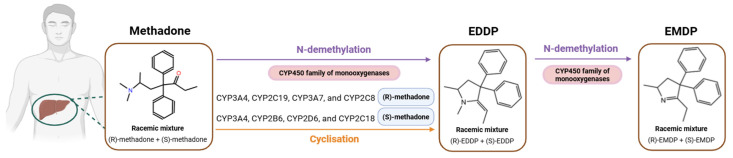
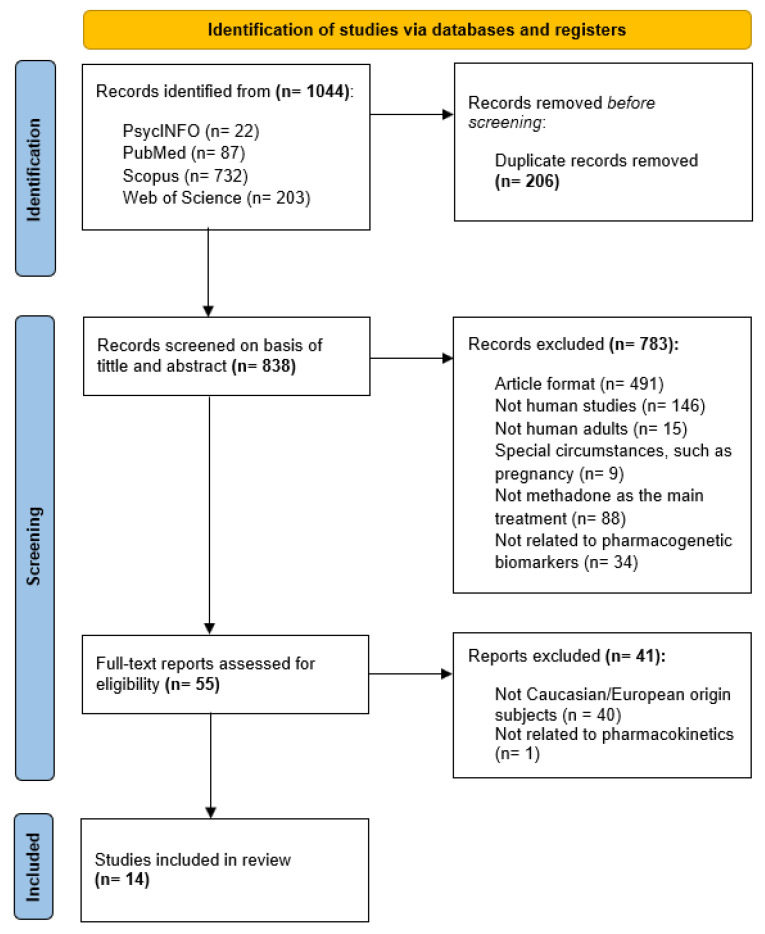
: Methadone maintenance treatment (MMT) is widely used in opioid use disorder (OUD). Its efficacy is influenced by its metabolism, primarily mediated by Cytochrome P450 (CYP450) enzymes in the liver. Genetic polymorphisms in CYP450 genes and other factors, such as age, sex, and concomitant treatments, contribute to interindividual variability in methadone response. This article addresses the relevance of pharmacokinetic biomarkers in methadone metabolism and its impact on treatment outcomes in European populations over the past 25 years. : A systematic review was conducted using four databases (PsycINFO, PubMed, Scopus, and Web of Science) for studies published between 2000 and 2024 following the PRISMA 2020 guidelines (CRD42025641373 in PROSPERO). Two independent reviewers screened and assessed the study quality using NHLBI tools. Discrepancies were solved through consensus. Relevant data including sample size, genetic biomarkers, and key findings were extracted for each study. Data were synthesized and described in detail. : Fourteen studies on pharmacogenetic biomarkers influencing methadone metabolism in European populations were analyzed, encompassing a total of 3180 subjects. *6 was identified as a key variant associated with increased (S)-methadone plasma levels, potentially leading to cardiac complications, while the role of other pharmacokinetic genes, including and , was inconclusive. : Genetic polymorphisms significantly influence methadone metabolism, with the *6 allele playing a key role in (S)-methadone metabolism and associated with cardiac risks. Pharmacogenetic studies integrating co-mediation-the principal cause of phenoconversion-as a potential variable alongside gender differences and encompassing adequate sample sizes could improve outcomes and establish the basis for personalized medicine of MMT.
美沙酮维持治疗(MMT)广泛应用于阿片类物质使用障碍(OUD)。其疗效受代谢影响,主要由肝脏中的细胞色素P450(CYP450)酶介导。CYP450基因的遗传多态性以及年龄、性别和联合治疗等其他因素导致美沙酮反应存在个体差异。本文阐述了过去25年中药代动力学生物标志物在美沙酮代谢中的相关性及其对欧洲人群治疗结果的影响。
使用四个数据库(PsycINFO、PubMed、Scopus和Web of Science)按照PRISMA 2020指南(PROSPERO中的CRD42025641373)对2000年至2024年发表的研究进行了系统综述。两名独立评审员使用美国国立心、肺、血液研究所(NHLBI)工具筛选并评估研究质量。通过协商解决分歧。为每项研究提取了包括样本量、遗传生物标志物和主要发现在内的相关数据。对数据进行了综合和详细描述。
分析了14项关于影响欧洲人群美沙酮代谢的药物遗传学标志物的研究,共纳入3180名受试者。*6被确定为与(S)-美沙酮血浆水平升高相关的关键变异,可能导致心脏并发症,而其他药代动力学基因,包括[具体基因1]和[具体基因2]的作用尚无定论。
遗传多态性显著影响美沙酮代谢,*6等位基因在(S)-美沙酮代谢中起关键作用,并与心脏风险相关。将共介导(表型转换的主要原因)作为潜在变量与性别差异一起纳入且样本量充足的药物遗传学研究可以改善治疗结果,并为MMT的个性化医疗奠定基础。