National Infection Service, Public Health England, UK.
Population Health Sciences, Bristol Medical School, University of Bristol, Bristol, UK.
Addiction. 2021 Aug;116(8):2076-2083. doi: 10.1111/add.15371. Epub 2021 Jan 17.
There are concerns that national population-based estimates of illicit drug use are underestimated. We investigated this by comparing estimates of illicit substance use at age 24 from the Crime Survey for England and Wales (CSEW) with a birth cohort (Avon Longitudinal Study of Parents and Children, ALSPAC) and by comparing the Smoking and Alcohol Toolkit Studies (STS/ATS) to ALSPAC.
Cross-sectional household survey and cross-sectional data from one wave of a longitudinal birth cohort.
England and Wales.
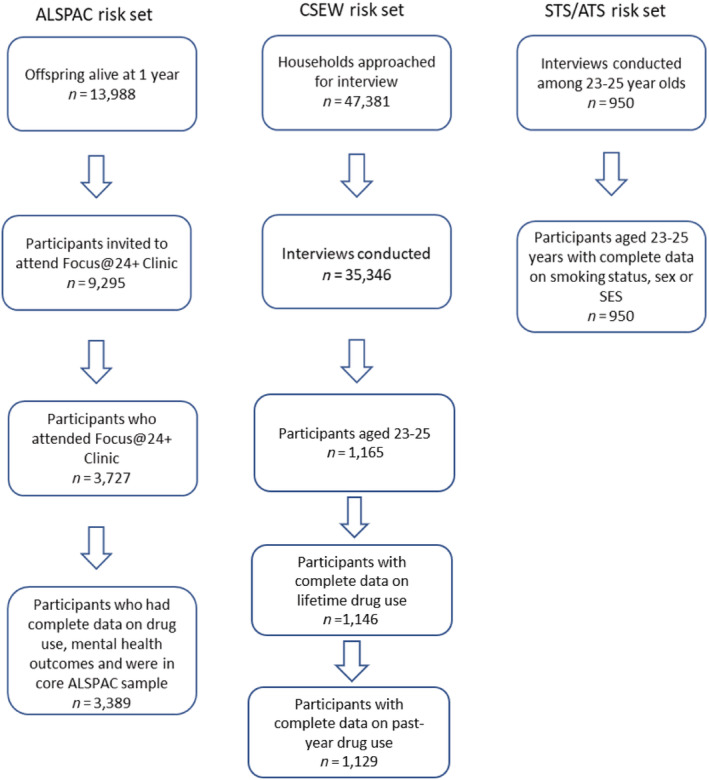
Young adults aged 23-25 reporting on substance use in 2017 to CSEW (n = 1165), ALSPAC (n = 3389) and STS/ATS (n = 950).
Lifetime and past-year illicit drug use, smoking status and hazardous drinking at age 24.
The 2017 CSEW estimate of lifetime illicit drug use was 40.6%, compared with 62.8% in ALSPAC (risk difference % [RD%] = 22.2%; 95% CI = 18.9-25.5%; P ≤ 0.001). The RD in lifetime use between ALSPAC and the CSEW was 23.2% (95% CI = 20.0-26.4%) for cannabis, 16.9% (95% CI = 14.4-19.4%) for powder cocaine and 24.8% (95% CI = 22.6-27.0%) for amphetamine. Past-year drug use was 16.4% in CSEW, compared with 36.7% in ALSPAC (RD% = 20.3%; 95% CI = 17.6-23.0%; P ≤ 0.001). For past-year substance use, the RD between ALSPAC and the CSEW was 15.4% (95% CI = 12.9-17.9%) for cannabis, 14.8% (95% CI = 13.0%-16.6%) for powder cocaine and 15.9% (95% CI = 14.5-17.4%) for amphetamine. Levels of current smoking were similar between STS (27.4%) and ALSPAC (29.4%). Hazardous drinking was substantially higher in ALSPAC (60.3%) than the ATS (32.1%; RD% = 28.2%; 95% CI = 24.8-31.6%; P ≤ 0.001).
The Avon Longitudinal Study of Parents and Children provides one source of validation for measurements of drug use in government household surveys and indicates that illicit drug use may be underestimated in the Crime Survey for England and Wales.
人们担心基于全国人口的非法药物使用估计值被低估了。我们通过比较英格兰和威尔士犯罪调查(CSEW)中 24 岁时的非法物质使用估计值与一个出生队列(雅芳纵向父母和儿童研究,ALSPAC),以及通过比较吸烟和酒精工具包研究(STS/ATS)与 ALSPAC,来研究这一问题。
横断面家庭调查和一个纵向出生队列的一个波次的横断面数据。
英格兰和威尔士。
2017 年在 CSEW(n=1165)、ALSPAC(n=3389)和 STS/ATS(n=950)报告物质使用情况的 23-25 岁的年轻人。
24 岁时的终身和过去一年的非法药物使用、吸烟状况和危险饮酒。
2017 年 CSEW 对终身非法药物使用的估计为 40.6%,而 ALSPAC 为 62.8%(风险差异%[RD%]为 22.2%;95%CI=18.9-25.5%;P≤0.001)。ALSPAC 和 CSEW 之间终身使用的 RD 为大麻 23.2%(95%CI=20.0-26.4%)、粉可卡因 16.9%(95%CI=14.4-19.4%)和苯丙胺 24.8%(95%CI=22.6-27.0%)。CSEW 中的过去一年药物使用为 16.4%,而 ALSPAC 为 36.7%(RD%为 20.3%;95%CI=17.6-23.0%;P≤0.001)。对于过去一年的物质使用,ALSPAC 和 CSEW 之间的 RD 为大麻 15.4%(95%CI=12.9-17.9%)、粉可卡因 14.8%(95%CI=13.0%-16.6%)和苯丙胺 15.9%(95%CI=14.5-17.4%)。STS(27.4%)和 ALSPAC(29.4%)之间的当前吸烟水平相似。ALSPAC 中的危险饮酒量明显高于 ATS(32.1%;RD%为 28.2%;95%CI=24.8-31.6%;P≤0.001)。
雅芳纵向父母和儿童研究提供了对政府家庭调查中药物使用测量的一个验证来源,并表明在英格兰和威尔士犯罪调查中非法药物使用可能被低估。