Faculty of Rehabilitation, Kobe Gakuin University, Kobe, Japan.
Department of Rehabilitation, IMS Itabashi Rehabilitation Hospital, Tokyo, Japan.
Occup Ther Int. 2020 Dec 30;2020:1621595. doi: 10.1155/2020/1621595. eCollection 2020.
This study is aimed at understanding how practicing the use of public transportation can affect the self-efficacy and perceptions of occupational enablement among patients with physical disabilities in a recovery rehabilitation hospital.
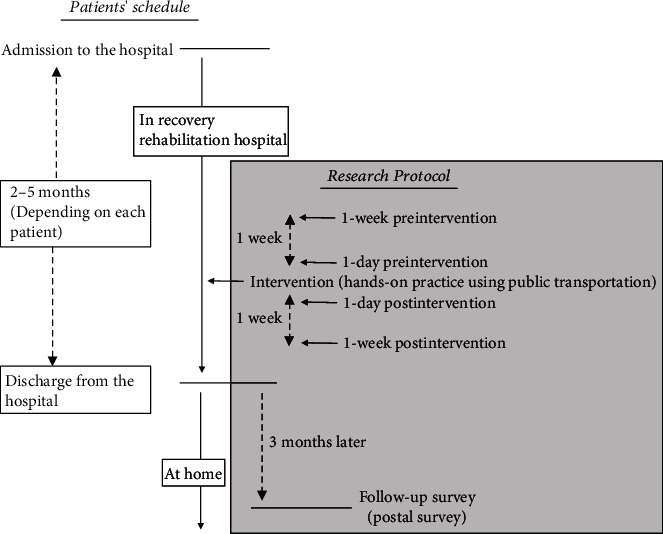
We recruited 21 inpatients with physical disabilities caused by stroke or orthopedic diseases from a recovery rehabilitation hospital in Japan and used a multimethod design including an intervention study and a follow-up survey. The intervention study utilized a before-after trial and provided hands-on training in the use of public transportation as the intervention. How self-efficacy and perceptions of occupational enablement changed before and after the intervention was measured using the visual analog scale (VAS). The follow-up survey was conducted to investigate whether patients used public transportation postdischarge.
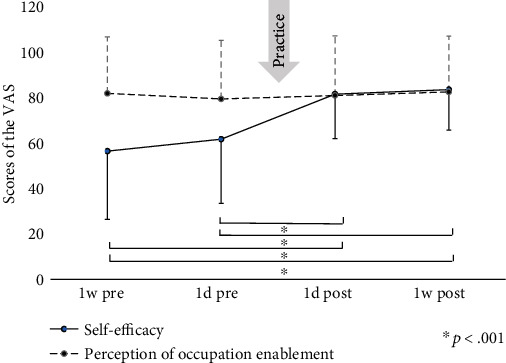
Only differences in the VAS scores regarding self-efficacy were significant between before and after the hands-on training in the use of public transportation, whereas differences regarding the perceptions of occupation enablement were not. Self-efficacy after the intervention was higher than that before the intervention. In the follow-up survey, both VAS scores of the psychological factors were significantly higher in the group that used public transportation postdischarge than in the group that did not.
Providing hands-on training in the use of public transportation for inpatients with physical disabilities increased their self-efficacy, indicating that psychological factors should be evaluated to predict their occupational skill improvement and to verify the outcomes of an occupational therapeutic intervention.
本研究旨在了解在康复医院中,让患有身体残疾的患者实际练习使用公共交通工具对其自我效能感和职业能力感知的影响。
我们在日本的一家康复医院招募了 21 名因中风或骨科疾病而导致身体残疾的住院患者,并采用了包括干预研究和随访调查在内的多方法设计。干预研究采用前后试验,提供公共交通使用方面的实践培训作为干预措施。使用视觉模拟量表(VAS)测量干预前后自我效能感和职业能力感知的变化。随访调查旨在调查患者出院后是否使用公共交通工具。
仅在使用公共交通工具的实践培训前后的 VAS 评分中,自我效能感方面存在显著差异,而职业能力感知方面则没有。干预后的自我效能感高于干预前。在随访调查中,出院后使用公共交通工具的患者的 VAS 评分的心理因素均显著高于未使用的患者。
为身体残疾的住院患者提供公共交通使用的实践培训可以提高他们的自我效能感,这表明应评估心理因素,以预测他们职业技能的提高,并验证职业治疗干预的效果。