Abe Minori, Purnama Indra, Mulyana Jacob Yan, Hada Masahiko
Department of Chemistry, Tokyo Metropolitan University, 192-0364 Hachioji, Tokyo, Japan.
Department of Chemistry, Islamic University of Indonesia, Yogyakarta, Jl. Kaliurang km 14.5, Sleman, 55584 Yogyakarta, Indonesia.
ACS Omega. 2020 Dec 28;6(1):55-64. doi: 10.1021/acsomega.0c01199. eCollection 2021 Jan 12.
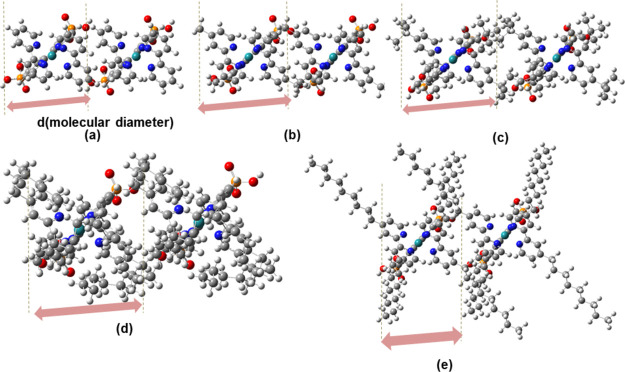
In this study, we present a density functional study of four ruthenium complexes by means of UV-visible spectroscopy and Marcus theory. These molecules, [Ru(bipyP)(bipy)] (P1), [Ru(bipyP)(dmb)] (P2), [Ru(bipyP)(dtbb)] (P3), and [Ru(bipyP)(dnb)] (P4), where bipyP = 2,2'-bipyridine-4,4'-diphosphonic acid, bipy = 2,2'-bipyridine, dmb = 4,4'-dimethyl-2,2'-bipyridine, dtbb = 4,4'-di--butyl-2,2'-bipyridine, and dnb = 4,4'-dinonyl-2,2'-bipyridine, are photosensitizers for applications in dye-sensitized photo-electrochemical cells (DSPECs). Because of the undetermined P4 conformation in the experiment, we modeled three P4 conformers with straight (P4-straight) and bent nonyl chains (P4-bend1 and bend2). UV-vis absorption spectra by time-dependent density functional theory showed intense metal-to-ligand charge transfer to anchor bipyridine ligands (MLCT-anchoring) at 445-460 nm, which accurately reproduce experimental data. The largest light-harvesting efficiency of the MLCT-anchoring state was observed in the P4-bend1 conformer, which has the lowest P4 energy. This may relate to greater electron injection in the P4 and supports experimental results of dye-only systems (do-DSPEC). The calculated charge transfer rates agree well with the experimental trend. The largest rate was obtained for P2, which was attributed to the expansion of the highest-occupied molecular orbital toward the ancillary bipy ligands and also to the short distances between dyes on the TiO surface. These results also support experimental results for P2, which was the best compound for lateral hole-hopping in a sacrificial agent-containing system (sa-DSPEC).
在本研究中,我们通过紫外可见光谱和马库斯理论对四种钌配合物进行了密度泛函研究。这些分子,即[Ru(bipyP)(bipy)](P1)、[Ru(bipyP)(dmb)](P2)、[Ru(bipyP)(dtbb)](P3)和[Ru(bipyP)(dnb)](P4),其中bipyP = 2,2'-联吡啶-4,4'-二膦酸,bipy = 2,2'-联吡啶,dmb = 4,4'-二甲基-2,2'-联吡啶,dtbb = 4,4'-二叔丁基-2,2'-联吡啶,dnb = 4,4'-二壬基-2,2'-联吡啶,是用于染料敏化光电化学电池(DSPEC)的光敏剂。由于实验中P4构象不确定,我们对具有直链(P4-直链)和弯曲壬基链(P4-弯曲1和弯曲2)的三种P4构象体进行了建模。通过含时密度泛函理论得到的紫外可见吸收光谱显示,在445 - 460 nm处有强烈的金属到配体的电荷转移以锚定联吡啶配体(MLCT-锚定),这准确地再现了实验数据。在具有最低P4能量的P4-弯曲1构象体中观察到MLCT-锚定态的最大光捕获效率。这可能与P4中更大的电子注入有关,并支持仅含染料体系(do-DSPEC)的实验结果。计算得到的电荷转移速率与实验趋势吻合良好。P2获得了最大速率,这归因于最高占据分子轨道向辅助联吡啶配体的扩展以及TiO表面上染料之间的短距离。这些结果也支持了P2的实验结果,P2是含牺牲剂体系(sa-DSPEC)中横向空穴跳跃的最佳化合物。