Department of Biomedical and Neuromotor Sciences DIBINEM, University of Bologna, Italy.
Child Neurology and Psychiatry Unit, S. Orsola Hospital, Department of Medical and Surgical Sciences (DIMEC), University of Bologna, Italy.
Acta Myol. 2020 Dec 1;39(4):200-206. doi: 10.36185/2532-1900-023. eCollection 2020 Dec.
In Duchenne muscular dystrophy, quadriceps weakness is recognized as a key factor in gait deterioration. The objective of this work was three-fold: first, to document the strength of the quadriceps in corticosteroid-naïve DMD boys; second, to measure the effect of corticosteroids on quadriceps strength; and third, to evaluate the correlation between baseline quadriceps strength and the age when starting corticosteroids with the loss of ambulation.
Quadriceps muscle strength using hand-held dynamometry was measured in 12 ambulant DMD boys who had never taken corticosteroids and during corticosteroid treatment until the loss of ambulation.
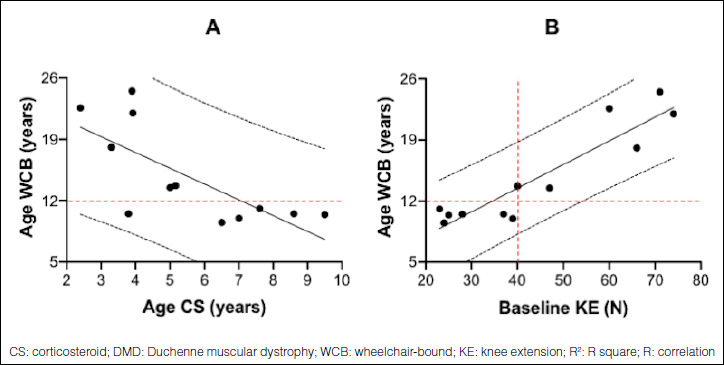
Baseline quadriceps muscle strength at 6 years of age was 28% that of normal children of the same age; it decreased to 15% at 8 years and to 6% at 10 years. The increase in quadriceps muscle strength obtained after 1 year of corticosteroid treatment had a strong direct correlation with the baseline strength (R = 0.96). With corticosteroid treatment, the age of ambulation loss showed a very strong direct relationship (R = 0.92) with baseline quadriceps muscle strength but only a very weak inverse relationship (R = -0.73) with the age of starting treatment. Age of loss of ambulation was 10.3 ± 0.5 19.1 ± 4.7 (P < 0.05) in children with baseline quadriceps muscle strength less than or greater than 40 N, respectively.
Corticosteroid-naïve DMD boys have a quantifiable severe progressive quadriceps weakness. This long-term study, for the first time, shows that both of the positive effects obtained with CS treatment, i.e. increasing quadriceps strength and delaying the loss of ambulation, have a strong and direct correlation with baseline quadriceps muscle strength. As such, hand-held dynamometry may be a useful tool in the routine physical examination and during clinical trial assessment.
在杜氏肌营养不良症中,股四头肌无力被认为是步态恶化的关键因素。本研究的目的有三:首先,记录皮质类固醇治疗前 DMD 男孩的股四头肌力量;其次,测量皮质类固醇对股四头肌力量的影响;最后,评估基线股四头肌力量与开始使用皮质类固醇的年龄以及丧失步行能力之间的相关性。
使用手持测力计测量 12 名从未服用过皮质类固醇且在开始使用皮质类固醇治疗直至丧失步行能力期间接受治疗的可走动的 DMD 男孩的股四头肌力量。
6 岁时的基线股四头肌力量为同龄正常儿童的 28%;8 岁时降至 15%,10 岁时降至 6%。皮质类固醇治疗 1 年后股四头肌力量的增加与基线力量呈强直接相关(R = 0.96)。使用皮质类固醇治疗时,基线股四头肌力量与丧失步行能力的年龄呈很强的直接关系(R = 0.92),但与开始治疗的年龄呈很弱的负相关(R = -0.73)。基线股四头肌力量小于或大于 40 N 的儿童丧失步行能力的年龄分别为 10.3 ± 0.5 岁和 19.1 ± 4.7 岁(P < 0.05)。
皮质类固醇治疗前的 DMD 男孩存在可量化的严重进行性股四头肌无力。这项长期研究首次表明,CS 治疗获得的两种积极效果,即增加股四头肌力量和延缓丧失步行能力,与基线股四头肌力量具有很强的直接相关性。因此,手持测力计可能是常规体格检查和临床试验评估的有用工具。