Hao Leiyu, Liu Yan, Yu Xinqian, Zhu Yuerong, Zhu Yichao
Department of Physiology, Nanjing Medical University, Nanjing, China.
Qinhuai District, Nanjing Jinling Hospital, Nanjing, China.
Cell Prolif. 2021 Mar;54(3):e12994. doi: 10.1111/cpr.12994. Epub 2021 Jan 17.
Cancer cell migration to secondary organs remains an essential cause of death among breast cancer (BrCa) patients. Cell motility mainly relies on actin dynamics. Our previous reports verified that dishevelled-associated activator of morphogenesis 1 (Daam1) regulates invadopodia extension and BrCa cell motility. However, how Daam1 is involved in actin filament assembly and promotes pseudopodia formation in BrCa cells remains unclear.
One hundred human BrCa samples were collected at Women's Hospital of Nanjing Medical University. Immunohistochemistry (IHC) was used to examine Daam1 and Fascin expression. Wound healing and Boyden chamber assays were used to explore cell migration and pseudopodia extension of BrCa cells. Co-IP/pull down and Western blotting were performed to study the physical interaction between Daam1 and Fascin. Immunofluorescence assays were performed to observe whether Daam1 and Fascin were colocalized and mediated actin filament assembly.
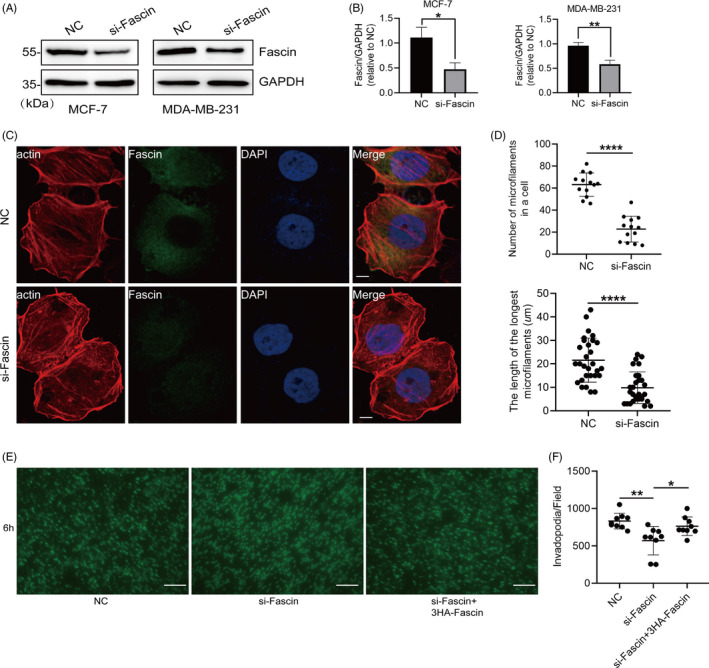
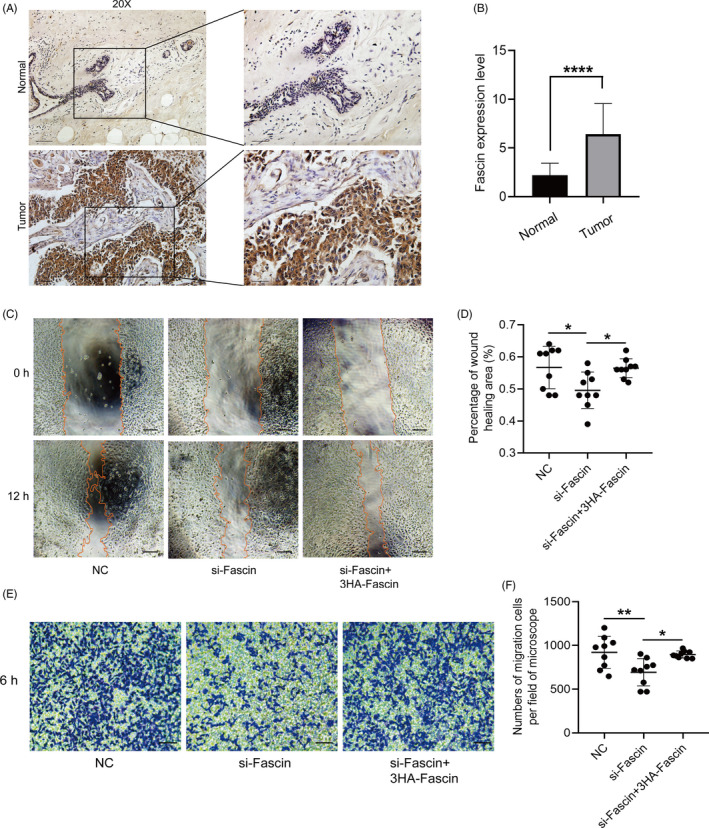
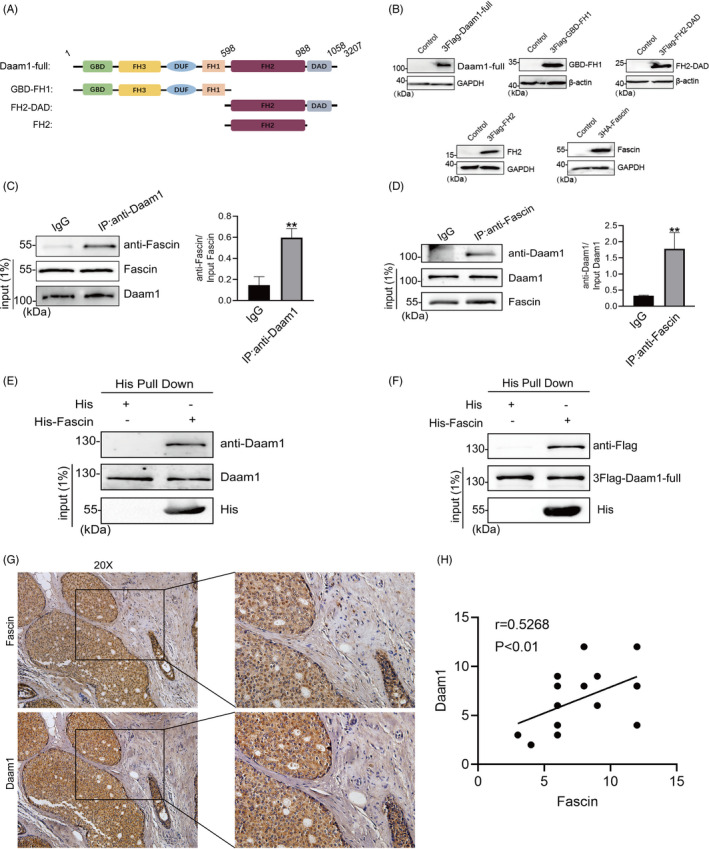
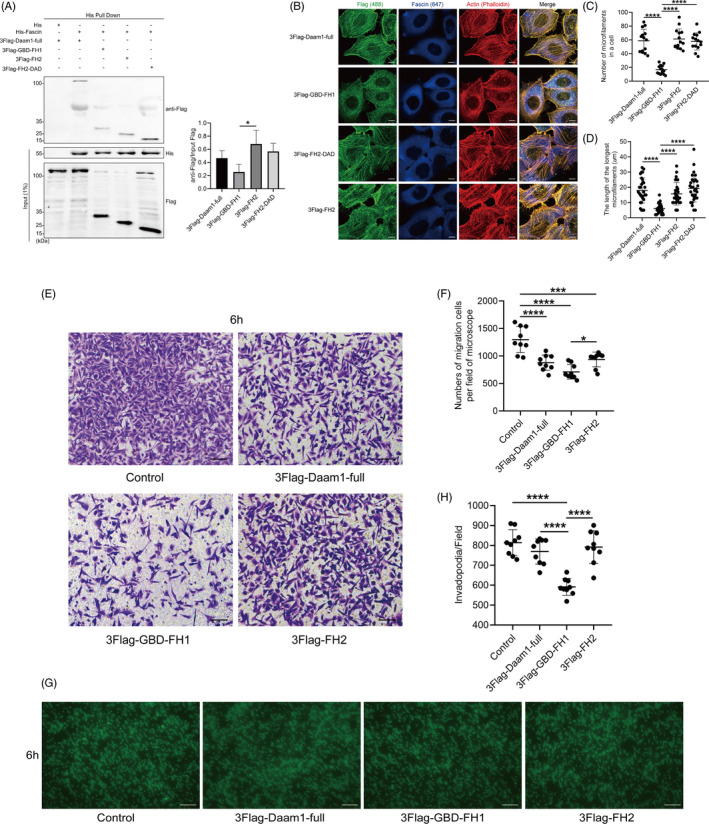
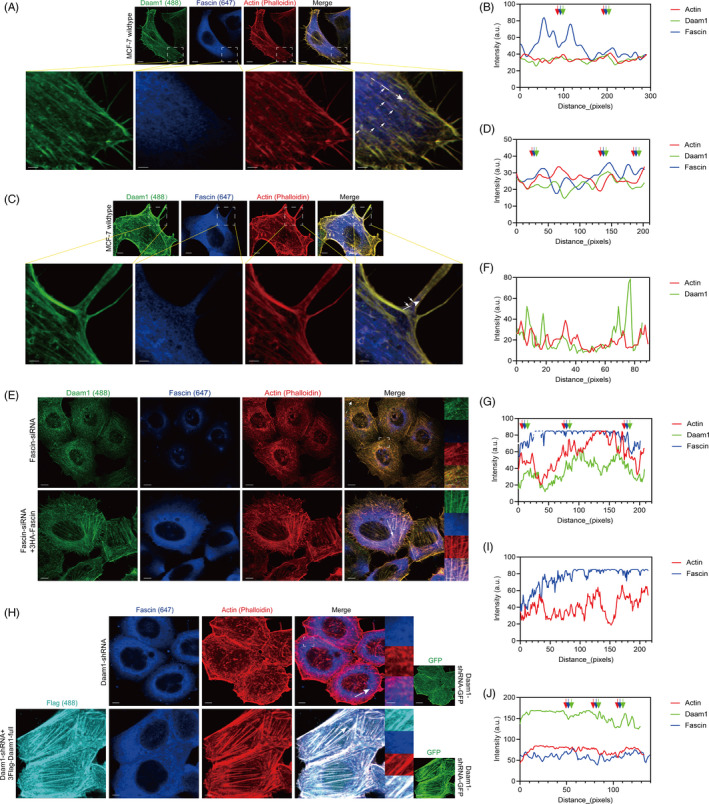
Fascin was upregulated in BrCa tissues compared with that in paracarcinoma tissues. The downregulation of Fascin caused a decline in pseudopodia formation and cell motility. Moreover, we found that Daam1 interacted with Fascin via formin homology (FH) domains, especially the FH2 domain. Immunofluorescence assays showed that Daam1 and Fascin partially colocalized to actin filaments, and the knockdown of Daam1 or Fascin failed to colocalize to short and curved actin filaments.
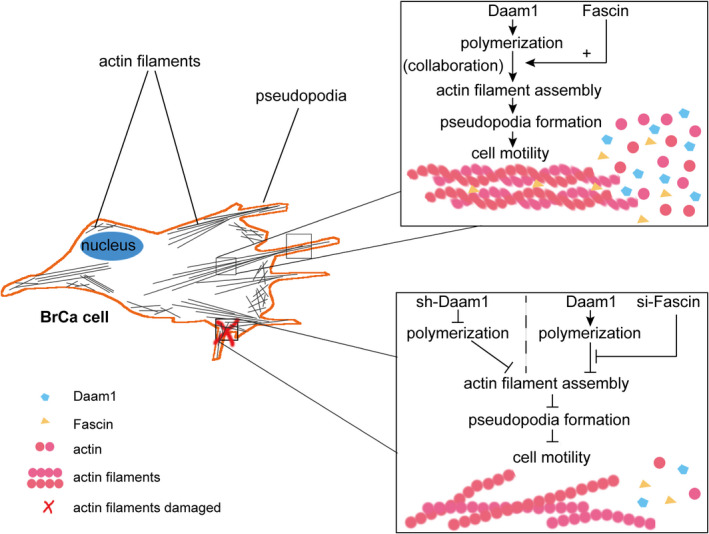
Daam1 specifically binds to Fascin via FH domains and cooperatively facilitates pseudopodia formation and cell migration by promoting actin filament assembly in BrCa.
癌细胞向继发器官的迁移仍然是乳腺癌(BrCa)患者死亡的一个重要原因。细胞运动主要依赖于肌动蛋白动力学。我们之前的报告证实,形态发生相关的无序激活蛋白1(Daam1)调节侵袭伪足的延伸和BrCa细胞的运动。然而,Daam1如何参与肌动蛋白丝组装并促进BrCa细胞中伪足的形成仍不清楚。
在南京医科大学附属妇产医院收集了100例人BrCa样本。采用免疫组织化学(IHC)检测Daam1和Fascin的表达。采用伤口愈合实验和Boyden小室实验探究BrCa细胞的迁移和伪足延伸。进行免疫共沉淀/下拉实验和蛋白质免疫印迹法研究Daam1与Fascin之间的物理相互作用。进行免疫荧光实验观察Daam1和Fascin是否共定位并介导肌动蛋白丝组装。
与癌旁组织相比,Fascin在BrCa组织中上调。Fascin的下调导致伪足形成和细胞运动能力下降。此外,我们发现Daam1通过formin同源(FH)结构域,尤其是FH2结构域与Fascin相互作用。免疫荧光实验表明,Daam1和Fascin部分共定位于肌动蛋白丝,敲低Daam1或Fascin后未能共定位于短而弯曲的肌动蛋白丝。
Daam1通过FH结构域特异性结合Fascin,并通过促进BrCa中的肌动蛋白丝组装协同促进伪足形成和细胞迁移。