Department of Medical Oncology, Fondazione IRCCS Istituto Nazionale dei Tumori, Milan, Italy.
Department of Medical Oncology, Fondazione IRCCS Istituto Nazionale dei Tumori, Milan, Italy.
ESMO Open. 2021 Feb;6(1):100036. doi: 10.1016/j.esmoop.2020.100036. Epub 2021 Jan 15.
Several post hoc analyses of randomized controlled trials (RCTs) suggested the importance of microsatellite instability (MSI) as a positive predictive factor to immunotherapy in patients with advanced gastric cancer (GC); however, individually these have low statistical power.
RCTs investigating treatment with or without an anti-programmed cell death protein 1 (PD-1) agent for advanced GC and providing outcome according to MSI status were selected. The hazard ratio (HR) and the odds ratio were used to compare the treatment effect on survival outcomes and tumor response, respectively, for anti-PD-1-based therapy compared with standard therapy. Evidence for treatment effect by MSI status was evaluated by a test of interaction.
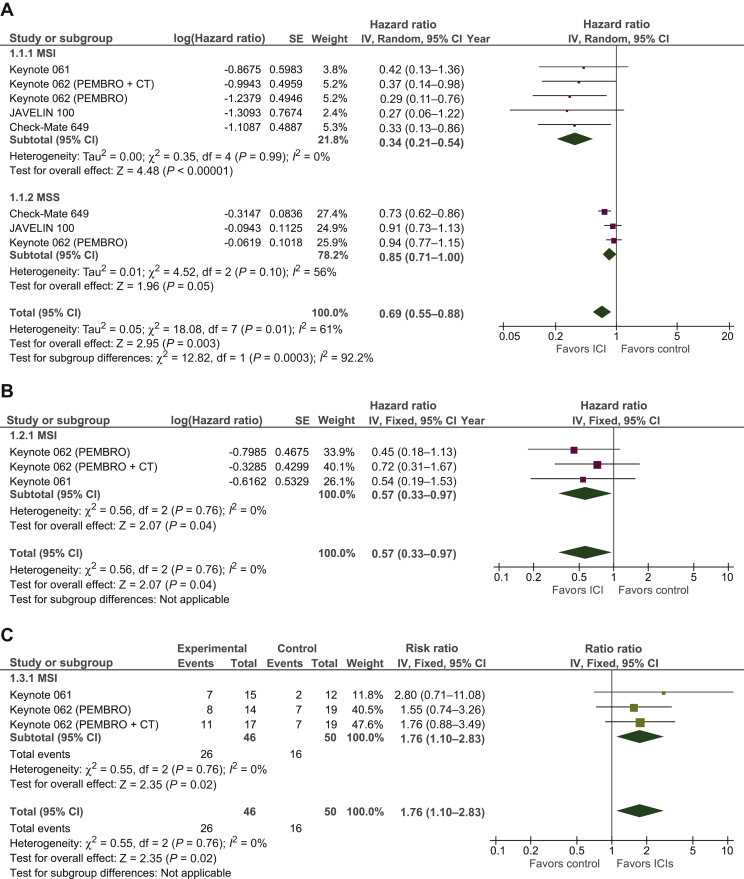
The phase III KEYNOTE-062, CheckMate-649, JAVELIN Gastric 100 and KEYNOTE-061 trials were included. A total of 2545 patients with evaluable MSI status were included and 123 (4.8%) had MSI-high cancers. The HR for overall survival benefit with anti-PD-1-based regimens was 0.34 (95% CI: 0.21-0.54) for MSI-high cancers versus 0.85 [95% confidence interval (CI): 0.71-1.00] for microsatellite stable. The treatment effect was significantly different in the two subgroups (P for interaction 0.003). In the MSI-high subgroup, the HR for progression-free survival was 0.57 (95% CI: 0.33-0.97; P = 0.04) and the odds ratio for response was 1.76 (95% CI: 1.10-2.83; P = 0.02).
Patients with MSI-high GC should be regarded as a specific and highly immunosensitive population worthy of dedicated clinical trials.
几项针对随机对照试验(RCT)的事后分析表明,微卫星不稳定性(MSI)作为晚期胃癌(GC)免疫治疗的阳性预测因子具有重要意义;然而,单独来看,这些分析的统计效力较低。
选择了调查晚期 GC 患者接受或不接受抗程序性细胞死亡蛋白 1(PD-1)药物治疗并根据 MSI 状态提供结果的 RCT。使用风险比(HR)和优势比分别比较了抗 PD-1 治疗与标准治疗对生存结果和肿瘤反应的治疗效果。通过交互检验评估 MSI 状态下治疗效果的证据。
纳入了 III 期 KEYNOTE-062、CheckMate-649、JAVELIN Gastric 100 和 KEYNOTE-061 试验。共有 2545 例可评估 MSI 状态的患者入组,其中 123 例(4.8%)为 MSI 高癌症。与 MSI 稳定相比,MSI 高癌症患者接受抗 PD-1 治疗方案的总生存获益 HR 为 0.34(95%CI:0.21-0.54),而 MSI 稳定患者为 0.85 [95%置信区间(CI):0.71-1.00]。两个亚组的治疗效果有显著差异(P 交互检验=0.003)。在 MSI 高亚组中,无进展生存期的 HR 为 0.57(95%CI:0.33-0.97;P=0.04),反应的优势比为 1.76(95%CI:1.10-2.83;P=0.02)。
MSI 高 GC 患者应被视为具有特定且高度免疫敏感性的人群,值得进行专门的临床试验。