Department of Cardiovascular Surgery, Renmin Hospital of Wuhan University, Wuhan, China.
Cardiovascular Surgery Laboratory, Renmin Hospital of Wuhan University, Wuhan, China.
Clin Transl Med. 2021 Jan;11(1):e276. doi: 10.1002/ctm2.276.
Aortic dissection (AD) and aortic aneurysm (AA) are critical illnesses with an unclear pathogenetic mechanism that seriously threaten human life. Aortic medial degeneration (AMD) is the main pathological feature of AD and AA. Diseases of iron metabolism can cause a variety of physiological dysfunctions. In this study, we aimed to clarify the state of iron metabolism in patients with AD and AA, and to explore the effect of iron metabolism on AMD.
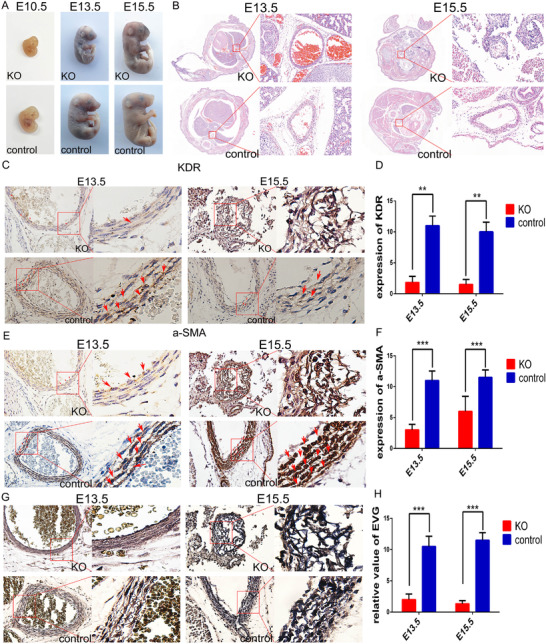
A total of 200 patients with AD or AA, and 60 patients with hypertension were included in the study. Blood samples were drawn immediately when patients were admitted to the hospital. Aortic specimens from patients with Stanford type A AD were obtained at the time of surgery. The status of iron metabolism in the circulation and the aortic wall was analyzed. In addition, apolipoprotein E knockout mice were fed chow with a different iron content, and angiotensin II (Ang II) was used to induce AMD. Furthermore, transferrin receptor 1 knockout (TFR1-/-) mice were used to study the effects of iron deficiency (ID) on aortic development, to observe the effects of different iron metabolism status on the formation of AMD in mice, and to explore the cytoskeleton of vascular smooth muscle cells (VSMCs) under different iron metabolism.
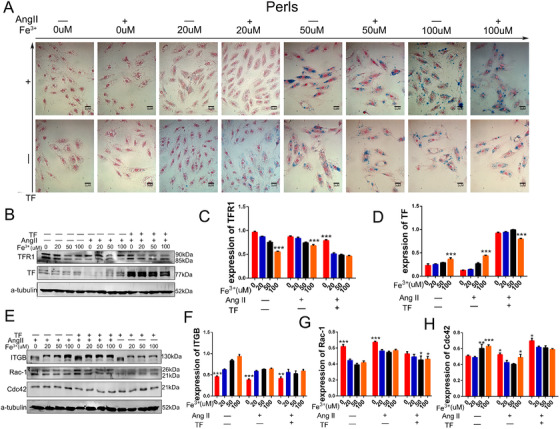
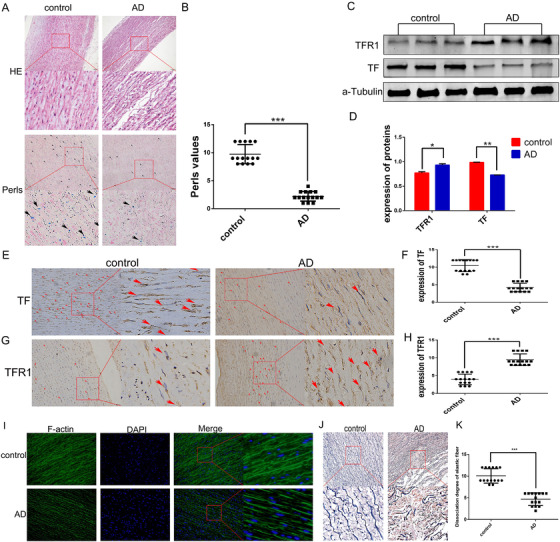
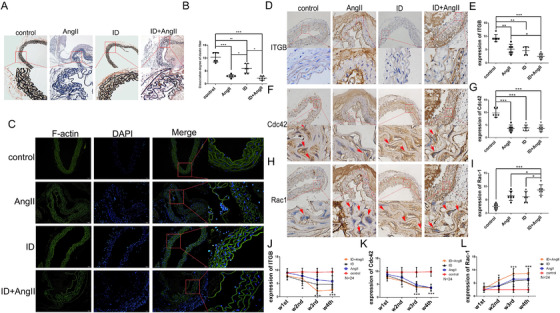
Patients with AMD were iron deficient. ID is associated with the development of AMD in hypertensive patients. Iron-deficient feeding combined with Ang II pumping promoted the formation of AMD and significantly shortened the survival time of mice. ID significantly impaired the cytoskeleton of VSMCs.
Our results highlighted that ID was associated with the formation of AMD in patients with hypertension. In this study, we identified a novel mechanism behind VSMCs dysfunction that was induced by ID, thereby suggesting iron homeostasis as a future precaution in patients with hypertension based on its important role in the maintenance of VSMC function.
主动脉夹层(AD)和主动脉瘤(AA)是危及生命的危急重症,其发病机制尚不清楚。主动脉中层退行性变(AMD)是 AD 和 AA 的主要病理特征。铁代谢疾病可引起多种生理功能障碍。本研究旨在阐明 AD 和 AA 患者铁代谢状态,并探讨铁代谢对 AMD 的影响。
共纳入 200 例 AD 或 AA 患者和 60 例高血压患者。患者入院时立即抽取血样。对 Stanford 型 A 型 AD 患者在手术时获取主动脉标本。分析循环和主动脉壁中铁代谢的状态。此外,用不同铁含量的饲料喂养载脂蛋白 E 敲除(ApoE-/-)小鼠,并使用血管紧张素 II(Ang II)诱导 AMD。进一步使用转铁蛋白受体 1 敲除(TFR1-/-)小鼠研究铁缺乏(ID)对主动脉发育的影响,观察不同铁代谢状态对小鼠 AMD 形成的影响,并探讨不同铁代谢下血管平滑肌细胞(VSMCs)的细胞骨架。
AMD 患者存在铁缺乏。ID 与高血压患者 AMD 的发生发展有关。缺铁喂养联合 Ang II 泵入促进 AMD 的形成,显著缩短了小鼠的生存时间。ID 显著损害了 VSMCs 的细胞骨架。
我们的结果强调 ID 与高血压患者 AMD 的形成有关。本研究发现了 ID 诱导 VSMCs 功能障碍的新机制,提示铁稳态可能成为高血压患者的未来预防措施,因为其在维持 VSMC 功能方面具有重要作用。