Department of Physiology of Energy Metabolism, German Institute of Human Nutrition Potsdam-Rehbrücke, Nuthetal, Germany.
University of Potsdam, Institute of Nutritional Science, Potsdam, Germany.
Cell Mol Life Sci. 2021 Apr;78(7):3369-3384. doi: 10.1007/s00018-020-03748-9. Epub 2021 Jan 19.
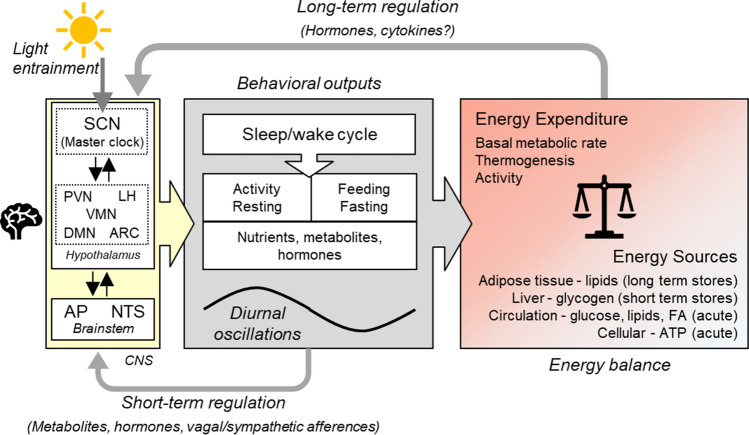
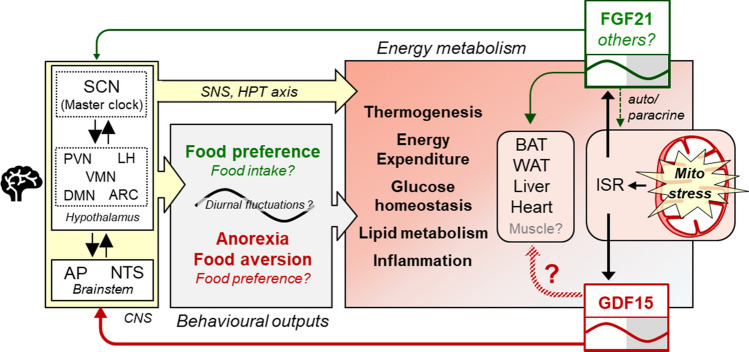
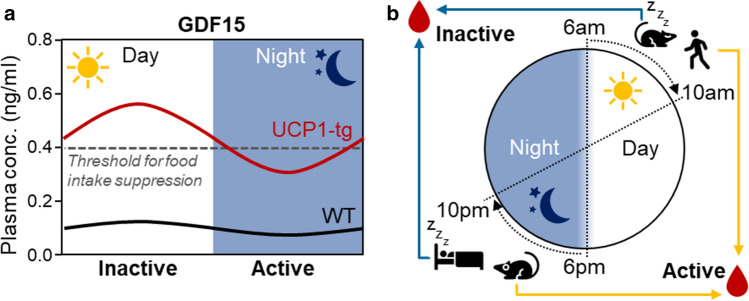
The mammalian system of energy balance regulation is intrinsically rhythmic with diurnal oscillations of behavioral and metabolic traits according to the 24 h day/night cycle, driven by cellular circadian clocks and synchronized by environmental or internal cues such as metabolites and hormones associated with feeding rhythms. Mitochondria are crucial organelles for cellular energy generation and their biology is largely under the control of the circadian system. Whether mitochondrial status might also feed-back on the circadian system, possibly via mitokines that are induced by mitochondrial stress as endocrine-acting molecules, remains poorly understood. Here, we describe our current understanding of the diurnal regulation of systemic energy balance, with focus on fibroblast growth factor 21 (FGF21) and growth differentiation factor 15 (GDF15), two well-known endocrine-acting metabolic mediators. FGF21 shows a diurnal oscillation and directly affects the output of the brain master clock. Moreover, recent data demonstrated that mitochondrial stress-induced GDF15 promotes a day-time restricted anorexia and systemic metabolic remodeling as shown in UCP1-transgenic mice, where both FGF21 and GDF15 are induced as myomitokines. In this mouse model of slightly uncoupled skeletal muscle mitochondria GDF15 proved responsible for an increased metabolic flexibility and a number of beneficial metabolic adaptations. However, the molecular mechanisms underlying energy balance regulation by mitokines are just starting to emerge, and more data on diurnal patterns in mouse and man are required. This will open new perspectives into the diurnal nature of mitokines and action both in health and disease.
哺乳动物的能量平衡调节系统具有内在的节律性,根据 24 小时的昼夜周期,行为和代谢特征呈现出昼夜波动,这是由细胞生物钟驱动的,并通过环境或内部线索(如与进食节律相关的代谢物和激素)进行同步。线粒体是细胞能量产生的关键细胞器,其生物学在很大程度上受生物钟系统的控制。线粒体状态是否也可能通过作为内分泌作用分子的线粒体应激诱导的mitokines 反馈到生物钟系统,目前还知之甚少。在这里,我们描述了我们对系统能量平衡昼夜调节的当前理解,重点介绍了成纤维细胞生长因子 21(FGF21)和生长分化因子 15(GDF15),这两种众所周知的内分泌代谢介质。FGF21 呈现出昼夜波动,并直接影响大脑主钟的输出。此外,最近的数据表明,线粒体应激诱导的 GDF15 促进了白天限制的厌食和全身代谢重塑,如 UCP1 转基因小鼠中所示,其中 FGF21 和 GDF15 都作为肌mitokines 诱导。在这种轻度解偶联的骨骼肌线粒体的小鼠模型中,GDF15 证明负责增加代谢灵活性和许多有益的代谢适应。然而,mitokines 通过调节能量平衡的分子机制才刚刚开始出现,并且需要更多关于小鼠和人类昼夜模式的更多数据。这将为 mitokines 的昼夜性质以及在健康和疾病中的作用开辟新的视角。