Stroke and Dementia Lab, "Luigi Sacco" Department of Biomedical and Clinical Sciences, University of Milan, Via Giovanni Battista Grassi 74, 20157, Milano, Italy.
Mol Neurobiol. 2021 Jun;58(6):2558-2573. doi: 10.1007/s12035-021-02282-4. Epub 2021 Jan 19.
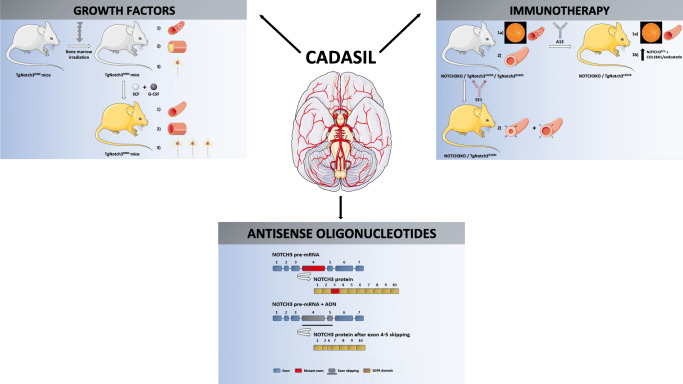
Cerebral autosomal dominant arteriopathy with subcortical infarcts and leukoencephalopathy (CADASIL) is a monogenic disease caused by NOTCH3 mutations and characterized by typical clinical, neuroradiological, and pathological features. NOTCH3 belongs to a family of highly conserved transmembrane receptors rich of epidermal growth factor repeats, mostly expressed in vascular smooth muscle cells and pericytes, which perform essential developmental functions and are involved in tissues maintenance and renewal. To date, no therapeutic option for CADASIL is available except for few symptomatic treatments. Novel in vitro and in vivo models are continuously explored with the aim to investigate underlying pathogenic mechanisms and to test novel therapeutic approaches. In this scenario, knock-out, knock-in, and transgenic mice studies have generated a large amount of information on molecular and biological aspects of CADASIL, despite that they incompletely reproduce the human phenotype. Moreover, the field of in vitro models has been revolutionized in the last two decades by the introduction of induced pluripotent stem cells (iPSCs) technology. As a consequence, novel therapeutic approaches, including immunotherapy, growth factors administration, and antisense oligonucleotides, are currently under investigation. While waiting that further studies confirm the promising results obtained, the data reviewed suggest that our therapeutic approach to the disease could be transformed, generating new hope for the future.
伴有皮质下梗死和白质脑病的常染色体显性脑动脉病(CADASIL)是一种由 NOTCH3 突变引起的单基因疾病,其特征为典型的临床、神经影像学和病理学特征。NOTCH3 属于富含表皮生长因子重复序列的高度保守跨膜受体家族,主要表达于血管平滑肌细胞和周细胞,发挥重要的发育功能,并参与组织的维持和更新。迄今为止,除了少数对症治疗外,CADASIL 尚无治疗选择。不断探索新的体外和体内模型,旨在研究潜在的发病机制并测试新的治疗方法。在此背景下,敲除、敲入和转基因小鼠研究已经提供了大量关于 CADASIL 的分子和生物学方面的信息,尽管它们不能完全再现人类表型。此外,在过去二十年中,诱导多能干细胞(iPSC)技术的引入彻底改变了体外模型领域。因此,目前正在研究包括免疫疗法、生长因子给药和反义寡核苷酸在内的新型治疗方法。在等待进一步研究证实已获得的有希望的结果的同时,综述的数据表明,我们对该疾病的治疗方法可能会发生转变,为未来带来新的希望。