Dunnett-Kane Victoria, Nicola Pantelis, Blackhall Fiona, Lindsay Colin
Wythenshawe Hospital, Manchester University NHS Foundation Trust, Manchester M23 9LT, UK.
Department of Medical Oncology, The Christie NHS Foundation Trust, Wilmslow Road, Manchester M20 4BX, UK.
Cancers (Basel). 2021 Jan 5;13(1):151. doi: 10.3390/cancers13010151.
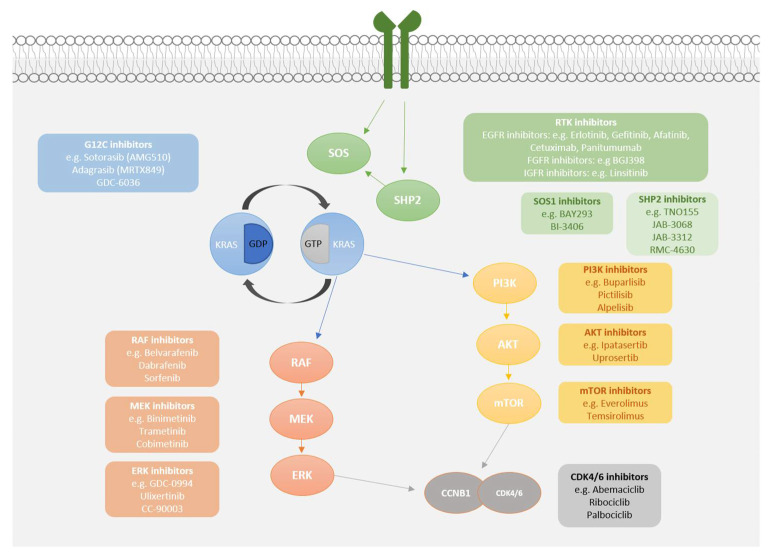
KRAS is one of the most common human oncogenes, but concerted efforts to produce direct inhibitors have largely failed, earning KRAS the title of "undruggable". Recent efforts to produce subtype specific inhibitors have been more successful, and several KRAS inhibitors have reached clinical trials, including adagrasib and sotorasib, which have shown early evidence of efficacy in patients. Lessons from other inhibitors of the RAS pathway suggest that the effect of these drugs will be limited in vivo by the development of drug resistance, and pre-clinical studies of G12C inhibitors have identified evidence of this. In this review we discuss the current evidence for G12C inhibitors, the mechanisms of resistance to G12C inhibitors and potential approaches to overcome them. We discuss possible targets of combination therapy, including SHP2, receptor tyrosine kinases, downstream effectors and PD1/PDL1, and review the ongoing clinical trials investigating these inhibitors.
KRAS是最常见的人类癌基因之一,但生产直接抑制剂的协同努力在很大程度上失败了,这使KRAS获得了“不可成药”的称号。最近生产亚型特异性抑制剂的努力更为成功,几种KRAS抑制剂已进入临床试验,包括阿达格拉西布和索托拉西布,它们已在患者中显示出早期疗效证据。来自RAS通路其他抑制剂的经验表明,这些药物在体内的效果将因耐药性的产生而受到限制,G12C抑制剂的临床前研究已证实了这一点。在这篇综述中,我们讨论了G12C抑制剂的现有证据、对G12C抑制剂的耐药机制以及克服这些机制的潜在方法。我们讨论了联合治疗的可能靶点,包括SHP2、受体酪氨酸激酶、下游效应器和PD1/PDL1,并综述了正在研究这些抑制剂的临床试验。