Clinica Medica 1, Department of Medicine, University of Padova, 35128 Padova, Italy.
Unit of Clinica e Terapia Medica, Department of Medicine and Surgery, University of Parma, 43126 Parma, Italy.
Nutrients. 2021 Jan 14;13(1):219. doi: 10.3390/nu13010219.
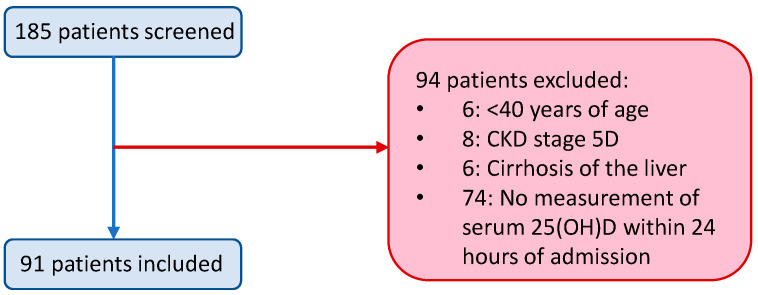
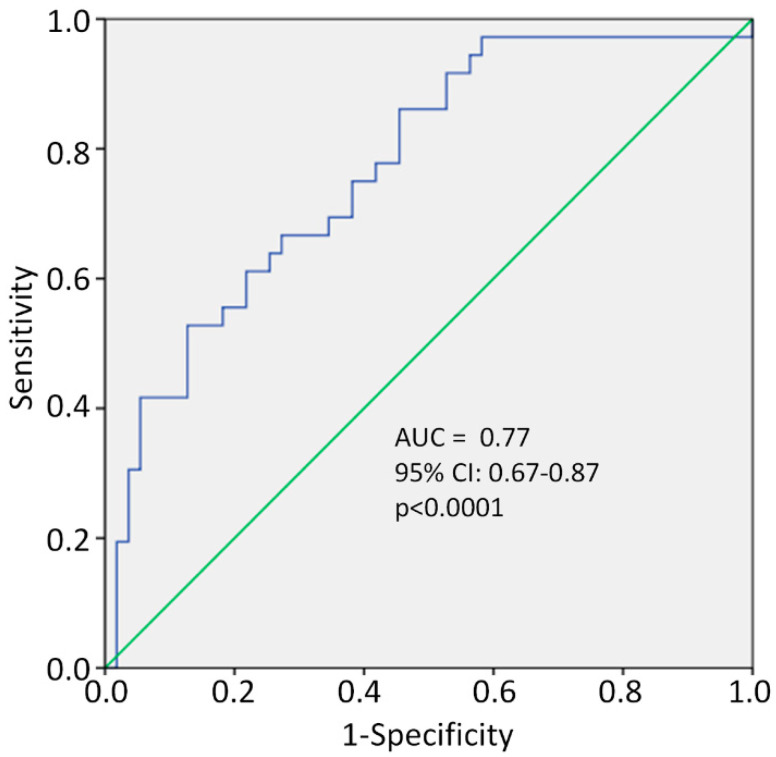
Little information is available on the beneficial effects of cholecalciferol treatment in comorbid patients hospitalized for COVID-19. The aim of this study was to retrospectively examine the clinical outcome of patients receiving in-hospital high-dose bolus cholecalciferol. Patients with a positive diagnosis of SARS-CoV-2 and overt COVID-19, hospitalized from 15 March to 20 April 2020, were considered. Based on clinical characteristics, they were supplemented (or not) with 400,000 IU bolus oral cholecalciferol (200,000 IU administered in two consecutive days) and the composite outcome (transfer to intensive care unit; ICU and/or death) was recorded. Ninety-one patients (aged 74 ± 13 years) with COVID-19 were included in this retrospective study. Fifty (54.9%) patients presented with two or more comorbid diseases. Based on the decision of the referring physician, 36 (39.6%) patients were treated with vitamin D. Receiver operating characteristic curve analysis revealed a significant predictive power of the four variables: (a) low (<50 nmol/L) 25(OH) vitamin D levels, (b) current cigarette smoking, (c) elevated D-dimer levels (d) and the presence of comorbid diseases, to explain the decision to administer vitamin D (area under the curve = 0.77, 95% CI: 0.67-0.87, < 0.0001). Over the follow-up period (14 ± 10 days), 27 (29.7%) patients were transferred to the ICU and 22 (24.2%) died (16 prior to ICU and six in ICU). Overall, 43 (47.3%) patients experienced the combined endpoint of transfer to ICU and/or death. Logistic regression analyses revealed that the comorbidity burden significantly modified the effect of vitamin D treatment on the study outcome, both in crude ( = 0.033) and propensity score-adjusted analyses ( = 0.039), so the positive effect of high-dose cholecalciferol on the combined endpoint was significantly amplified with increasing comorbidity burden. This hypothesis-generating study warrants the formal evaluation (i.e., clinical trial) of the potential benefit that cholecalciferol can offer in these comorbid COVID-19 patients.
关于住院 COVID-19 患者中胆钙化醇治疗的有益效果,信息有限。本研究的目的是回顾性检查接受住院大剂量冲击胆钙化醇治疗的患者的临床结局。考虑到 SARS-CoV-2 检测阳性和明显 COVID-19 的住院患者,他们从 2020 年 3 月 15 日至 4 月 20 日住院。根据临床特征,他们补充(或不补充)40 万 IU 口服胆钙化醇(20 万 IU 连续两天给予),并记录复合结局(转至重症监护病房;ICU 和/或死亡)。这项回顾性研究纳入了 91 名 COVID-19 患者(年龄 74 ± 13 岁)。50 名(54.9%)患者存在两种或两种以上合并症。根据转诊医生的决定,36 名(39.6%)患者接受了维生素 D 治疗。受试者工作特征曲线分析显示,四个变量(a)低(<50 nmol/L)25(OH)维生素 D 水平、(b)当前吸烟、(c)升高的 D-二聚体水平和(d)合并症的存在,对解释给予维生素 D 的决定具有显著的预测能力(曲线下面积=0.77,95%CI:0.67-0.87,<0.0001)。在随访期间(14 ± 10 天),27 名(29.7%)患者转至 ICU,22 名(24.2%)死亡(16 例在 ICU 前,6 例在 ICU 内)。总的来说,43 名(47.3%)患者经历了 ICU 转科和/或死亡的联合终点。Logistic 回归分析显示,合并症负担显著改变了维生素 D 治疗对研究结局的影响,在未校正( = 0.033)和倾向评分校正分析中( = 0.039)均如此,因此,高剂量胆钙化醇对联合终点的积极影响随着合并症负担的增加而显著放大。这项产生假说的研究需要对胆钙化醇在这些合并 COVID-19 的患者中可能带来的益处进行正式评估(即临床试验)。