Kärssin Age, Häkkinen Liidia, Vilem Annika, Jokelainen Pikka, Lassen Brian
Estonian Veterinary and Food Laboratory, 51006 Tartu, Estonia.
Institute of Veterinary Medicine and Animal Sciences, Estonian University of Life Sciences, 51006 Tartu, Estonia.
Animals (Basel). 2021 Jan 14;11(1):183. doi: 10.3390/ani11010183.
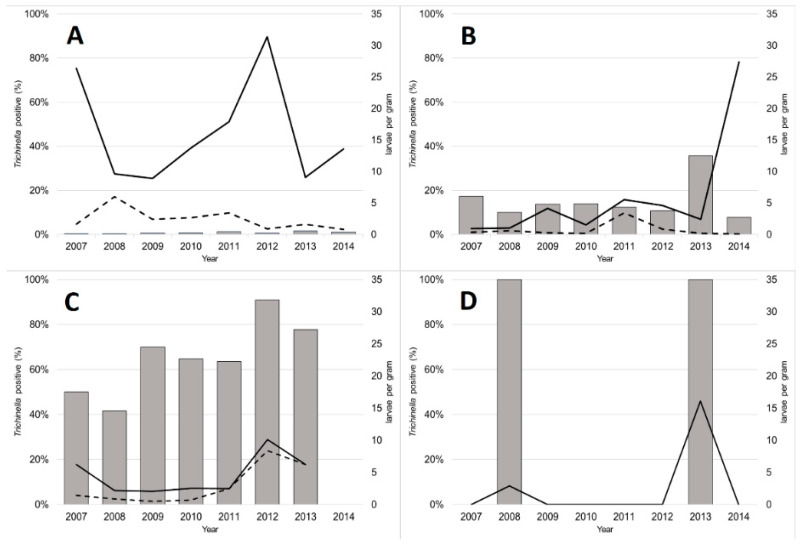
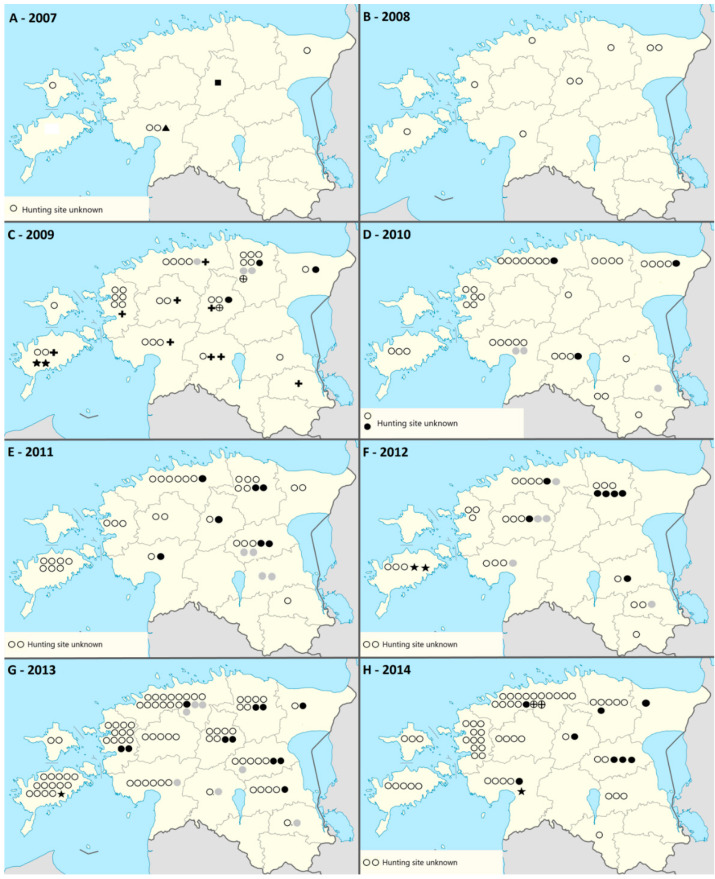
In this study, we summarize findings from four wild, free-ranging host species from Estonia during 2007-2014. spp. larvae were detected in 281 (0.9%, 95% confidence interval (CI) 0.8-1.0) of 30,566 wild boars (), 63 (14.7%, 95% CI 11.6-18.3) of 429 brown bears (), 59 (65.56%, 95% CI 55.3-74.8) of 90 Eurasian lynxes (), and three (60.0%, 95% CI 18.2-92.7) of five badgers (). All four European species were detected: in 0.7% of the wild boars, 7.2% of the brown bears, 45.6% of the lynxes, and 40.0% of the badgers; in 0.1% of the wild boars, 5.8% of the brown bears, and 20.0% of the lynxes; in 0.02% the wild boars; and in 0.03% of the wild boars and 4.4% of the lynxes. The results include the first description from Estonia of in brown bear and badgers, in wild boars, and in wild boars and lynxes. The results indicate high infection pressure in the sylvatic cycles across the years-illustrating continuous risk of spillover to domestic cycles and of transmission to humans.
在本研究中,我们总结了2007年至2014年期间来自爱沙尼亚的四种野生自由放养宿主物种的研究结果。在30566头野猪中,检测到281头(0.9%,95%置信区间(CI)0.8 - 1.0)感染了某种幼虫;在429头棕熊中,检测到63头(14.7%,95%CI 11.6 - 18.3);在90只欧亚猞猁中,检测到59只(65.56%,95%CI 55.3 - 74.8);在5只獾中,检测到3只(60.0%,95%CI 18.2 - 92.7)。检测到了所有四种欧洲物种:在0.7%的野猪、7.2%的棕熊、45.6%的猞猁和40.0%的獾中检测到了某种物种;在0.1%的野猪、5.8%的棕熊和20.0%的猞猁中检测到了另一种物种;在0.02%的野猪中检测到了第三种物种;在0.03%的野猪和4.4%的猞猁中检测到了第四种物种。这些结果包括爱沙尼亚首次对棕熊和獾中某种物种、野猪中某种物种以及野猪和猞猁中某种物种的描述。结果表明,多年来野生动物循环中的感染压力很高,这说明存在向家畜循环溢出以及传播给人类的持续风险。