• 文献检索
  • 文档翻译
  • 深度研究
  • 学术资讯
  • Suppr Zotero 插件Zotero 插件
  • 邀请有礼
  • 套餐&价格
  • 历史记录
应用&插件
Suppr Zotero 插件Zotero 插件浏览器插件Mac 客户端Windows 客户端微信小程序
定价
高级版会员购买积分包购买API积分包
服务
文献检索文档翻译深度研究API 文档MCP 服务
关于我们
关于 Suppr公司介绍联系我们用户协议隐私条款
关注我们

Suppr 超能文献

核心技术专利:CN118964589B侵权必究
粤ICP备2023148730 号-1Suppr @ 2026

文献检索

告别复杂PubMed语法,用中文像聊天一样搜索,搜遍4000万医学文献。AI智能推荐,让科研检索更轻松。

立即免费搜索

文件翻译

保留排版,准确专业,支持PDF/Word/PPT等文件格式,支持 12+语言互译。

免费翻译文档

深度研究

AI帮你快速写综述,25分钟生成高质量综述,智能提取关键信息,辅助科研写作。

立即免费体验

波黑(Bosnia and Herzegovina)肉食动物中旋毛虫种的多样性。

Diversity of Trichinella species in carnivores from Bosnia and Herzegovina.

机构信息

University of Sarajevo - Veterinary Faculty, Zmaja od Bosne 90, Sarajevo, 71 000, Bosnia and Herzegovina.

University of Sarajevo - Faculty of Agriculture and Food Science, Zmaja od Bosne 8, Sarajevo, 71 000, Bosnia and Herzegovina.

出版信息

BMC Vet Res. 2024 Mar 23;20(1):117. doi: 10.1186/s12917-024-03964-6.

DOI:10.1186/s12917-024-03964-6
PMID:38521906
原文链接:https://pmc.ncbi.nlm.nih.gov/articles/PMC10960444/
Abstract

BACKGROUND

In Bosnia and Herzegovina, domestic and wild carnivores represent a significant driver for the transmission and ecology of zoonotic pathogens, especially those of parasitic aetiology. Nevertheless, there is no systematic research of Trichinella species in animals that have been conducted in Bosnia and Herzegovina, even though trichinellosis is considered the most important parasitic zoonosis. The available results of the few studies carried out in Bosnia and Herzegovina are mainly related to the confirmation of parasitic larvae in the musculature of domestic pigs and wild boars or data related to trichinellosis in humans. The objective of our study was to present the findings of a comprehensive investigation into the species composition of Trichinella among 11 carnivorous species within the territory of Bosnia and Herzegovina, as follows: red fox (Vulpes vulpes), grey wolf (Canis lupus), brown bear (Ursus arctos), wildcat (Felis silvestris), pine marten (Martes martes), European badger (Meles meles), weasel (Mustela nivalis), European polecat (Mustela putorius), Eurasian lynx (Lynx lynx), but also dog (Canis lupus familiaris) and cat (Felis catus).

RESULTS

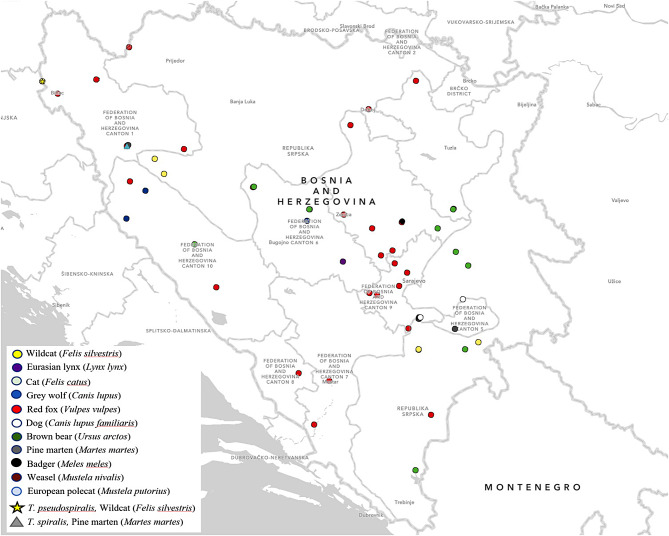
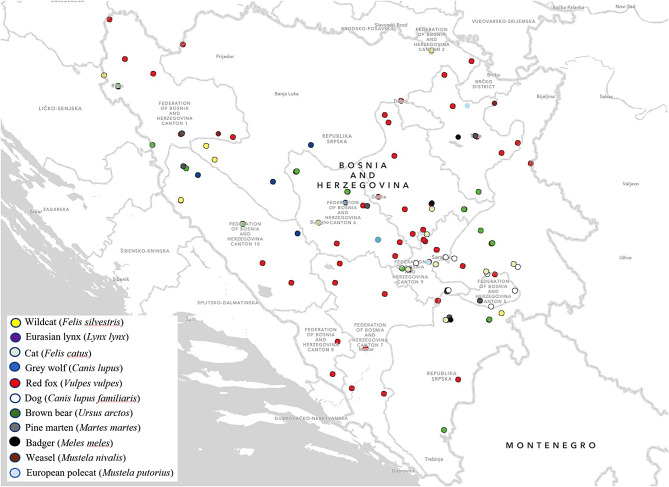
In the period 2013-2023, carnivore musculature samples (n = 629), each consisting of 10 g of muscle tissue, were taken post-mortem and individually examined using the artificial digestion method. In the positive samples (n = 128), molecular genotyping and identification of parasitic larvae of Trichinella spp. were performed using a PCR-based technique up to the species/genotype level. Positive samples were used for basic PCR detection of the genus Trichinella (rrnS rt-PCR technique) and genotyping (rrnl-EVS rt-PCR technique). The Trichinella infection was documented for the first time in Bosnia and Herzegovina among red foxes, grey wolves, brown bears, dogs, badgers and Eurasian lynx, with a frequency rate of 20.3%. Additionally, the presence of T. britovi infection was newly confirmed in Bosnia and Herzegovina, marking the initial documented cases. Furthermore, both T. britovi and T. pseudospiralis infections were observed in the wildcat population, whereas T. britovi and T. spiralis infections were detected in pine martens. Consistent with previous research, our findings align particularly regarding carnivores, with data from other countries such as Germany, Finland, Romania, Poland and Spain, where T. britovi exhibits a wider distribution (62.5-100%) compared to T. spiralis (0.0-37.5%). T. britovi is more common among sylvatic carnivores (89.0%), while T. spiralis prevails in wild boars (62.0%), domestic swine (82.0%) and rodents (75.0%).

CONCLUSION

The results of our study represent the first molecular identification of species of the genus Trichinella in Bosnia and Herzegovina. Additionally, our findings underscore the necessity for targeted epidemiological studies to thoroughly assess trichinellosis prevalence across diverse animal populations. Considering the relatively high frequency of trichinellosis infection in investigated animal species and its public health implications, there is an evident need for establishing an effective trichinellosis surveillance system in Bosnia and Herzegovina.

摘要

背景

在波斯尼亚和黑塞哥维那,国内和野生动物的食肉动物是动物源性病原体传播和生态学的重要驱动因素,特别是寄生虫病因的病原体。尽管旋毛虫病被认为是最重要的寄生虫性人畜共患病,但在波斯尼亚和黑塞哥维那,还没有对动物中的旋毛虫物种进行系统的研究。在波斯尼亚和黑塞哥维那进行的为数不多的研究的现有结果主要与在国内猪和野猪的肌肉中确认寄生虫幼虫有关,或者与人类旋毛虫病有关的数据。我们研究的目的是介绍在波斯尼亚和黑塞哥维那领土内对 11 种食肉动物中 Trichinella 物种组成的全面调查结果,如下:红狐(Vulpes vulpes)、灰狼(Canis lupus)、棕熊(Ursus arctos)、野猫(Felis silvestris)、松貂(Martes martes)、欧洲獾(Meles meles)、黄鼠狼(Mustela nivalis)、欧洲雪貂(Mustela putorius)、欧亚猞猁(Lynx lynx),还有狗(Canis lupus familiaris)和猫(Felis catus)。

结果

在 2013 年至 2023 年期间,从死后采集了 629 份食肉动物肌肉样本(每份 10 克肌肉组织),并使用人工消化法单独检查。在阳性样本(n=128)中,使用基于 PCR 的技术对寄生虫幼虫的 Trichinella spp. 进行了分子基因分型和鉴定,直至种/基因型水平。使用基本 PCR 检测 Trichinella 属(rrnS rt-PCR 技术)和基因分型(rrnl-EVS rt-PCR 技术)对阳性样本进行了检测。首次在波斯尼亚和黑塞哥维那记录到红狐、灰狼、棕熊、狗、獾和欧亚猞猁的旋毛虫感染,感染率为 20.3%。此外,在波斯尼亚和黑塞哥维那新确认了 T. britovi 感染,这是首次记录到的病例。此外,在野猫种群中观察到 T. britovi 和 T. pseudospiralis 感染,而在松貂中检测到 T. britovi 和 T. spiralis 感染。与以前的研究一致,我们的研究结果特别与来自德国、芬兰、罗马尼亚、波兰和西班牙等其他国家的食肉动物数据一致,在这些国家,T. britovi 的分布更为广泛(62.5-100%),而 T. spiralis 的分布则较为有限(0.0-37.5%)。T. britovi 在森林食肉动物中更为常见(89.0%),而 T. spiralis 在野猪(62.0%)、家猪(82.0%)和啮齿动物(75.0%)中更为常见。

结论

我们的研究结果代表了在波斯尼亚和黑塞哥维那首次对 Trichinella 属种进行的分子鉴定。此外,我们的研究结果强调了需要针对不同动物群体进行有针对性的流行病学研究,以彻底评估旋毛虫病的流行情况。鉴于所调查动物物种中旋毛虫病感染的相对较高频率及其对公共卫生的影响,显然需要在波斯尼亚和黑塞哥维那建立有效的旋毛虫病监测系统。
https://cdn.ncbi.nlm.nih.gov/pmc/blobs/354d/10960444/bb2109826f68/12917_2024_3964_Fig1_HTML.jpg
https://cdn.ncbi.nlm.nih.gov/pmc/blobs/354d/10960444/0054b4498df4/12917_2024_3964_Fig2_HTML.jpg
https://cdn.ncbi.nlm.nih.gov/pmc/blobs/354d/10960444/bb2109826f68/12917_2024_3964_Fig1_HTML.jpg
https://cdn.ncbi.nlm.nih.gov/pmc/blobs/354d/10960444/0054b4498df4/12917_2024_3964_Fig2_HTML.jpg
https://cdn.ncbi.nlm.nih.gov/pmc/blobs/354d/10960444/bb2109826f68/12917_2024_3964_Fig1_HTML.jpg

相似文献

1
Diversity of Trichinella species in carnivores from Bosnia and Herzegovina.波黑(Bosnia and Herzegovina)肉食动物中旋毛虫种的多样性。
BMC Vet Res. 2024 Mar 23;20(1):117. doi: 10.1186/s12917-024-03964-6.
2
Diversity of Trichinella species in relation to the host species and geographical location.旋毛虫种的多样性与宿主种类和地理位置的关系。
Vet Parasitol. 2020 Mar;279:109052. doi: 10.1016/j.vetpar.2020.109052. Epub 2020 Feb 5.
3
[Wild and domestic animals as permanent Trichinella reservoir in Poland].[野生和家畜作为波兰旋毛虫的永久宿主]
Wiad Parazytol. 2006;52(3):175-9.
4
The first report of Trichinella pseudospiralis presence in domestic swine and T. britovi in wild boar in Bosnia and Herzegovina.关于波斯尼亚和黑塞哥维那家猪体内旋毛虫属伪旋毛虫以及野猪体内布氏旋毛虫存在情况的首次报告。
Acta Parasitol. 2015 Sep;60(3):471-5. doi: 10.1515/ap-2015-0066.
5
Environmental and human influence on the ecology of Trichinella spiralis and Trichinella britovi in Western Europe.环境和人类对西欧旋毛形线虫和布氏旋毛虫生态的影响。
Parasitology. 1996 Dec;113 ( Pt 6):527-33. doi: 10.1017/s0031182000067573.
6
Associations between Trichinella species and host species in Finland.芬兰旋毛虫物种与宿主物种之间的关联。
J Parasitol. 2002 Feb;88(1):84-8. doi: 10.1645/0022-3395(2002)088[0084:ABTSAH]2.0.CO;2.
7
spp. in Wild Boars (), Brown Bears (), Eurasian Lynxes () and Badgers () in Estonia, 2007-2014.2007 - 2014年爱沙尼亚野猪()、棕熊()、欧亚猞猁()和獾()中的物种。
Animals (Basel). 2021 Jan 14;11(1):183. doi: 10.3390/ani11010183.
8
Trichinella infections in different host species of an endemic district of Serbia.塞尔维亚一个地方性流行区不同宿主物种中的旋毛虫感染
Vet Parasitol. 2013 May 20;194(2-4):136-8. doi: 10.1016/j.vetpar.2013.01.039. Epub 2013 Feb 5.
9
Sylvatic Trichinella spp. infection in Finland.芬兰的野生动物旋毛虫属感染
J Parasitol. 2010 Feb;96(1):67-76. doi: 10.1645/GE-2202.1.
10
New insights into the molecular epidemiology of Trichinella infection in domestic pigs, wild boars, and bears in Romania.罗马尼亚家猪、野猪和熊旋毛虫感染分子流行病学的新见解。
Vet Parasitol. 2015 Sep 15;212(3-4):257-61. doi: 10.1016/j.vetpar.2015.07.021. Epub 2015 Jul 26.

引用本文的文献

1
Endoparasites of peritoneal organs and skeletal muscles of the European wildcat (Felis silvestris) in Germany.德国欧洲野生猫(Felis silvestris)腹膜器官和骨骼肌的内寄生虫。
Parasit Vectors. 2024 Nov 18;17(1):473. doi: 10.1186/s13071-024-06571-4.

本文引用的文献

1
Wolf Is Back: A Novel Sensitive Sentinel Rejoins the Cycle in the Western Alps.狼回来了:一种新型灵敏哨兵重新加入西阿尔卑斯山的循环。
Vet Sci. 2023 Mar 9;10(3):206. doi: 10.3390/vetsci10030206.
2
First report of Trichinella pseudospiralis in a wolf (Canis lupus italicus).旋毛虫在意大利狼(Canis lupus italicus)体内的首次发现报告。
Int J Parasitol Parasites Wildl. 2021 May 24;15:195-198. doi: 10.1016/j.ijppaw.2021.05.002. eCollection 2021 Aug.
3
infection and muscle distribution in free-living martens ( spp.) from the Głęboki Bród Forest District, Poland.
波兰格莱博基布罗德森林区自由生活的貂(貂属)的感染情况与肌肉分布
Int J Parasitol Parasites Wildl. 2020 Jun 17;12:176-180. doi: 10.1016/j.ijppaw.2020.06.003. eCollection 2020 Aug.
4
Diversity of Trichinella species in relation to the host species and geographical location.旋毛虫种的多样性与宿主种类和地理位置的关系。
Vet Parasitol. 2020 Mar;279:109052. doi: 10.1016/j.vetpar.2020.109052. Epub 2020 Feb 5.
5
Trichinella spp. in wild mesocarnivores in an endemic setting.地方性流行地区野生中型食肉动物中的旋毛虫属物种。
Acta Vet Hung. 2019 Mar;67(1):34-39. doi: 10.1556/004.2019.004.
6
The role of the wolf in endemic sylvatic Trichinella britovi infection in the Abruzzi region of Central Italy.狼在意大利中部阿布鲁齐地区地方性森林型布氏旋毛虫感染中的作用。
Vet Parasitol. 2016 Nov 15;231:124-127. doi: 10.1016/j.vetpar.2016.07.030. Epub 2016 Jul 26.
7
Trichinella britovi biomass in naturally infected pine martens (Martes martes) of Latvia.拉脱维亚自然感染的松貂(Martes martes)体内的布氏旋毛虫生物量。
Vet Parasitol. 2016 Nov 15;231:110-114. doi: 10.1016/j.vetpar.2016.05.008. Epub 2016 May 9.
8
High prevalence of Trichinella spp. in sylvatic carnivore mammals of Latvia.拉脱维亚野生食肉哺乳动物中旋毛虫属的高流行率。
Vet Parasitol. 2016 Nov 15;231:118-123. doi: 10.1016/j.vetpar.2016.04.012. Epub 2016 Apr 12.
9
The first report of Trichinella pseudospiralis presence in domestic swine and T. britovi in wild boar in Bosnia and Herzegovina.关于波斯尼亚和黑塞哥维那家猪体内旋毛虫属伪旋毛虫以及野猪体内布氏旋毛虫存在情况的首次报告。
Acta Parasitol. 2015 Sep;60(3):471-5. doi: 10.1515/ap-2015-0066.
10
The red fox (Vulpes vulpes) plays a minor role in the epidemiology of the domestic cycle of Trichinella in Romania.在罗马尼亚,赤狐(赤狐属)在旋毛虫国内传播周期的流行病学中作用较小。
Vet Parasitol. 2015 Sep 15;212(3-4):448-50. doi: 10.1016/j.vetpar.2015.06.032. Epub 2015 Jul 2.