Vaccine and Infectious Disease Division, Fred Hutchinson Cancer Research Center, Seattle, WA 98109.
Molecular and Cellular Biology Graduate Program, University of Washington, Seattle, WA 98195.
J Immunol. 2021 Feb 1;206(3):455-462. doi: 10.4049/jimmunol.2000937.
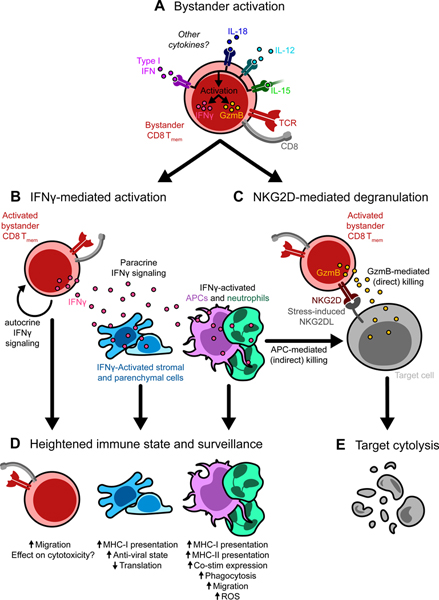
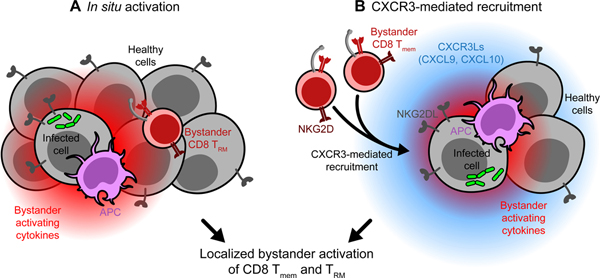
Memory T cells (T) rapidly mount Ag-specific responses during pathogen reencounter. However, T also respond to inflammatory cues in the absence of an activating TCR signal, a phenomenon termed bystander activation. Although bystander activation was first described over 20 years ago, the physiological relevance and the consequences of T cell bystander activation have only become more evident in recent years. In this review, we discuss the scenarios that trigger CD8 T bystander activation including acute and chronic infections that are either systemic or localized, as well as evidence for bystander CD8 T within tumors and following vaccination. We summarize the possible consequences of bystander activation for the T cell itself, the subsequent immune response, and the host. We highlight when T cell bystander activation appears to benefit or harm the host and briefly discuss our current knowledge gaps regarding regulatory signals that can control bystander activation.
记忆 T 细胞(T 细胞)在病原体再次入侵时会迅速产生针对特定抗原的反应。然而,T 细胞也会在没有激活 TCR 信号的情况下对炎症信号做出反应,这种现象被称为旁观者激活。尽管旁观者激活现象早在 20 多年前就已被描述,但 T 细胞旁观者激活的生理相关性及其后果近年来才变得更加明显。在这篇综述中,我们讨论了触发 CD8 T 细胞旁观者激活的情况,包括全身性或局部的急性和慢性感染,以及在肿瘤和接种疫苗后 CD8 T 细胞旁观者激活的证据。我们总结了旁观者激活对 T 细胞本身、随后的免疫反应和宿主可能产生的后果。我们强调了 T 细胞旁观者激活何时似乎对宿主有益或有害,并简要讨论了我们目前在可以控制旁观者激活的调节信号方面的知识空白。