Department of Medical Microbiology and Immunology, School of Medicine, University of California Davis, Davis, California, USA.
Vanderbilt Institute for Infection, Immunology, and Inflammation, Vanderbilt University Medical Center, Nashville, Tennessee, USA.
mBio. 2021 Jan 19;12(1):e03227-20. doi: 10.1128/mBio.03227-20.
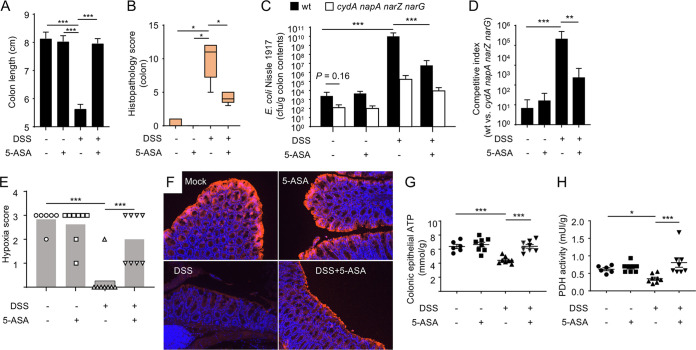
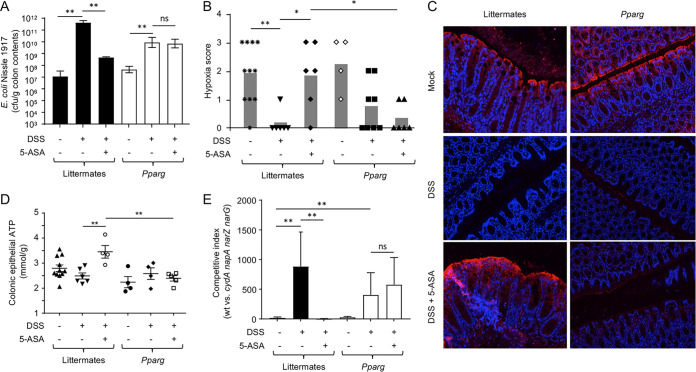
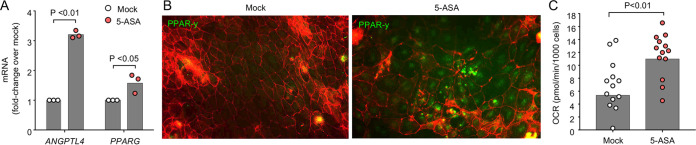
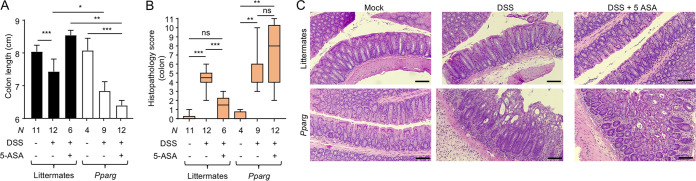
5-Aminosalicylic acid (5-ASA), a peroxisome proliferator-activated receptor gamma (PPAR-γ) agonist, is a widely used first-line medication for the treatment of ulcerative colitis, but its anti-inflammatory mechanism is not fully resolved. Here, we show that 5-ASA ameliorates colitis in dextran sulfate sodium (DSS)-treated mice by activating PPAR-γ signaling in the intestinal epithelium. DSS-induced colitis was associated with a loss of epithelial hypoxia and a respiration-dependent luminal expansion of , which could be ameliorated by treatment with 5-ASA. However, 5-ASA was no longer able to reduce inflammation, restore epithelial hypoxia, or blunt an expansion of in DSS-treated mice that lacked expression specifically in the intestinal epithelium. These data suggest that the anti-inflammatory activity of 5-ASA requires activation of epithelial PPAR-γ signaling, thus pointing to the intestinal epithelium as a potential target for therapeutic intervention in ulcerative colitis. An expansion of in the fecal microbiota is a microbial signature of dysbiosis that is linked to many noncommunicable diseases, including ulcerative colitis. Here, we used , a representative of the , to show that its dysbiotic expansion during colitis can be remediated by modulating host epithelial metabolism. Dextran sulfate sodium (DSS)-induced colitis reduced mitochondrial activity in the colonic epithelium, thereby increasing the amount of oxygen available to fuel an expansion through aerobic respiration. Activation of epithelial peroxisome proliferator-activated receptor gamma (PPAR-γ) signaling with 5-aminosalicylic acid (5-ASA) was sufficient to restore mitochondrial activity and blunt a dysbiotic expansion. These data identify the host's epithelial metabolism as a potential treatment target to remediate microbial signatures of dysbiosis, such as a dysbiotic expansion in the fecal microbiota.
5-氨基水杨酸(5-ASA),一种过氧化物酶体增殖物激活受体γ(PPAR-γ)激动剂,是治疗溃疡性结肠炎的广泛使用的一线药物,但它的抗炎机制尚未完全阐明。在这里,我们表明,5-ASA 通过激活肠道上皮细胞中的 PPAR-γ 信号来改善葡聚糖硫酸钠(DSS)处理的小鼠的结肠炎。DSS 诱导的结肠炎与上皮缺氧的丧失和依赖呼吸的腔扩张有关,这可以通过用 5-ASA 治疗来改善。然而,5-ASA 不再能够减轻炎症、恢复上皮缺氧或减轻 DSS 处理的小鼠中炎症的扩张,这些小鼠特异性地缺乏肠道上皮细胞中的 表达。这些数据表明,5-ASA 的抗炎活性需要激活上皮细胞的 PPAR-γ 信号,因此表明肠道上皮细胞是溃疡性结肠炎治疗干预的潜在靶点。在粪便微生物群中扩张是一种与许多非传染性疾病(包括溃疡性结肠炎)相关的微生物特征。在这里,我们使用代表该科的作为模型,表明其在结肠炎期间的失调扩张可以通过调节宿主上皮细胞代谢来纠正。葡聚糖硫酸钠(DSS)诱导的结肠炎降低了结肠上皮中的线粒体活性,从而通过有氧呼吸增加了可用于为扩张提供燃料的氧气量。用 5-氨基水杨酸(5-ASA)激活上皮过氧化物酶体增殖物激活受体γ(PPAR-γ)信号足以恢复线粒体活性并减弱失调的扩张。这些数据确定了宿主的上皮细胞代谢作为一种潜在的治疗靶点,以纠正微生物失调的特征,例如粪便微生物群中失调的扩张。