Martín-Nares Eduardo, Saavedra-González Vanessa, Fagundo-Sierra Reynerio, Santinelli-Núñez Blanca Estela, Romero-Maceda Teresa, Calderón-Vasquez Karla, Hernandez-Molina Gabriela
Department of Immunology and Rheumatology, Instituto Nacional de Ciencias Médicas y Nutrición Salvador Zubirán, Vasco de Quiroga 15, Col. Belisario Dominguez Sección XVI, 14080, Mexico City, Mexico.
Central Laboratory, Instituto Nacional de Ciencias Médicas y Nutrición Salvador Zubirán, Mexico City, Mexico.
Sci Rep. 2021 Jan 19;11(1):1832. doi: 10.1038/s41598-021-81321-5.
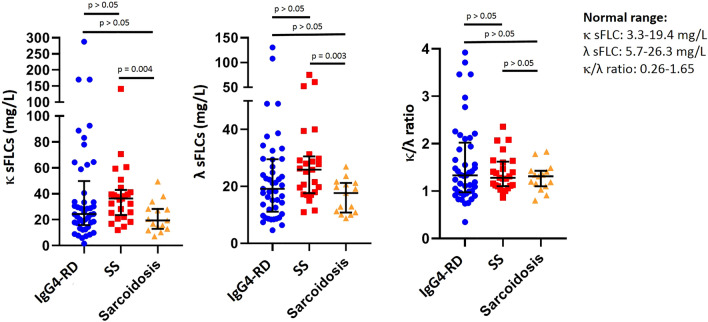
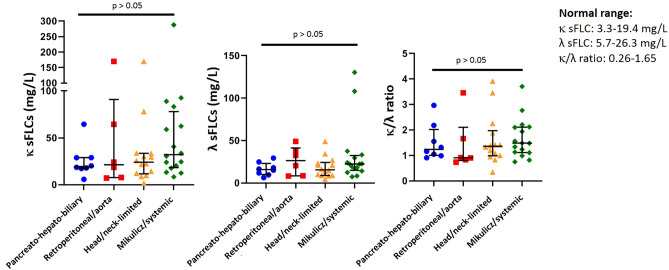
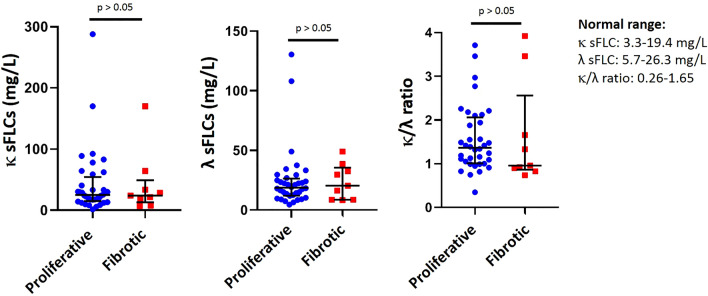
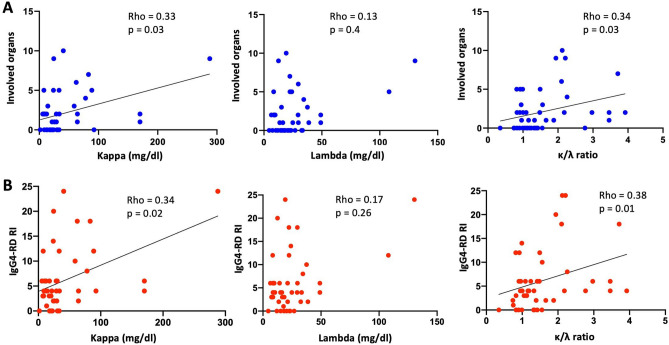
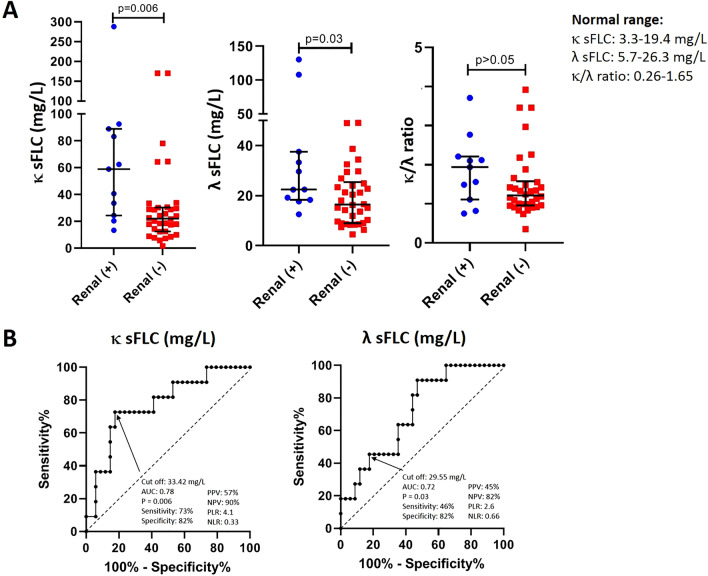
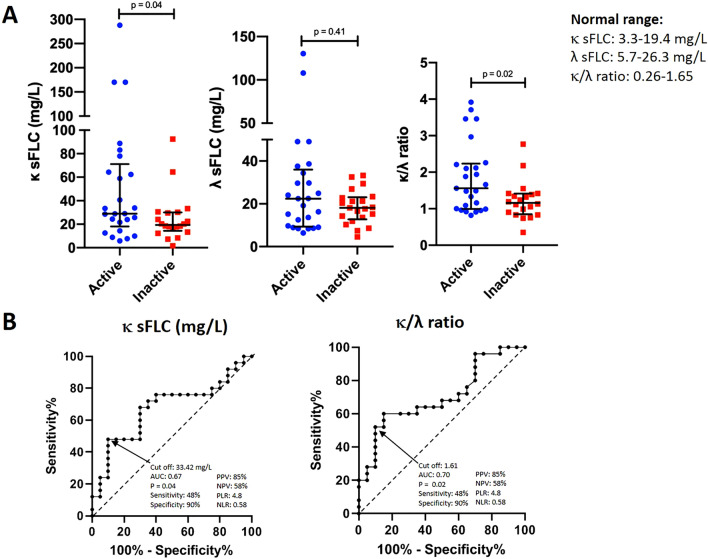
The clinical utility of serum immunoglobulin free light chains (sFLC) in IgG4-related disease (IgG4-RD) is unknown. Herein we evaluated their association with clinical phenotypes, serology and activity in patients with IgG4-RD. Cross-sectional study that included 45 patients with IgG4-RD, and as controls 25 with Sjögren's syndrome (SS) and 15 with sarcoidosis. IgG4-RD patients were classified in clinical phenotypes: pancreato-hepato-biliary, retroperitoneum/aorta, head/neck-limited and Mikulicz/systemic; as well as proliferative vs. fibrotic phenotypes. We assessed the IgG4-RD Responder Index (IgG4-RD RI) at recruitment and measured IgG1, IgG4, κ and λ sFLC serum levels by turbidometry. sFLC levels were similar among IgG4-RD, SS and sarcoidosis groups. Regarding the IgG4-RD patients, the mean age was 49 years, 24 (53.3%) were men and 55.5% had activity. Eight (17.7%) belonged to pancreato-hepato-biliary, 6 (13.3%) to retroperitoneum/aorta, 14 (31.1%) to head/neck-limited, 16 (35.5%) to Mikulicz/systemic phenotypes, whereas 36 (80%) to proliferative and 9 (20%) to fibrotic phenotypes. High κ sFLC, λ sFLC and κ/λ ratio were present in 29 (64.4%), 13 (28.9%) and 13 (28.9%) of IgG4-RD patients, respectively. There were no differences in sFLC among IgG4-RD phenotypes. κ sFLC and κ/λ ratio correlated positively with the number of involved organs and IgG4-RD RI. Patients with renal involvement had higher κ sFLC and λ sFLC. The AUC for κ sFLC and λ sFLC, for renal involvement was 0.78 and 0.72, respectively. Active IgG4-RD had higher levels of κ sFLC and more frequently a high κ/λ ratio. The AUC for κ sFLC and κ/λ ratio for predicting active IgG4-RD was 0.67 and 0.70, respectively. sFLC correlated positively with IgG1 and IgG4 levels. sFLC may be useful as a biomarker of disease activity as well as multiorgan and renal involvement. In particular, a high κ/λ ratio may identify patients with active disease.
血清游离免疫球蛋白轻链(sFLC)在IgG4相关疾病(IgG4-RD)中的临床应用尚不清楚。在此,我们评估了它们与IgG4-RD患者的临床表型、血清学及疾病活动度之间的关联。本研究为横断面研究,纳入45例IgG4-RD患者,并以25例干燥综合征(SS)患者及15例结节病患者作为对照。将IgG4-RD患者按临床表型分类:胰胆管型、腹膜后/主动脉型、头颈部局限型及米库利奇/全身型;以及增殖型与纤维化型。我们在入组时评估了IgG4-RD反应指数(IgG4-RD RI),并通过比浊法检测IgG1、IgG4、κ及λ sFLC血清水平。IgG4-RD组、SS组及结节病组的sFLC水平相似。IgG4-RD患者的平均年龄为49岁,24例(53.3%)为男性,55.5%有疾病活动。8例(17.7%)属于胰胆管型,6例(13.3%)属于腹膜后/主动脉型,14例(31.1%)属于头颈部局限型,16例(35.5%)属于米库利奇/全身型,而36例(80%)属于增殖型,9例(20%)属于纤维化型。分别有29例(64.4%)、13例(28.9%)及13例(28.9%)IgG4-RD患者存在高κ sFLC、高λ sFLC及高κ/λ比值。IgG4-RD各临床表型的sFLC水平无差异。κ sFLC及κ/λ比值与受累器官数量及IgG4-RD RI呈正相关。有肾脏受累的患者κ sFLC和λ sFLC水平更高。κ sFLC和λ sFLC预测肾脏受累的曲线下面积(AUC)分别为0.78和0.72。活动期IgG4-RD患者的κ sFLC水平更高,且κ/λ比值高的情况更常见。κ sFLC和κ/λ比值预测活动期IgG4-RD的AUC分别为0.67和0.70。sFLC与IgG1和IgG4水平呈正相关。sFLC可能作为疾病活动度以及多器官和肾脏受累的生物标志物。特别是,高κ/λ比值可能有助于识别疾病活动的患者。