Cheng Haidong, Sharen Gaowa, Wang Zhaoyang, Zhou Jing
Department of Gastroenterology, Affiliated Hospital of Inner Mongolia Medical University, Hohhot 010059, People's Republic of China.
Department of Pathological Anatomy, College of Basic Medicine of Inner Mongolia Medical University, Hohhot 010059, People's Republic of China.
Cancer Manag Res. 2021 Jan 14;13:367-377. doi: 10.2147/CMAR.S277399. eCollection 2021.
Chemoresistance contributes to treatment failure of gastric cancer (GC) patients but the molecular mechanism of chemoresistance in GC is still unclear. Long-chain noncoding RNA (lncRNA) urothelial cancer associated 1 () is associated with resistance to chemotherapy drugs.
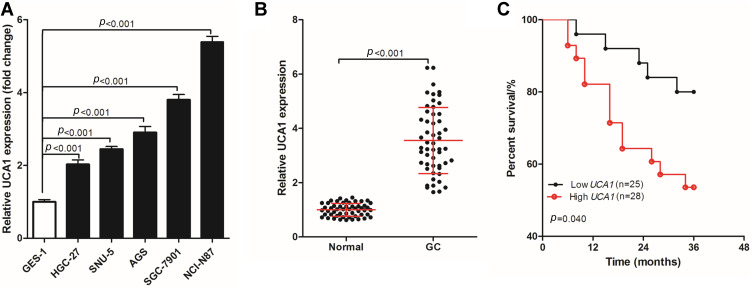
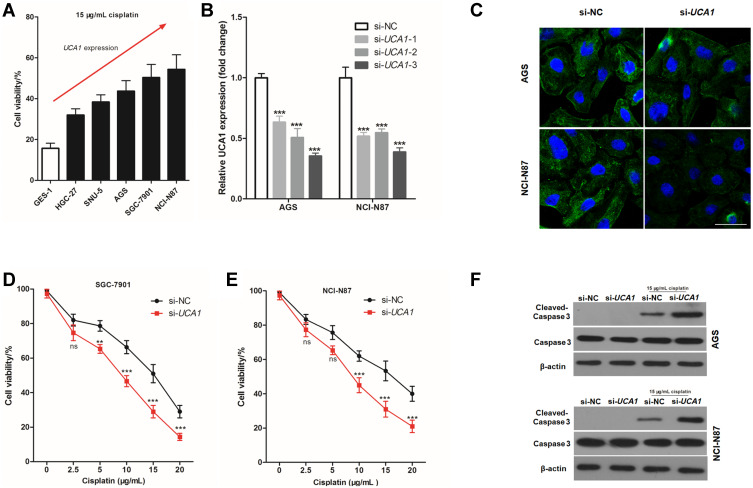
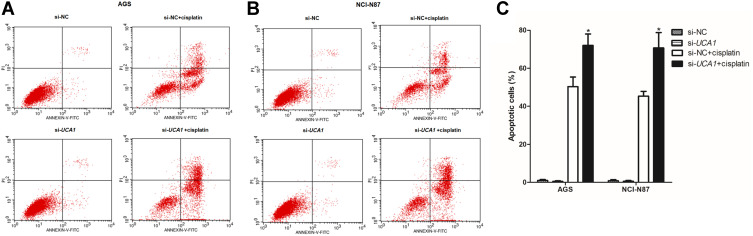
We detected the expression of in 53 pairs of GC tumor tissue and adjacent normal tissue, human normal gastric mucosa cells (GES-1) and human GC cells (HGC-27, SNU-5, AGS, SGC-7901, and NCI-N87) using RT-qPCR. Small RNA interference technology was used to knock down the expression of in gastric cancer cells. CCK8 solution was used to detect cell viability. Flow cytometry was used to detect apoptosis, and Western blotting was used to detect protein expression.
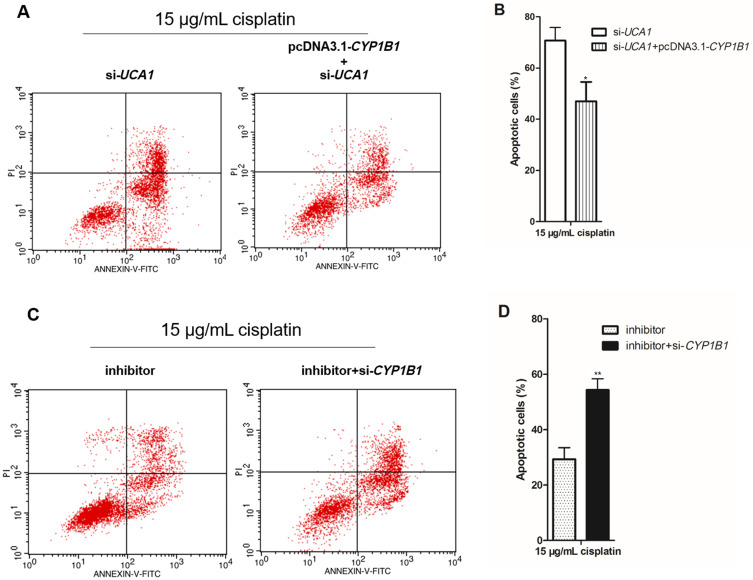
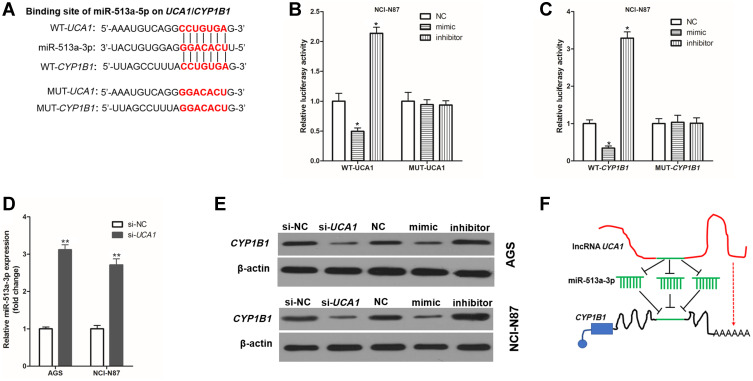
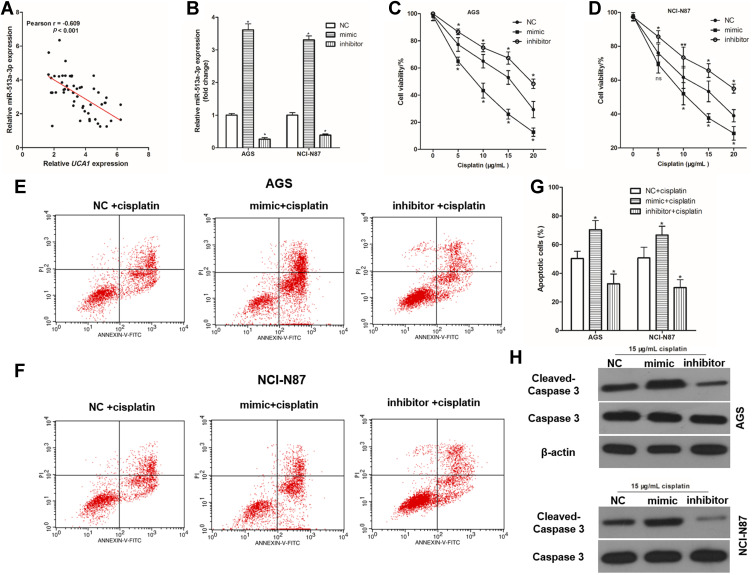
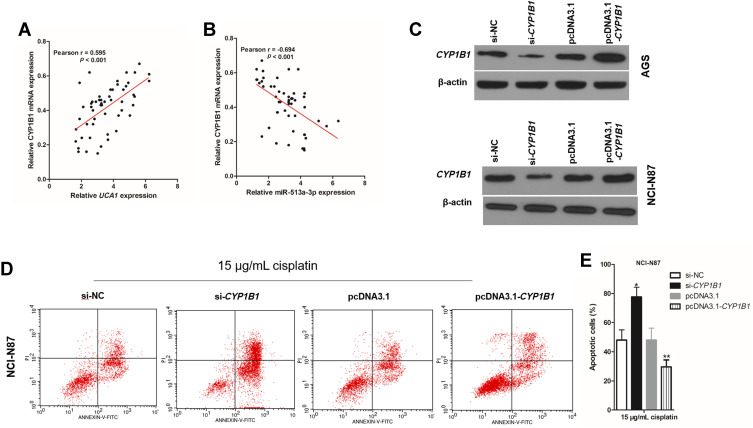
was highly expressed in GC tissues and cells, and knockdown of increased chemosensitivity to cisplatin by inducing cell apoptosis. Furthermore, promoted expression by binding to in human GC cells in vitro, and / expression was negatively related to expression, while expression was positively related to expression in human GC tissues. Moreover, overexpression of or knockdown of increased chemosensitivity to cisplatin, and knockdown of or overexpression of decreased chemosensitivity to cisplatin by inducing cell apoptosis in human GC cells. Importantly, overexpression of reduced chemosensitivity to cisplatin which increased by knockdown of , and knockdown of increased chemosensitivity to cisplatin which decreased by knockdown of in human GC cells.
The lncRNA // axis regulates cisplatin resistance in human GC cells; hence, it is a potential target for treating chemoresistance in GC.
化疗耐药导致胃癌(GC)患者治疗失败,但GC中化疗耐药的分子机制仍不清楚。长链非编码RNA(lncRNA)尿路上皮癌相关1()与化疗药物耐药相关。
我们使用RT-qPCR检测了53对GC肿瘤组织和癌旁正常组织、人正常胃黏膜细胞(GES-1)以及人GC细胞(HGC-27、SNU-5、AGS、SGC-7901和NCI-N87)中 的表达。采用小RNA干扰技术敲低胃癌细胞中 的表达。使用CCK8溶液检测细胞活力。采用流式细胞术检测细胞凋亡,并用蛋白质印迹法检测蛋白质表达。
在GC组织和细胞中高表达,敲低 通过诱导细胞凋亡增加对顺铂的化疗敏感性。此外, 在体外人GC细胞中通过与 结合促进 表达,且 / 表达与 表达呈负相关,而 在人GC组织中的表达与 表达呈正相关。此外,过表达 或敲低 增加对顺铂的化疗敏感性,而敲低 或过表达 在人GC细胞中通过诱导细胞凋亡降低对顺铂的化疗敏感性。重要的是,过表达 降低对顺铂的化疗敏感性,而敲低 可增加其敏感性,敲低 可增加对顺铂的化疗敏感性,而过表达 则降低其敏感性。
lncRNA // 轴调节人GC细胞对顺铂的耐药性;因此,它是治疗GC化疗耐药的潜在靶点。