Jeschke Marcus, Happel Max F K, Tziridis Konstantin, Krauss Patrick, Schilling Achim, Schulze Holger, Ohl Frank W
Leibniz Institute for Neurobiology (LIN), Magdeburg, Germany.
Institute of Biology (IBIO), Otto-von-Guericke University Magdeburg (OVGU), Magdeburg, Germany.
Front Neurosci. 2021 Jan 5;14:598406. doi: 10.3389/fnins.2020.598406. eCollection 2020.
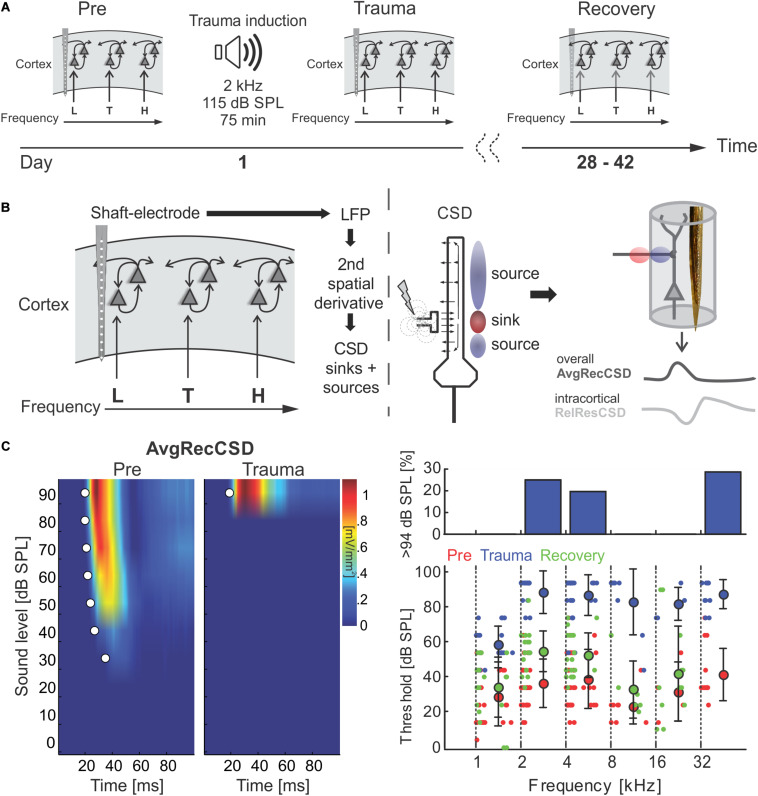
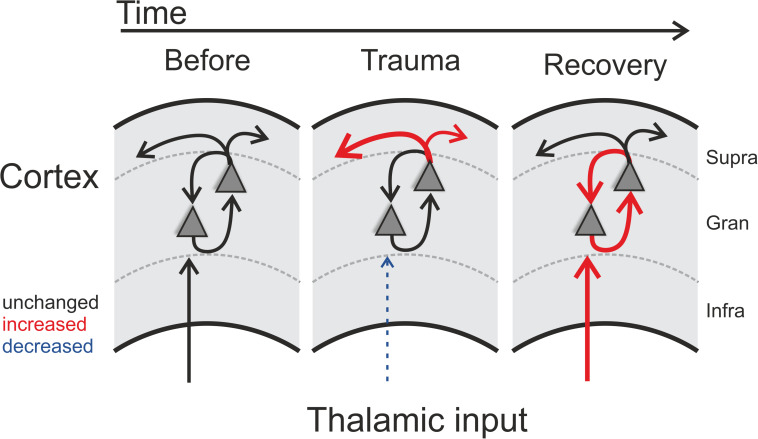
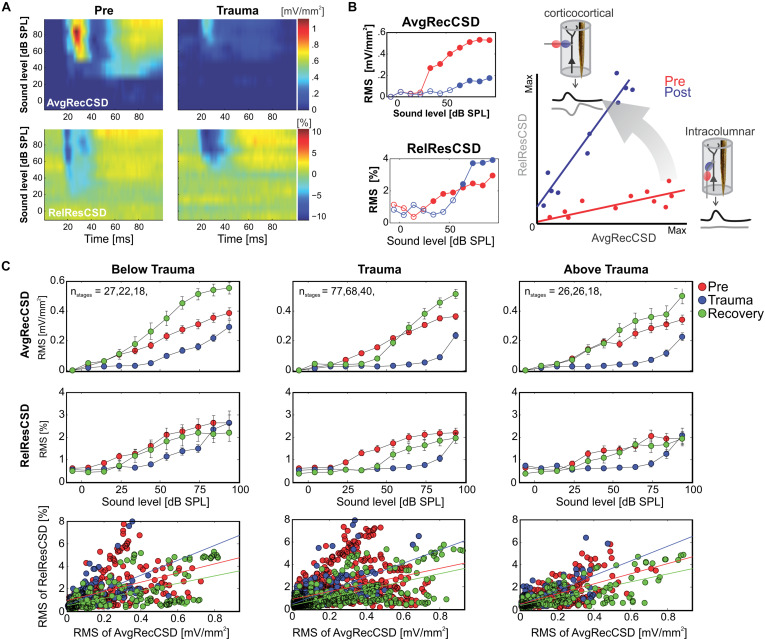
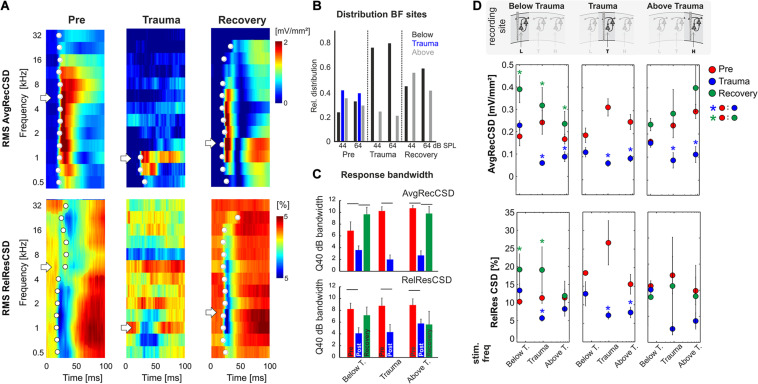
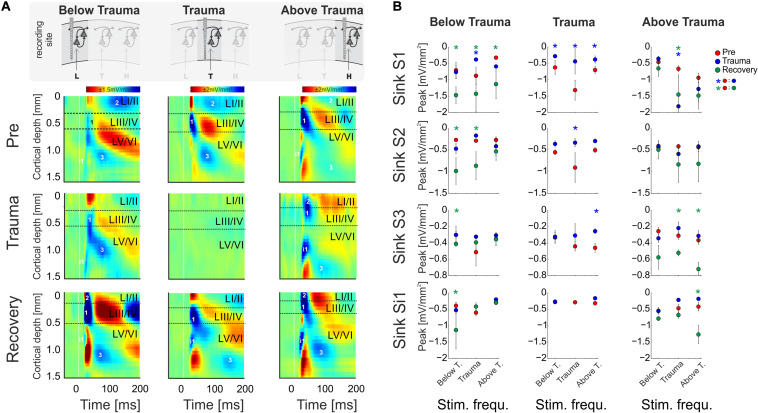
Harmful environmental sounds are a prevailing source of chronic hearing impairments, including noise induced hearing loss, hyperacusis, or tinnitus. How these symptoms are related to pathophysiological damage to the sensory receptor epithelia and its effects along the auditory pathway, have been documented in numerous studies. An open question concerns the temporal evolution of maladaptive changes after damage and their manifestation in the balance of thalamocortical and corticocortical input to the auditory cortex (ACx). To address these issues, we investigated the loci of plastic reorganizations across the tonotopic axis of the auditory cortex of male Mongolian gerbils () acutely after a sound trauma and after several weeks. We used a residual current-source density analysis to dissociate adaptations of intracolumnar input and horizontally relayed corticocortical input to synaptic populations across cortical layers in ACx. A pure tone-based sound trauma caused acute changes of subcortical inputs and corticocortical inputs at all tonotopic regions, particularly showing a broad reduction of tone-evoked inputs at tonotopic regions around the trauma frequency. At other cortical sites, the overall columnar activity acutely decreased, while relative contributions of lateral corticocortical inputs increased. After 4-6 weeks, cortical activity in response to the altered sensory inputs showed a general increase of local thalamocortical input reaching levels higher than before the trauma. Hence, our results suggest a detailed mechanism for overcompensation of altered frequency input in the auditory cortex that relies on a changing balance of thalamocortical and intracortical input and along the frequency gradient of the cortical tonotopic map.
有害环境声音是慢性听力损伤的主要来源,包括噪声性听力损失、听觉过敏或耳鸣。这些症状如何与感觉受体上皮的病理生理损伤及其沿听觉通路的影响相关,已在众多研究中得到记录。一个悬而未决的问题涉及损伤后适应不良变化的时间演变及其在丘脑皮质和皮质皮质输入到听觉皮层(ACx)平衡中的表现。为了解决这些问题,我们研究了雄性蒙古沙鼠在遭受声音创伤后急性以及数周后,听觉皮层音调拓扑轴上可塑性重组的位点。我们使用残余电流源密度分析来区分柱状内输入和水平中继的皮质皮质输入对ACx各皮质层突触群体的适应性。基于纯音的声音创伤在所有音调拓扑区域引起了皮质下输入和皮质皮质输入的急性变化,特别是在创伤频率周围的音调拓扑区域,音调诱发输入出现广泛减少。在其他皮质部位,整体柱状活动急性下降,而外侧皮质皮质输入的相对贡献增加。4-6周后,对改变的感觉输入的皮质活动显示局部丘脑皮质输入普遍增加,达到高于创伤前的水平。因此,我们的结果表明了一种听觉皮层中频率输入改变的过度补偿的详细机制,该机制依赖于丘脑皮质和皮质内输入的变化平衡以及沿着皮质音调拓扑图的频率梯度。