Center for Autoimmunity and Inflammation, Type 1 Diabetes Center at La Jolla Institute for Immunology, La Jolla, CA, United States.
Front Endocrinol (Lausanne). 2021 Jan 5;11:606434. doi: 10.3389/fendo.2020.606434. eCollection 2020.
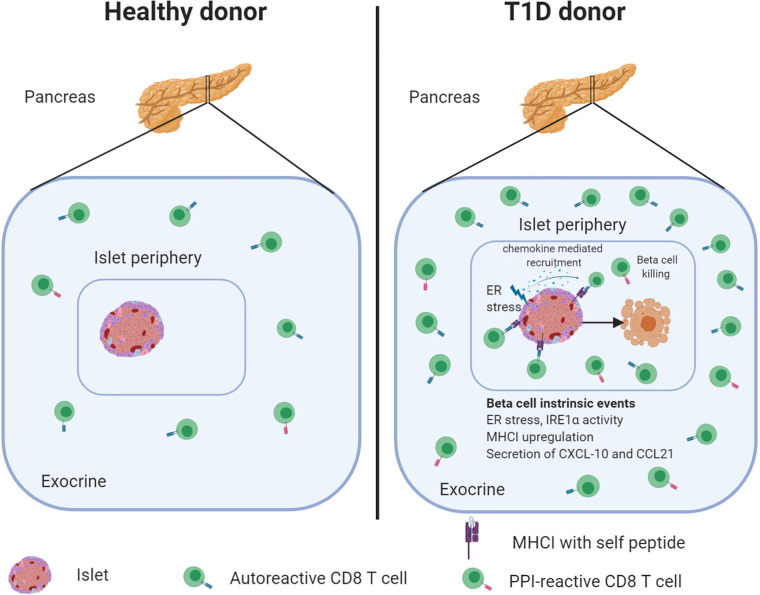
Since the establishment of the network for pancreatic organ donors with diabetes (nPOD), we have gained unprecedented insight into the pathology of human type 1 diabetes. Many of the pre-existing "dogmas", mostly derived from studies of animal models and sometimes limited human samples, have to be revised now. For example, we have learned that autoreactive CD8 T cells are present even in healthy individuals within the exocrine pancreas. Furthermore, their "attraction" to islets probably relies on beta-cell intrinsic events, such as the over-expression of MHC class I and resulting presentation of autoantigens such as (prepro)insulin. In addition, we are discovering other signs of beta-cell dysfunction, possibly at least in part due to stress, such as the over-expression of certain cytokines. This review summarizes the latest developments focusing on cytokines and autoreactive CD8 T cells in human type 1 diabetes pathogenesis.
自胰腺器官糖尿病供体网络(nPOD)成立以来,我们对人类 1 型糖尿病的病理学有了前所未有的深入了解。许多现有的“定论”,主要来自于对动物模型的研究,有时也来自于有限的人类样本,现在都需要进行修正。例如,我们已经了解到,即使在健康个体的外分泌胰腺中,自身反应性 CD8 T 细胞也存在。此外,它们向胰岛的“吸引”可能依赖于β细胞内在的事件,如 MHC Ⅰ类的过度表达和自身抗原(如前胰岛素原)的呈现。此外,我们还发现了其他β细胞功能障碍的迹象,至少部分可能是由于应激,如某些细胞因子的过度表达。这篇综述总结了最新的发展,重点是人类 1 型糖尿病发病机制中的细胞因子和自身反应性 CD8 T 细胞。