Kirchner Julian, O'Donoghue Joseph A, Becker Anton S, Ulaner Gary A
Department of Radiology, Memorial Sloan Kettering Cancer Center, New York, NY, USA.
Department of Diagnostic and Interventional Radiology, University Dusseldorf, Medical Faculty, Dusseldorf, Germany.
EJNMMI Phys. 2021 Jan 19;8(1):6. doi: 10.1186/s40658-021-00352-z.
The aim of this study was to evaluate the use of a Bayesian penalized likelihood reconstruction algorithm (Q.Clear) for Zr-immunoPET image reconstruction and its potential to improve image quality and reduce the administered activity of Zr-immunoPET tracers.
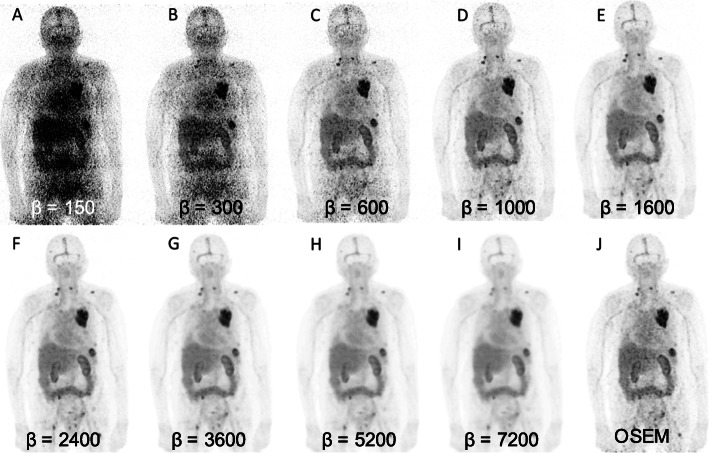
Eight Zr-immunoPET whole-body PET/CT scans from three Zr-immunoPET clinical trials were selected for analysis. On average, patients were imaged 6.3 days (range 5.0-8.0 days) after administration of 69 MBq (range 65-76 MBq) of [Zr]Zr-DFO-daratumumab, [Zr]Zr-DFO-pertuzumab, or [Zr]Zr-DFO-trastuzumab. List-mode PET data was retrospectively reconstructed using Q.Clear with incremental β-values from 150 to 7200, as well as standard ordered-subset expectation maximization (OSEM) reconstruction (2-iterations, 16-subsets, a 6.4-mm Gaussian transaxial filter, "heavy" z-axis filtering and all manufacturers' corrections active). Reduced activities were simulated by discarding 50% and 75% of original counts in each list mode stream. All reconstructed PET images were scored for image quality and lesion detectability using a 5-point scale. SUV for normal liver and sites of disease and liver signal-to-noise ratio were measured.
Q.Clear reconstructions with β = 3600 provided the highest scores for image quality. Images reconstructed with β-values of 3600 or 5200 using only 50% or 25% of the original counts provided comparable or better image quality scores than standard OSEM reconstruction images using 100% of counts.
The Bayesian penalized likelihood reconstruction algorithm Q.Clear improved the quality of Zr-immunoPET images. This could be used in future studies to improve image quality and/or decrease the administered activity of Zr-immunoPET tracers.
本研究旨在评估贝叶斯惩罚似然重建算法(Q.Clear)在Zr免疫正电子发射断层显像(PET)图像重建中的应用,以及其改善图像质量和降低Zr免疫PET示踪剂给药剂量的潜力。
从三项Zr免疫PET临床试验中选取八例Zr免疫PET全身PET/CT扫描进行分析。平均而言,患者在注射69 MBq(范围65 - 76 MBq)的[Zr]Zr-DFO-达雷妥尤单抗、[Zr]Zr-DFO-帕妥珠单抗或[Zr]Zr-DFO-曲妥珠单抗后6.3天(范围5.0 - 8.0天)进行成像。列表模式PET数据使用Q.Clear进行回顾性重建,β值从150递增至7200,同时使用标准的有序子集期望最大化(OSEM)重建(2次迭代,16个子集,6.4毫米高斯横向滤波器,“重度”z轴滤波,所有制造商校正开启)。通过在每个列表模式数据流中丢弃50%和75%的原始计数来模拟降低剂量情况。使用5分制对所有重建的PET图像进行图像质量和病变可检测性评分。测量正常肝脏和疾病部位的标准化摄取值(SUV)以及肝脏信噪比。
β = 3600时的Q.Clear重建图像质量得分最高。仅使用50%或25%原始计数且β值为3600或5200重建的图像,其质量得分与使用100%计数的标准OSEM重建图像相当或更高。
贝叶斯惩罚似然重建算法Q.Clear改善了Zr免疫PET图像质量。这可用于未来研究以改善图像质量和/或降低Zr免疫PET示踪剂的给药剂量。