Institute of Molecular Physics, Polish Academy of Sciences, ul. Mariana Smoluchowskiego 17, 60-179 Poznan, Poland.
Institute of Chemistry and Biochemistry, Free University of Berlin, Arnimallee 22, 14195 Berlin, Germany.
J Phys Chem B. 2021 Jan 28;125(3):841-849. doi: 10.1021/acs.jpcb.0c10485. Epub 2021 Jan 20.
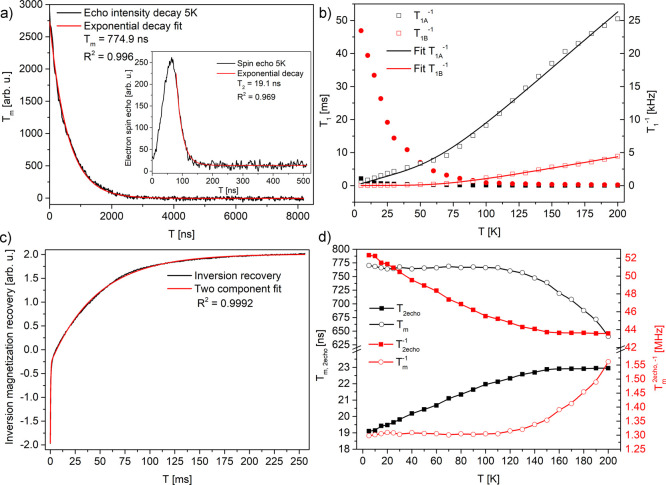
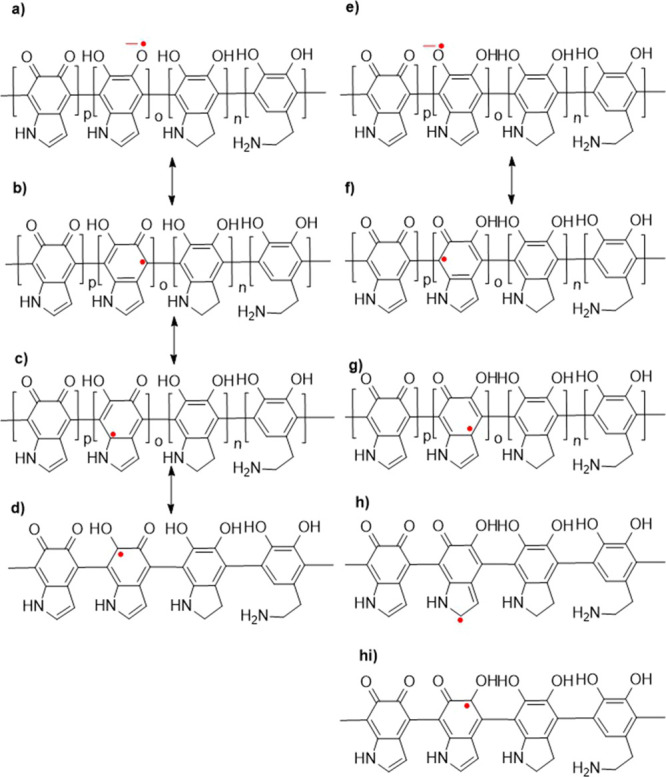
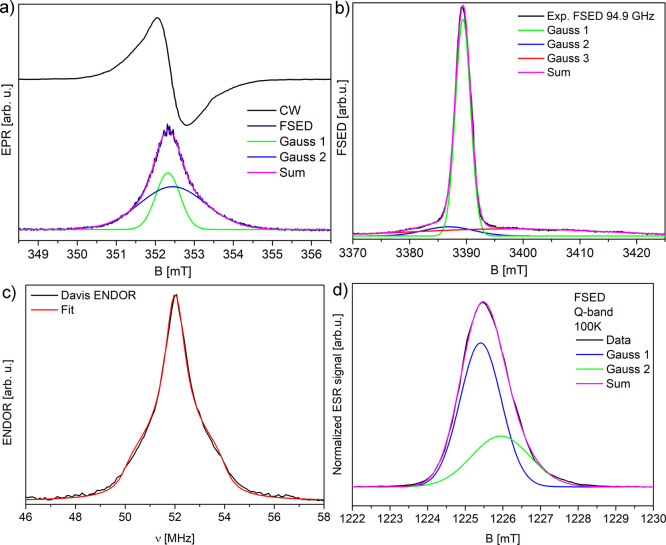
We present a thoroughgoing electron paramagnetic resonance investigation of polydopamine (PDA) radicals using multiple electron paramagnetic resonance techniques at the W-band (94 GHz), electron nuclear double resonance at the Q-band (34 GHz), spin relaxation, and continuous wave measurements at the X-band (9 GHz). The analysis proves the existence of two distinct paramagnetic species in the PDA structure. One of the two radical species is characterized by a long spin-lattice T relaxation time equal to 46.9 ms at 5 K and is assigned to the radical center on oxygen. The obtained data revealed that the paramagnetic species exhibit different electron spin relaxation behaviors due to different couplings to local phonons, which confirm spatial distancing between two radical types. Our results shed new light on the radical structure of PDA, which is of great importance in the application of PDA in materials science and biomedicine and allows us to better understand the properties of these materials and predict their future applications.
我们使用 W 波段(94GHz)的多种电子顺磁共振技术、Q 波段(34GHz)的电子核双共振、自旋弛豫和 X 波段(9GHz)的连续波测量,对聚多巴胺(PDA)自由基进行了彻底的电子顺磁共振研究。分析证明了 PDA 结构中存在两种不同的顺磁物种。两种自由基之一的特征是自旋晶格 T1 弛豫时间长,在 5K 时等于 46.9ms,被分配到氧上的自由基中心。所得数据表明,由于与局部声子的不同耦合,顺磁物种表现出不同的电子自旋弛豫行为,这证实了两种自由基类型之间的空间距离。我们的结果为 PDA 的自由基结构提供了新的认识,这对于 PDA 在材料科学和生物医学中的应用具有重要意义,使我们能够更好地理解这些材料的性质并预测它们的未来应用。