Department of Cardiovascular Medicine University of Missouri Columbia MO.
Dalton Cardiovascular Research Center University of Missouri Columbia MO.
J Am Heart Assoc. 2021 Feb 2;10(3):e017633. doi: 10.1161/JAHA.120.017633. Epub 2021 Jan 20.
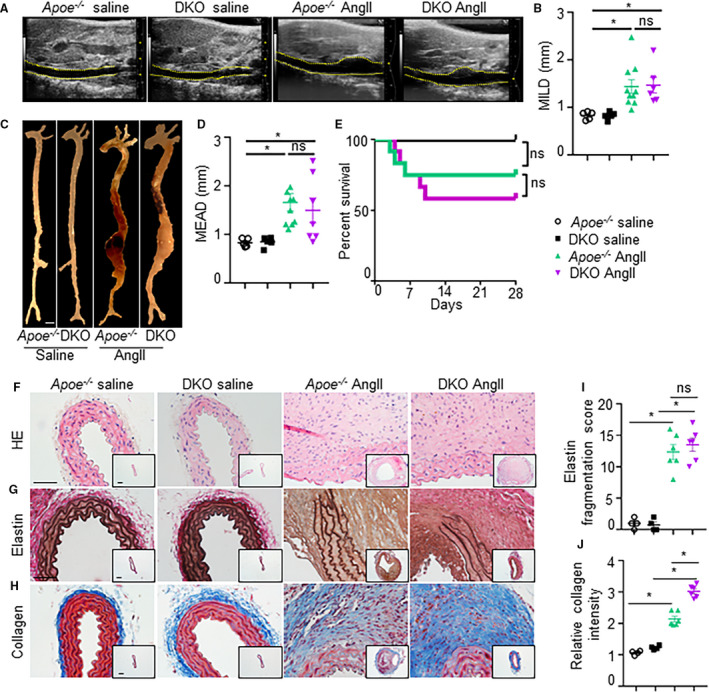
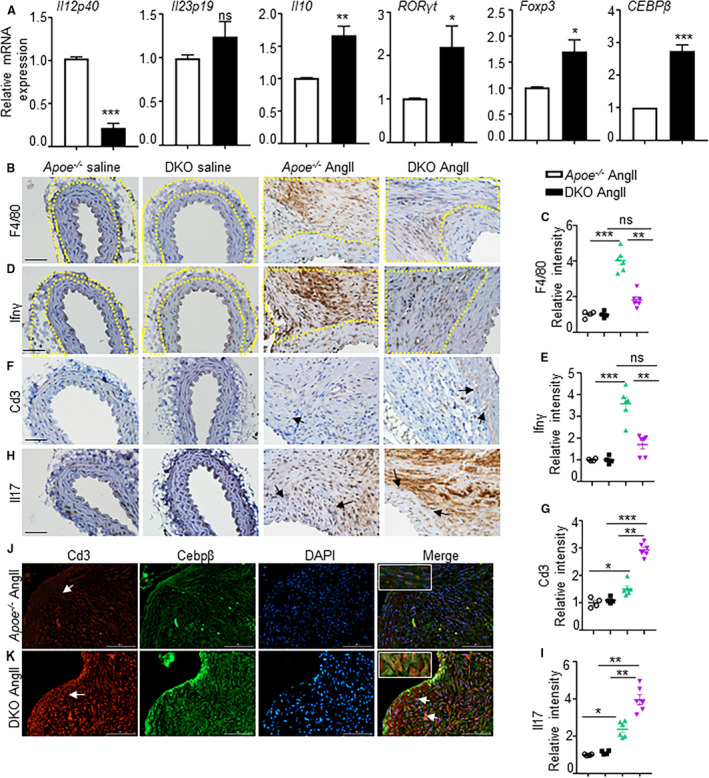
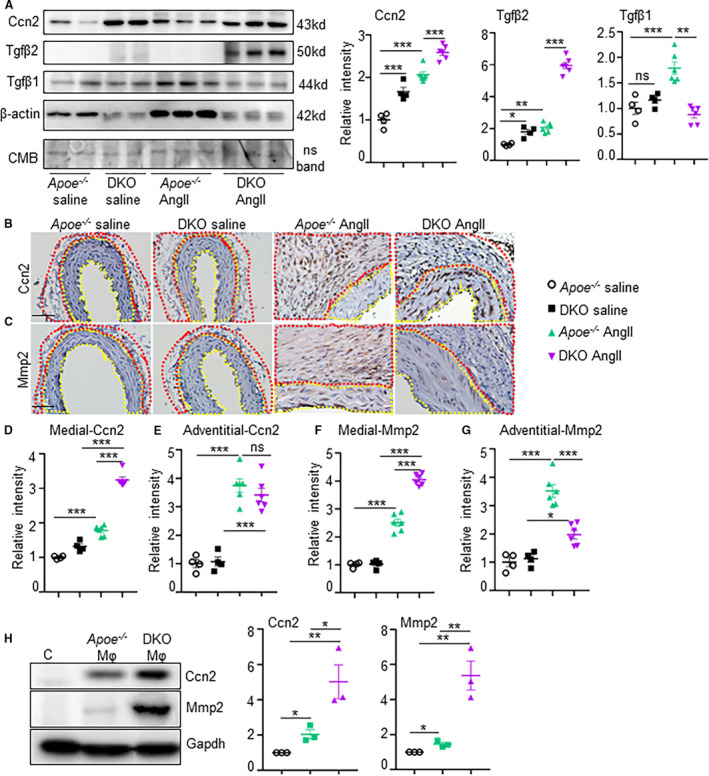
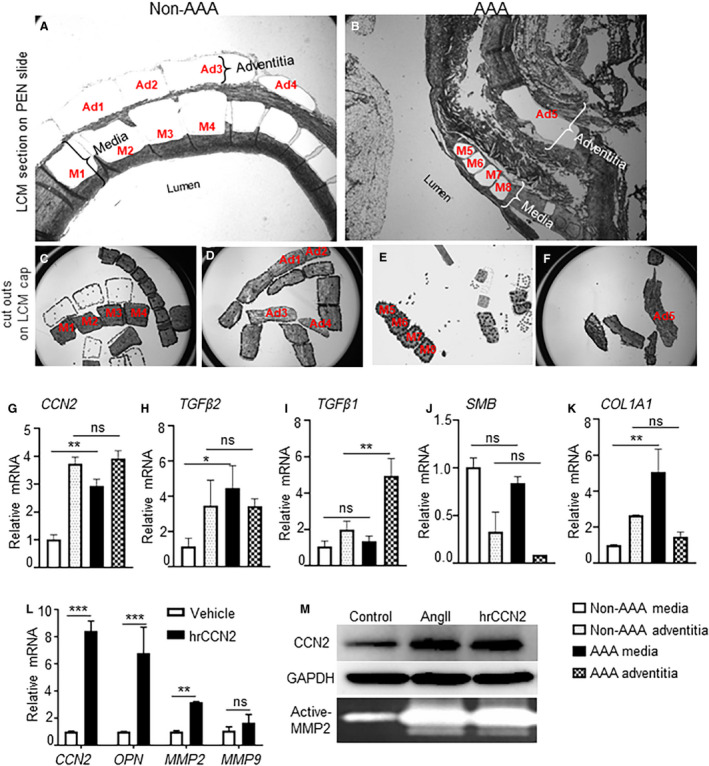
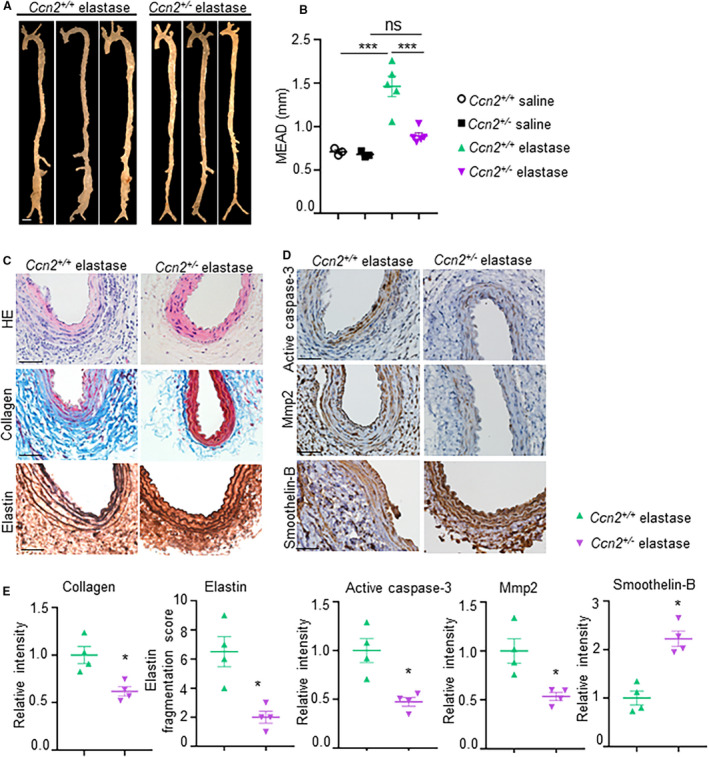
Background Development of abdominal aortic aneurysm (AAA) is associated with proinflammatory cytokines including interleukin-12 (IL12). Deficiency of interleukin 12p40 (IL12p40) increases localized fibrotic events by promoting TGFβ2 (transforming growth factor β)-dependent anti-inflammatory response. Here, we determined whether IL12p40 deficiency in apolipoprotein E mice attenuates the development of AAA by antagonizing proinflammatory response. Methods and Results Double knockout (DKO) mice were generated by crossbreeding IL12p40 mice with apolipoprotein E mice (n=12). Aneurysmal studies were performed using angiotensin II (1 µg/kg/min; subcutaneous). Surprisingly, DKO mice did not prevent the development of AAA with angiotensin II infusion. Immunohistological analysis, however, showed distinct pathological features between apolipoprotein E and DKO mice. Polymerase chain reaction (7 day) and cytokine arrays (28 day) of the aortic tissues from DKO mice showed significantly increased expression of cytokines related to anti-inflammatory response (interleukin 5 and interleukin 13), synthetic vascular smooth muscle cell phenotype (Activin receptor-like kinase-1 (ALK-1), artemin, and betacellulin) and T helper 17-associated response (4-1BB, interleukin-17e (Il17e) and Cd40 ligand (Cd-40L)). Indeed, DKO mice exhibited increased expression of the fibro-proteolytic pathway in the medial layer of aortae induced by cellular communication network factor 2 (CCN2) and Cd3IL17 cells compared with apolipoprotein E mice. Laser capture microdissection showed predominant expression of CCN2/TGFβ2 in the medial layer of human AAA. Finally, haploinsufficiency in the mice showed decreased AAA incidence in response to elastase infusion, associated with decreased matrix metalloproteinase-2 expression. Conclusions Our study reveals novel roles for deficiency in inducing fibro-proteolytic activities in the aneurysmal mouse model. Mechanistically, these effects of IL12p40 deficiency are mediated by CCN2/matrix metalloproteinase-2 crosstalk in the medial layer of aneurysmal aortae.
背景 腹主动脉瘤 (AAA) 的发展与包括白细胞介素-12 (IL12) 在内的促炎细胞因子有关。白细胞介素 12p40 (IL12p40) 的缺乏通过促进 TGFβ2(转化生长因子β)依赖性抗炎反应增加局部纤维化事件。在这里,我们通过交叉繁殖 IL12p40 小鼠和载脂蛋白 E 小鼠来确定载脂蛋白 E 小鼠中的 IL12p40 缺乏是否通过拮抗促炎反应来减轻 AAA 的发展。
方法和结果 通过交叉繁殖 IL12p40 小鼠和载脂蛋白 E 小鼠(n=12)生成双敲除(DKO)小鼠。使用血管紧张素 II(1μg/kg/min;皮下)进行动脉瘤研究。令人惊讶的是,DKO 小鼠不能预防血管紧张素 II 输注引起的 AAA 发展。然而,免疫组织化学分析显示载脂蛋白 E 和 DKO 小鼠之间存在明显不同的病理特征。DKO 小鼠主动脉组织的聚合酶链反应(7 天)和细胞因子阵列(28 天)显示与抗炎反应(白细胞介素 5 和白细胞介素 13)、合成血管平滑肌细胞表型(激活素受体样激酶-1 (ALK-1)、artemin 和 betacellulin)和 Th17 相关反应(4-1BB、白细胞介素 17e (Il17e) 和 CD40 配体 (Cd-40L))相关的细胞因子表达显著增加。事实上,与载脂蛋白 E 小鼠相比,DKO 小鼠在由细胞通讯网络因子 2 (CCN2) 和 CD3IL17 细胞诱导的主动脉中层表现出增加的纤维蛋白溶解途径表达。激光捕获显微解剖显示人 AAA 中层中 CCN2/TGFβ2 的主要表达。最后,小鼠的单倍不足减少了对弹性酶输注的 AAA 发生率,与基质金属蛋白酶-2 表达减少有关。
结论 我们的研究揭示了 IL12p40 缺乏在诱导动脉瘤小鼠模型中纤维蛋白溶解活性方面的新作用。从机制上讲,IL12p40 缺乏的这些作用是通过动脉瘤主动脉中层的 CCN2/基质金属蛋白酶-2 相互作用介导的。