Department of Internal Medicine and Cardiology, B.P. Koirala Institute of Health Sciences, Dharan, Nepal.
Department of Cardiology, Neuro Cardio and Multispeciality Hospital, Biratnagar, Nepal.
JAMA Cardiol. 2021 Apr 1;6(4):420-426. doi: 10.1001/jamacardio.2020.7050.
Echocardiographic screening allows for early detection of subclinical stages of rheumatic heart disease among children in endemic regions.
To investigate the effectiveness of systematic echocardiographic screening in combination with secondary antibiotic prophylaxis on the prevalence of rheumatic heart disease.
DESIGN, SETTING, AND PARTICIPANTS: This cluster randomized clinical trial included students 9 to 16 years of age attending public and private schools in urban and rural areas of the Sunsari district in Nepal that had been randomly selected on November 17, 2012. Echocardiographic follow-up was performed between January 7, 2016, and January 3, 2019.
In the experimental group, children underwent systematic echocardiographic screening followed by secondary antibiotic prophylaxis in case they had echocardiographic evidence of latent rheumatic heart disease. In the control group, children underwent no echocardiographic screening.
Prevalence of the composite of definite or borderline rheumatic heart disease according to the World Heart Federation criteria in experimental and control schools as assessed 4 years after intervention.
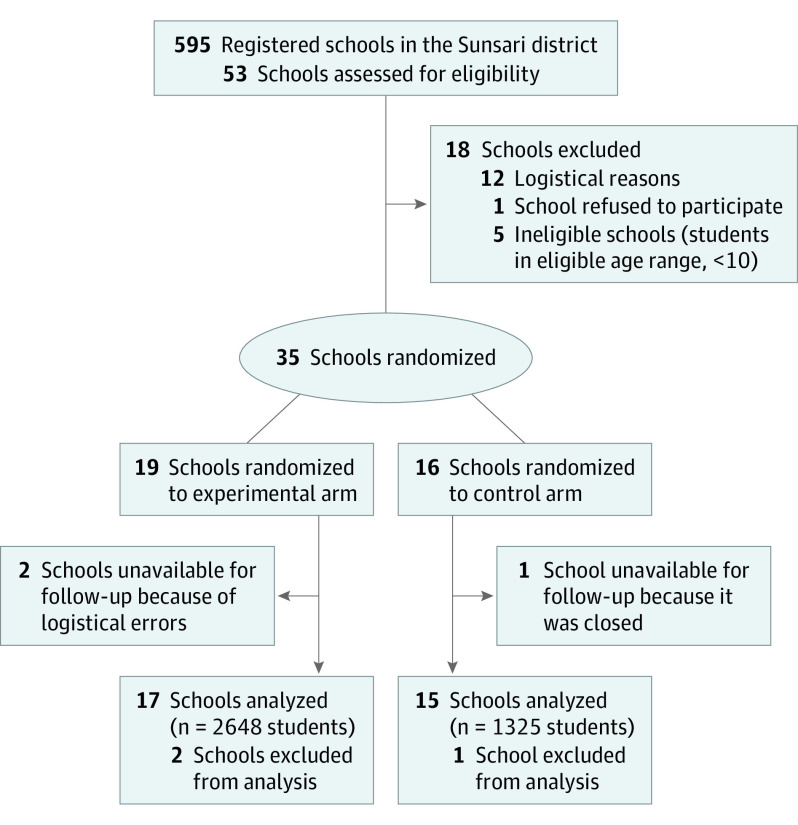
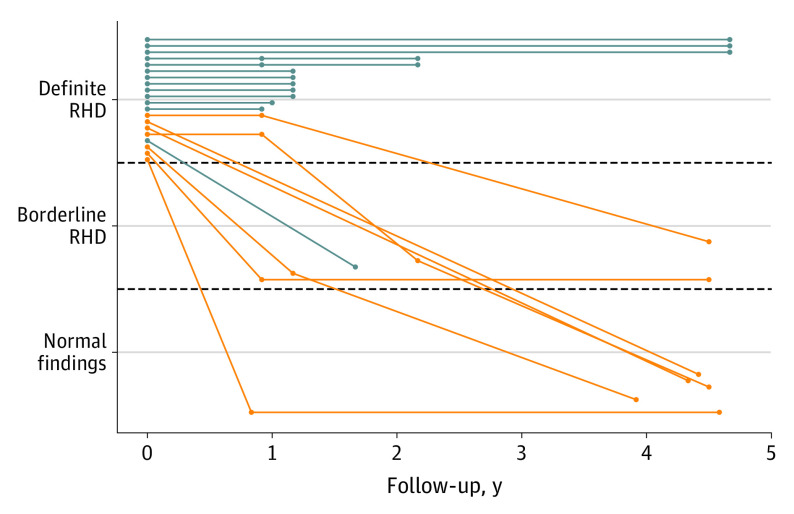
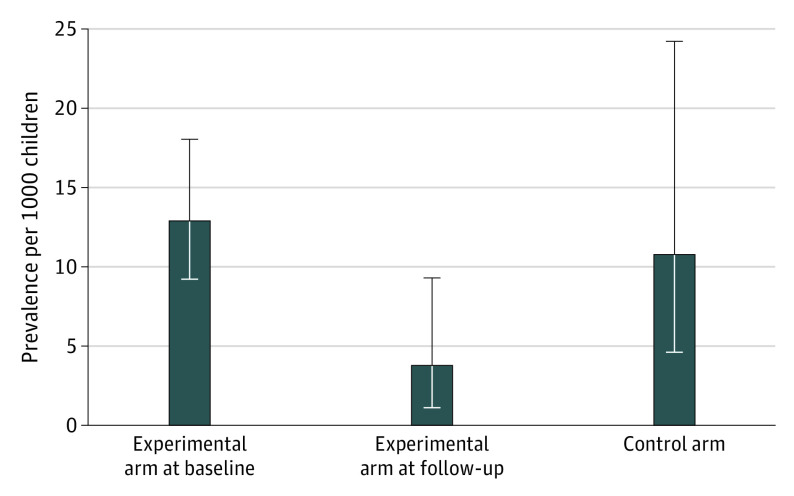
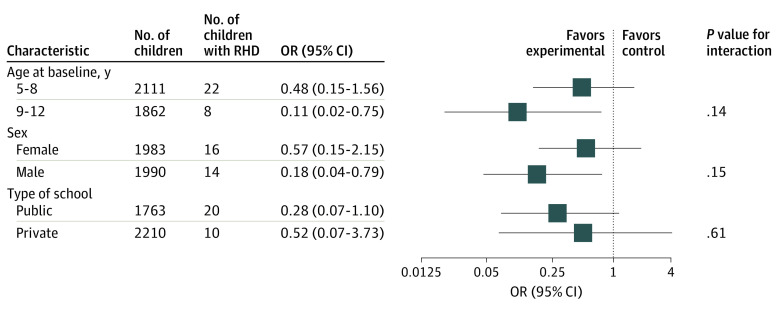
A total of 35 schools were randomized to the experimental group (n = 19) or the control group (n = 16). After a median of 4.3 years (interquartile range [IQR], 4.0-4.5 years), 17 of 19 schools in the experimental group (2648 children; median age at follow-up, 12.1 years; IQR, 10.3-12.5 years; 1308 [49.4%] male) and 15 of 16 schools in the control group (1325 children; median age at follow-up, 10.6 years; IQR, 10.0-12.5 years; 682 [51.5%] male) underwent echocardiographic follow-up. The prevalence of definite or borderline rheumatic heart disease was 10.8 per 1000 children (95% CI, 4.7-24.7) in the control group and 3.8 per 1000 children (95% CI, 1.5-9.8) in the experimental group (odds ratio, 0.34; 95% CI, 0.11-1.07; P = .06). The prevalence in the experimental group at baseline had been 12.9 per 1000 children (95% CI, 9.2-18.1). In the experimental group, the odds ratio of definite or borderline rheumatic heart disease at follow-up vs baseline was 0.29 (95% CI, 0.13-0.65; P = .008).
School-based echocardiographic screening in combination with secondary antibiotic prophylaxis in children with evidence of latent rheumatic heart disease may be an effective strategy to reduce the prevalence of definite or borderline rheumatic heart disease in endemic regions.
ClinicalTrials.gov Identifier: NCT01550068.
超声心动图筛查可在流行地区的儿童中早期发现亚临床阶段的风湿性心脏病。
研究系统的超声心动图筛查联合二级抗生素预防对风湿性心脏病发病率的影响。
设计、地点和参与者:这是一项集群随机临床试验,纳入了 2012 年 11 月 17 日随机选择的尼泊尔桑萨里区城乡公立和私立学校 9 至 16 岁的学生。超声心动图随访于 2016 年 1 月 7 日至 2019 年 1 月 3 日进行。
实验组儿童接受系统的超声心动图筛查,如果有潜在风湿性心脏病的超声心动图证据,则进行二级抗生素预防。对照组儿童不接受超声心动图筛查。
干预 4 年后实验组和对照组按世界心脏联合会标准评估的明确或边界性风湿性心脏病复合发病率。
共有 35 所学校被随机分为实验组(n = 19)或对照组(n = 16)。中位随访 4.3 年后(四分位距[IQR],4.0-4.5 年),实验组 19 所学校中的 17 所(2648 名儿童;中位随访年龄,12.1 岁;IQR,10.3-12.5 岁;1308 名[49.4%]男性)和对照组 16 所学校中的 15 所(1325 名儿童;中位随访年龄,10.6 岁;IQR,10.0-12.5 岁;682 名[51.5%]男性)接受了超声心动图随访。对照组儿童的明确或边界性风湿性心脏病发病率为每 1000 名儿童 10.8 例(95%CI,4.7-24.7),实验组为每 1000 名儿童 3.8 例(95%CI,1.5-9.8)(比值比,0.34;95%CI,0.11-1.07;P = .06)。实验组基线时的发病率为每 1000 名儿童 12.9 例(95%CI,9.2-18.1)。实验组中,随访时与基线时相比,明确或边界性风湿性心脏病的比值比为 0.29(95%CI,0.13-0.65;P = .008)。
在有潜在风湿性心脏病证据的儿童中,以学校为基础的超声心动图筛查联合二级抗生素预防可能是降低流行地区明确或边界性风湿性心脏病发病率的有效策略。
ClinicalTrials.gov 标识符:NCT01550068。