Division of Cardiology and Cardiovascular Surgery and Telehealth Center - Hospital das Clínicas da Universidade Federal de Minas Gerais, Belo Horizonte, Minas Gerais, Brazil
School of Medicine - Universidade Federal de Minas Gerais, Belo Horizonte, Minas Gerais, Brazil.
J Am Heart Assoc. 2018 Feb 14;7(4):e008039. doi: 10.1161/JAHA.117.008039.
Considering the limited accuracy of clinical examination for early diagnosis of rheumatic heart disease (RHD), echocardiography has emerged as an important epidemiological tool. The ideal setting for screening is yet to be defined. We aimed to evaluate the prevalence and pattern of latent RHD in schoolchildren (aged 5-18 years) and to compare effectiveness of screening between public schools, private schools, and primary care centers in Minas Gerais, Brazil.
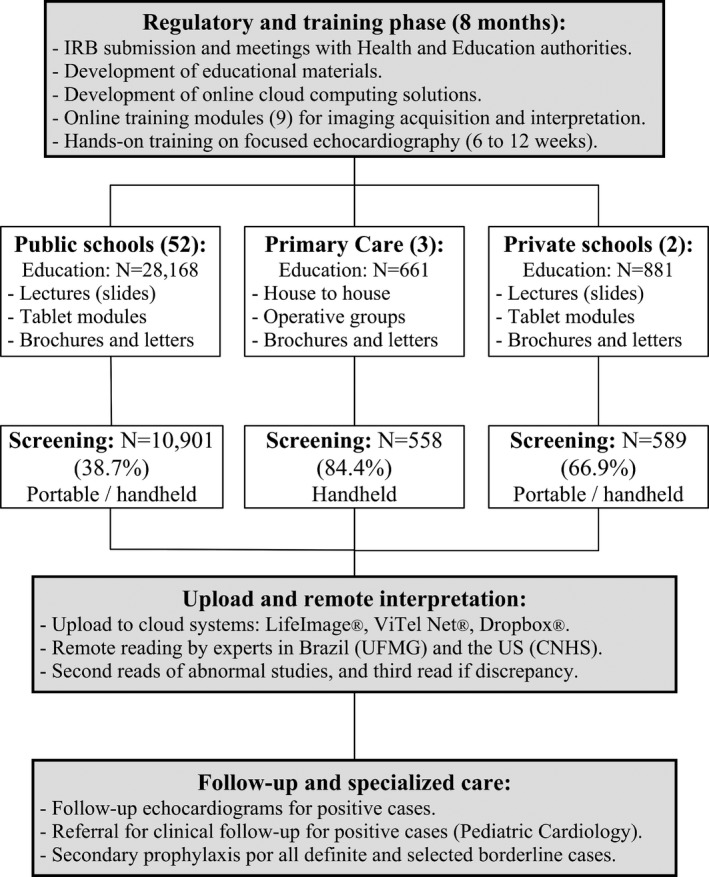
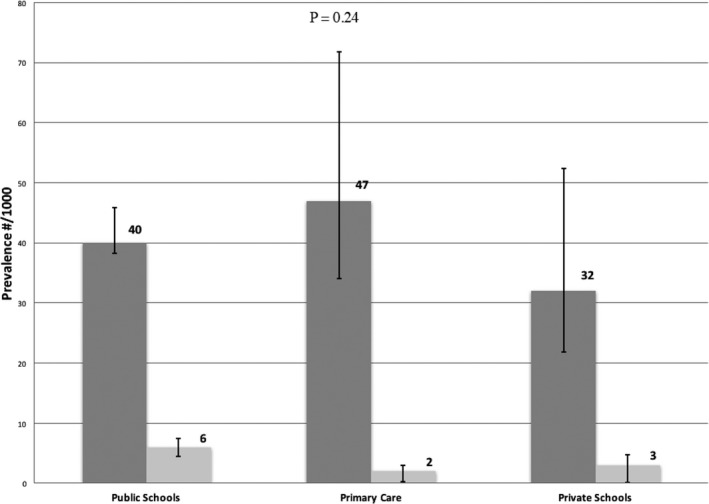
The PROVAR (Rheumatic Valve Disease Screening Program) study uses nonexperts and portable and handheld devices for RHD echocardiographic screening, with remote interpretation by telemedicine, according to the 2012 World Heart Federation criteria. Compliance with study consent and prevalence were compared between different screening settings, and variables associated with RHD were analyzed. In 26 months, 12 048 students were screened in 52 public schools (n=10 901), 2 private schools (n=589), and 3 primary care centers (n=558). Median age was 12.9 years, and 55.4% were girls. Overall RHD prevalence was 4.0% borderline (n=486) and 0.5% definite (n=63), with statistically similar rates between public schools (4.6%), private schools (3.5%), and primary care centers (4.8%) (=0.24). The percentage of informed consents signed was higher in primary care centers (84.4%) and private schools (66.9%) compared with public schools (38.7%) (<0.001). Prevalence was higher in children ≥12 years (5.3% versus 3.1%; <0.001) and girls (4.9% versus 4.0%; =0.02). Only age (odds ratio, 1.12; 95% confidence interval, 1.09-1.17; <0.001) was independently associated with RHD.
RHD screening in primary care centers seems to achieve higher coverage rates. Prevalence among schoolchildren is significantly high, with rates higher than expected in private schools of high-income areas. These data are important for the formulation of public policies to confront RHD.
鉴于临床检查对风湿性心脏病(RHD)早期诊断的准确性有限,超声心动图已成为一种重要的流行病学工具。理想的筛查环境仍有待确定。我们旨在评估巴西米纳斯吉拉斯州的学童(5-18 岁)中潜伏性 RHD 的流行率和模式,并比较公立学校、私立学校和初级保健中心之间筛查的效果。
PROVAR(风湿性瓣膜病筛查计划)研究使用非专家和便携式、手持式设备进行 RHD 超声心动图筛查,并通过远程医疗进行远程解释,依据的是 2012 年世界心脏联合会标准。比较了不同筛查环境下的研究同意书遵守情况和流行率,并分析了与 RHD 相关的变量。在 26 个月的时间里,在 52 所公立学校(n=10901)、2 所私立学校(n=589)和 3 所初级保健中心(n=558)共筛查了 12048 名学生。中位年龄为 12.9 岁,55.4%为女孩。总体 RHD 患病率为 4.0%边界值(n=486)和 0.5%确定值(n=63),公立学校(4.6%)、私立学校(3.5%)和初级保健中心(4.8%)之间的发病率相似(=0.24)。初级保健中心(84.4%)和私立学校(66.9%)的知情同意书签署率明显高于公立学校(38.7%)(<0.001)。≥12 岁儿童(5.3%比 3.1%;<0.001)和女孩(4.9%比 4.0%;=0.02)的患病率更高。只有年龄(比值比,1.12;95%置信区间,1.09-1.17;<0.001)与 RHD 独立相关。
初级保健中心的 RHD 筛查似乎能达到更高的覆盖率。学童中的 RHD 患病率明显较高,高收入地区私立学校的发病率高于预期。这些数据对制定防治 RHD 的公共政策很重要。