Pons Joan Carles, Paez-Espino David, Riera Gabriel, Ivanova Natalia, Kyrpides Nikos C, Llabrés Mercè
Department of Mathematics and Computer Science, University of the Balearic Islands, Palma 07122, Spain.
Department of Energy Joint Genome Institute, Berkeley, CA 94720, USA.
Bioinformatics. 2021 Jul 27;37(13):1805-1813. doi: 10.1093/bioinformatics/btab026.
Two key steps in the analysis of uncultured viruses recovered from metagenomes are the taxonomic classification of the viral sequences and the identification of putative host(s). Both steps rely mainly on the assignment of viral proteins to orthologs in cultivated viruses. Viral Protein Families (VPFs) can be used for the robust identification of new viral sequences in large metagenomics datasets. Despite the importance of VPF information for viral discovery, VPFs have not yet been explored for determining viral taxonomy and host targets.
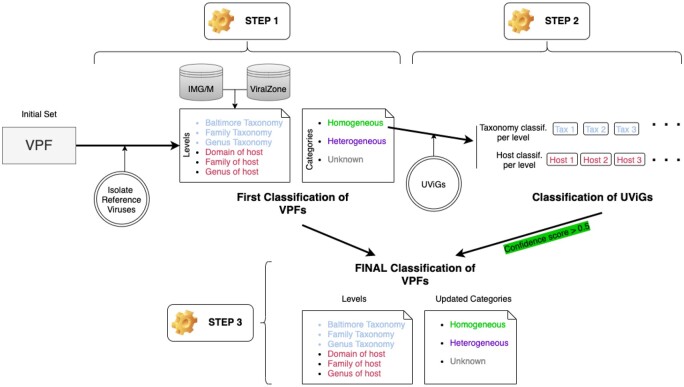
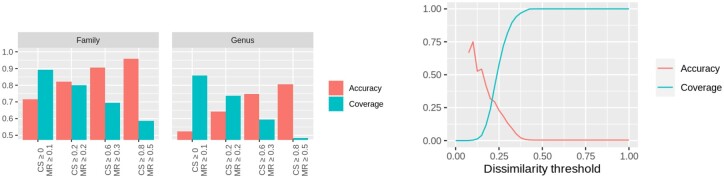
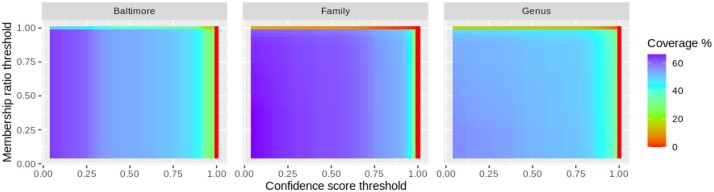
In this work, we classified the set of VPFs from the IMG/VR database and developed VPF-Class. VPF-Class is a tool that automates the taxonomic classification and host prediction of viral contigs based on the assignment of their proteins to a set of classified VPFs. Applying VPF-Class on 731K uncultivated virus contigs from the IMG/VR database, we were able to classify 363K contigs at the genus level and predict the host of over 461K contigs. In the RefSeq database, VPF-class reported an accuracy of nearly 100% to classify dsDNA, ssDNA and retroviruses, at the genus level, considering a membership ratio and a confidence score of 0.2. The accuracy in host prediction was 86.4%, also at the genus level, considering a membership ratio of 0.3 and a confidence score of 0.5. And, in the prophages dataset, the accuracy in host prediction was 86% considering a membership ratio of 0.6 and a confidence score of 0.8. Moreover, from the Global Ocean Virome dataset, over 817K viral contigs out of 1 million were classified.
The implementation of VPF-Class can be downloaded from https://github.com/biocom-uib/vpf-tools.
Supplementary data are available at Bioinformatics online.
从宏基因组中回收的未培养病毒分析中的两个关键步骤是病毒序列的分类学分类和推定宿主的鉴定。这两个步骤主要依赖于将病毒蛋白与培养病毒中的直系同源物进行比对。病毒蛋白家族(VPF)可用于在大型宏基因组数据集里可靠地鉴定新的病毒序列。尽管VPF信息对病毒发现很重要,但尚未探索VPF用于确定病毒分类学和宿主目标。
在这项工作中,我们对IMG/VR数据库中的VPF集进行了分类,并开发了VPF-Class。VPF-Class是一种工具,可根据病毒重叠群的蛋白质与一组分类的VPF的比对,自动对病毒重叠群进行分类学分类和宿主预测。将VPF-Class应用于IMG/VR数据库中的73.1万个未培养病毒重叠群,我们能够在属水平上对36.3万个重叠群进行分类,并预测超过46.1万个重叠群的宿主。在RefSeq数据库中,考虑到成员比例和置信度分数为0.2,VPF-class在属水平上对双链DNA、单链DNA和逆转录病毒进行分类的准确率接近100%。在宿主预测方面,考虑到成员比例为0.3和置信度分数为0.5,属水平上的准确率为86.4%。并且,在原噬菌体数据集中,考虑到成员比例为0.6和置信度分数为0.8,宿主预测的准确率为86%。此外,在全球海洋病毒组数据集中,100万个病毒重叠群中有超过81.7万个被分类。
VPF-Class的实现可从https://github.com/biocom-uib/vpf-tools下载。
补充数据可在《生物信息学》在线获取。