Department of Early Prehistory and Quaternary Ecology, Eberhard Karls University of Tübingen, Tübingen, Germany.
Institute of Geography and Geology, University of Würzburg, Würzburg, Germany.
PLoS One. 2021 Jan 20;16(1):e0245170. doi: 10.1371/journal.pone.0245170. eCollection 2021.
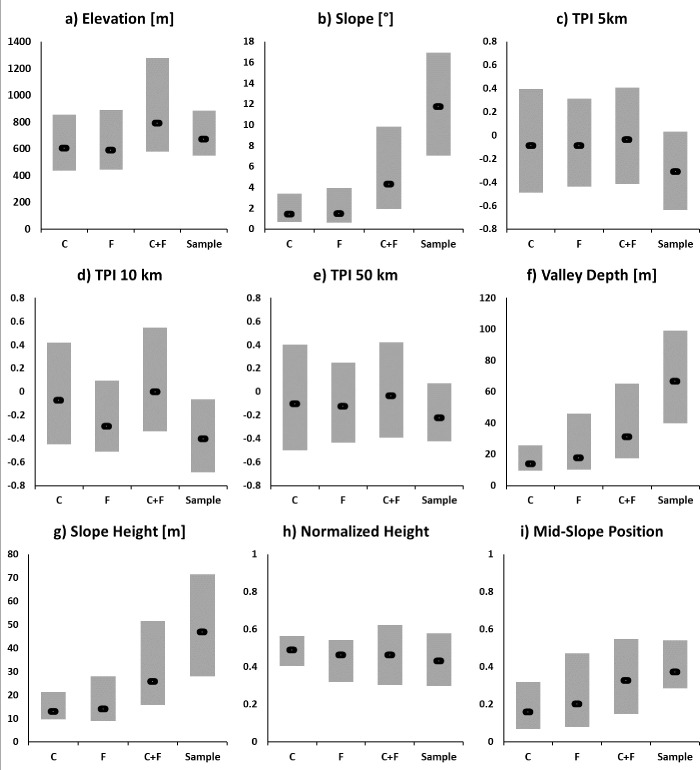
The area of the Inner Asian Mountain Corridor (IAMC) follows the foothills and piedmont zones around the northern limits of Asia's interior mountains, connecting two important areas for human evolution: the Fergana valley and the Siberian Altai. Prior research has suggested the IAMC may have provided an area of connected refugia from harsh climates during the Pleistocene. To date, this region contains very few secure, dateable Pleistocene sites, but its widely available carbonate units present an opportunity for discovering cave sites, which generally preserve longer sequences and organic remains. Here we present two models for predicting karstic cave and rockshelter features in the Kazakh portion of the IAMC. The 2018 model used a combination of lithological data and unsupervised landform classification, while the 2019 model used feature locations from the results of our 2017-2018 field surveys in a supervised classification using a minimum-distance classifier and morphometric features derived from the ASTER digital elevation model (DEM). We present the results of two seasons of survey using two iterations of the karstic cave models (2018 and 2019), and evaluate their performance during survey. In total, we identified 105 cave and rockshelter features from 2017-2019. We conclude that this model-led approach significantly reduces the target area for foot survey.
内亚山地廊道(IAMC)的范围沿着亚洲内陆山脉北缘的山麓和山前地带延伸,连接了人类进化的两个重要区域:费尔干纳山谷和西伯利亚阿尔泰山。先前的研究表明,在更新世期间,IAMC 可能为恶劣气候提供了一个连续的避难所区域。迄今为止,该地区只有很少的可靠、可定年的更新世遗址,但该地区广泛存在的碳酸盐单元为发现洞穴遗址提供了机会,洞穴遗址通常保存了更长的序列和有机残留物。在这里,我们提出了两种预测内亚山地廊道哈萨克部分喀斯特洞穴和岩棚特征的模型。2018 年的模型结合了岩性数据和无监督地貌分类,而 2019 年的模型则使用了我们 2017-2018 年实地调查结果中的特征位置,在使用最小距离分类器和从 ASTER 数字高程模型(DEM)派生的形态特征的监督分类中进行。我们展示了两个季节的调查结果,使用了两个喀斯特洞穴模型的迭代(2018 年和 2019 年),并在调查过程中评估了它们的性能。总共,我们从 2017 年至 2019 年共确定了 105 个洞穴和岩棚特征。我们得出的结论是,这种基于模型的方法显著减少了实地调查的目标区域。