Division of Infectious Diseases, Harbor-UCLA Medical Center, Torrance, California, United States of America.
Institute for Infection and Immunity, The Lundquist Institute for Biomedical Innovation at Harbor-UCLA Medical Center, Torrance, California, United States of America.
PLoS Pathog. 2021 Jan 20;17(1):e1009221. doi: 10.1371/journal.ppat.1009221. eCollection 2021 Jan.
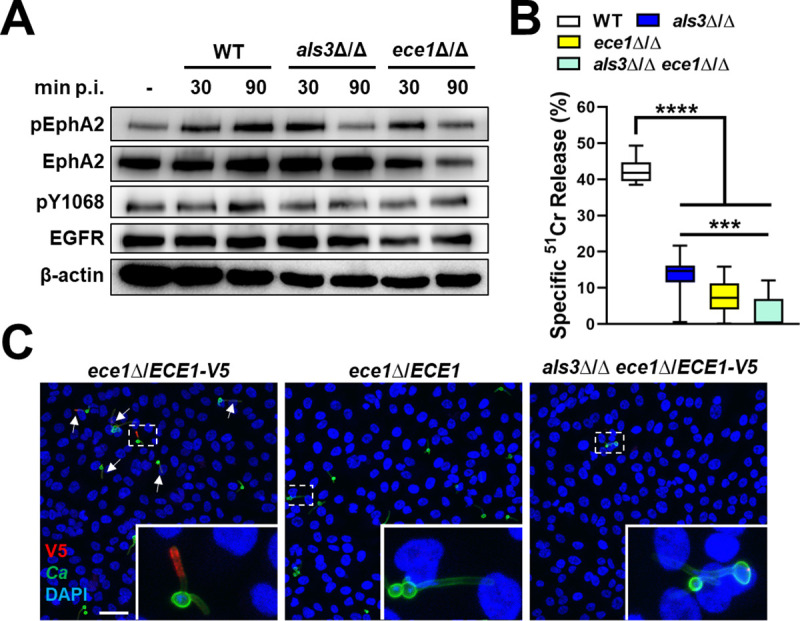
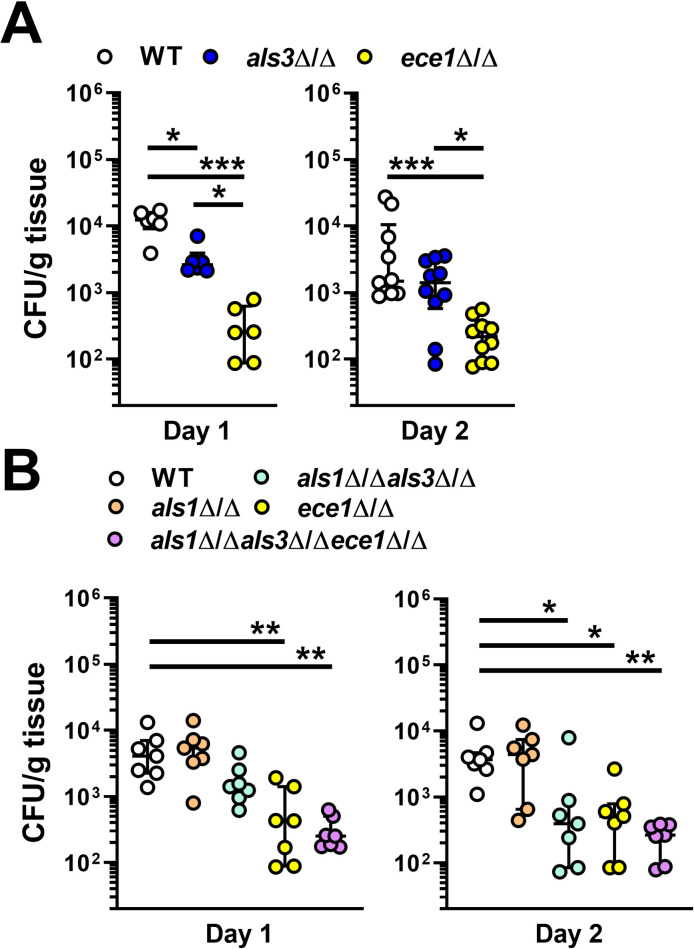
During oropharyngeal candidiasis (OPC), Candida albicans invades and damages oral epithelial cells, which respond by producing proinflammatory mediators that recruit phagocytes to foci of infection. The ephrin type-A receptor 2 (EphA2) detects β-glucan and plays a central role in stimulating epithelial cells to release proinflammatory mediators during OPC. The epidermal growth factor receptor (EGFR) also interacts with C. albicans and is known to be activated by the Als3 adhesin/invasin and the candidalysin pore-forming toxin. Here, we investigated the interactions among EphA2, EGFR, Als3 and candidalysin during OPC. We found that EGFR and EphA2 constitutively associate with each other as part of a heteromeric physical complex and are mutually dependent for C. albicans-induced activation. Als3-mediated endocytosis of a C. albicans hypha leads to the formation of an endocytic vacuole where candidalysin accumulates at high concentration. Thus, Als3 potentiates targeting of candidalysin, and both Als3 and candidalysin are required for C. albicans to cause maximal damage to oral epithelial cells, sustain activation of EphA2 and EGFR, and stimulate pro-inflammatory cytokine and chemokine secretion. In the mouse model of OPC, C. albicans-induced production of CXCL1/KC and CCL20 is dependent on the presence of candidalysin and EGFR, but independent of Als3. The production of IL-1α and IL-17A also requires candidalysin but is independent of Als3 and EGFR. The production of TNFα requires Als1, Als3, and candidalysin. Collectively, these results delineate the complex interplay among host cell receptors EphA2 and EGFR and C. albicans virulence factors Als1, Als3 and candidalysin during the induction of OPC and the resulting oral inflammatory response.
在口咽念珠菌病(OPC)期间,白念珠菌侵袭并破坏口腔上皮细胞,上皮细胞通过产生募集吞噬细胞到感染灶的促炎介质来作出反应。表皮生长因子受体(EGFR)也与白念珠菌相互作用,已知其被 Als3 黏附素/侵袭素和念珠菌溶素孔形成毒素激活。在这里,我们研究了 EphA2、EGFR、Als3 和念珠菌溶素在 OPC 期间的相互作用。我们发现,EGFR 和 EphA2 作为异源物理复合物的一部分,持续相互关联,并且彼此依赖于白念珠菌诱导的激活。Als3 介导的白念珠菌菌丝的内吞作用导致形成内吞小泡,其中念珠菌溶素在高浓度下积累。因此,Als3 增强了念珠菌溶素的靶向作用,并且 Als3 和念珠菌溶素都是白念珠菌对口腔上皮细胞造成最大损伤、维持 EphA2 和 EGFR 激活以及刺激促炎细胞因子和趋化因子分泌所必需的。在 OPC 的小鼠模型中,白念珠菌诱导的 CXCL1/KC 和 CCL20 的产生依赖于念珠菌溶素和 EGFR 的存在,但独立于 Als3。IL-1α 和 IL-17A 的产生也需要念珠菌溶素,但独立于 Als3 和 EGFR。TNFα 的产生需要 Als1、Als3 和念珠菌溶素。总之,这些结果描绘了宿主细胞受体 EphA2 和 EGFR 与白念珠菌毒力因子 Als1、Als3 和念珠菌溶素在诱导 OPC 和由此产生的口腔炎症反应中的复杂相互作用。