Discovery and Translational Science Department, Institute of Cardiovascular and Metabolic Medicine (R.-G.X., J.S.G., S.R.B., H.R.M., C.D., R.A.S.A.).
Department of Physics, Wake Forest University, Winston Salem, NC (S.R.B.).
Arterioscler Thromb Vasc Biol. 2021 Mar;41(3):1092-1104. doi: 10.1161/ATVBAHA.120.315030. Epub 2021 Jan 21.
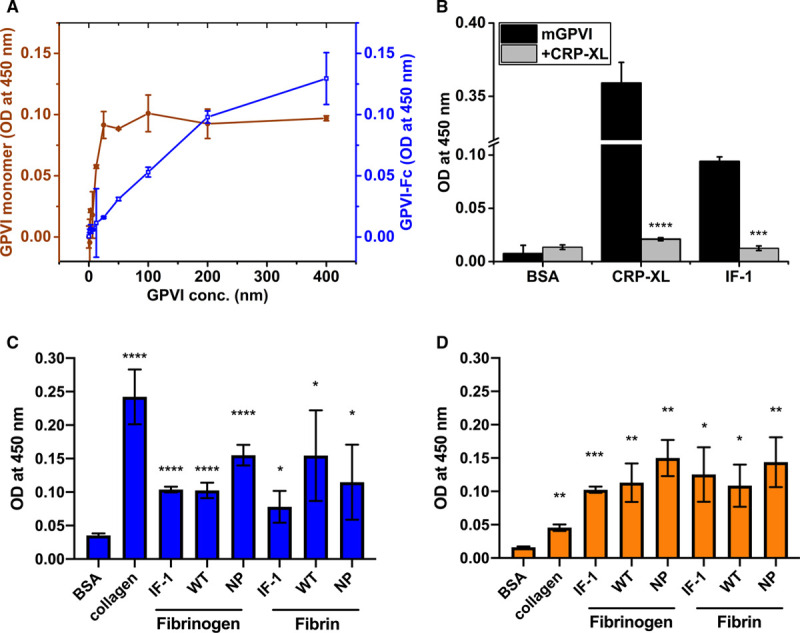
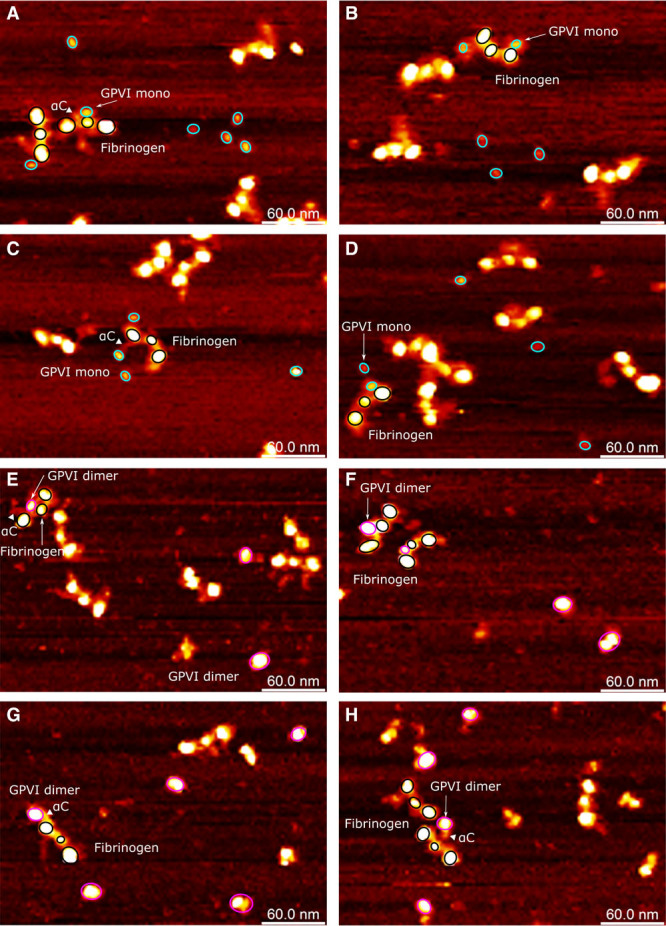
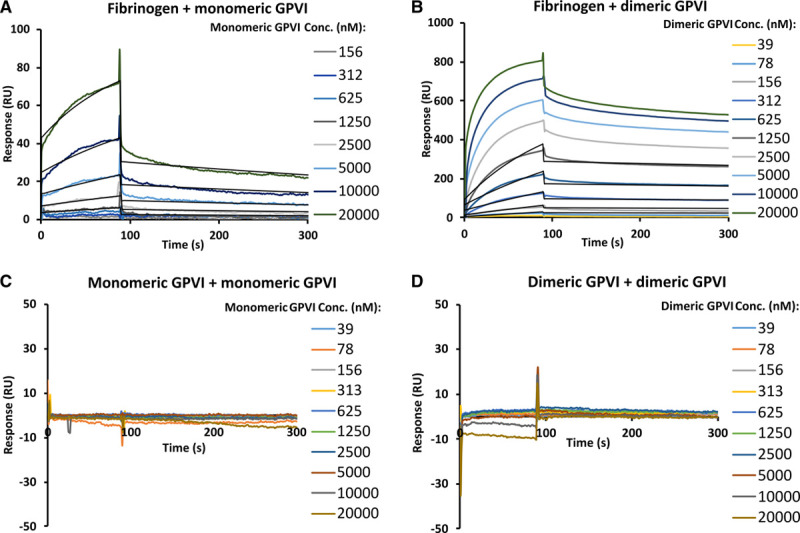
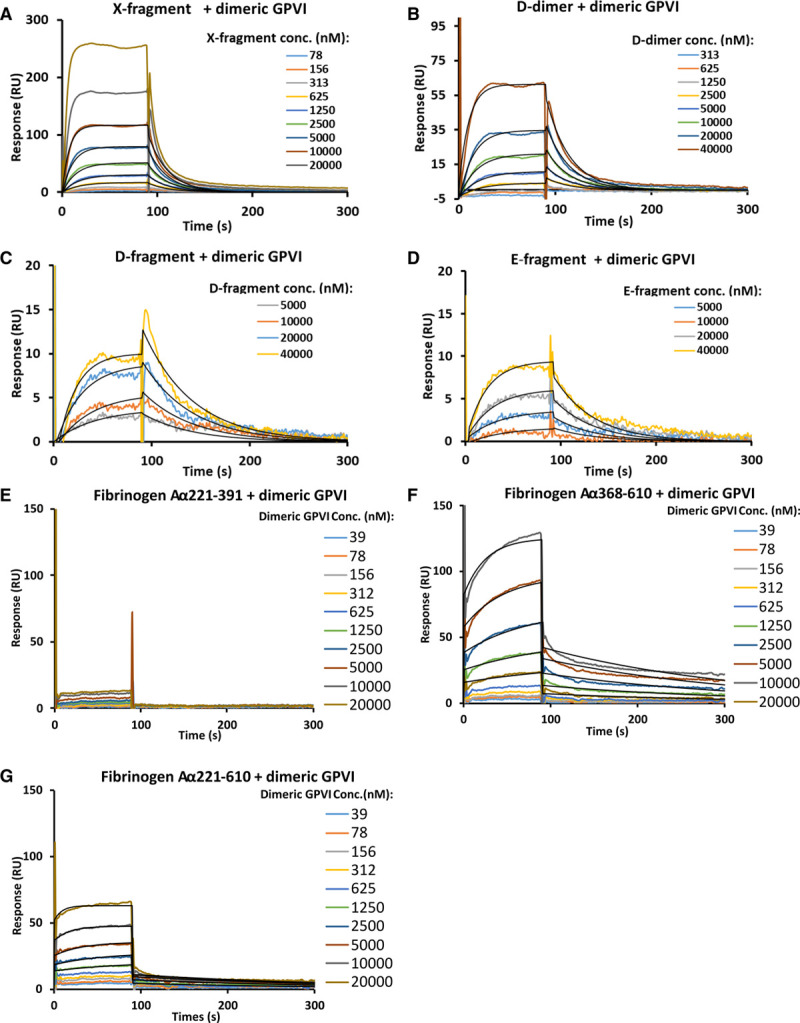
GPVI (glycoprotein VI) is a key molecular player in collagen-induced platelet signaling and aggregation. Recent evidence indicates that it also plays important role in platelet aggregation and thrombus growth through interaction with fibrin(ogen). However, there are discrepancies in the literature regarding whether the monomeric or dimeric form of GPVI binds to fibrinogen at high affinity. The mechanisms of interaction are also not clear, including which region of fibrinogen is responsible for GPVI binding. We aimed to gain further understanding of the mechanisms of interaction at molecular level and to identify the regions on fibrinogen important for GPVI binding. Approach and Results: Using multiple surface- and solution-based protein-protein interaction methods, we observe that dimeric GPVI binds to fibrinogen with much higher affinity and has a slower dissociation rate constant than the monomer due to avidity effects. Moreover, our data show that the highest affinity interaction of GPVI is with the αC-region of fibrinogen. We further show that GPVI interacts with immobilized fibrinogen and fibrin variants at a similar level, including a nonpolymerizing fibrin variant, suggesting that GPVI binding is independent of fibrin polymerization.
Based on the above findings, we conclude that the higher affinity of dimeric GPVI over the monomer for fibrinogen interaction is achieved by avidity. The αC-region of fibrinogen appears essential for GPVI binding. We propose that fibrin polymerization into fibers during coagulation will cluster GPVI through its αC-region, leading to downstream signaling, further activation of platelets, and potentially stimulating clot growth. Graphic Abstract: A graphic abstract is available for this article.
糖蛋白 VI(GPVI)是胶原诱导血小板信号转导和聚集的关键分子。最近的证据表明,它还通过与纤维蛋白原(ogen)相互作用在血小板聚集和血栓生长中发挥重要作用。然而,关于 GPVI 是与纤维蛋白原以高亲和力结合的单体还是二聚体形式,文献中存在差异。相互作用的机制也不清楚,包括纤维蛋白原的哪个区域负责与 GPVI 结合。我们旨在进一步了解分子水平上的相互作用机制,并确定纤维蛋白原上与 GPVI 结合重要的区域。方法和结果:使用多种基于表面和溶液的蛋白质-蛋白质相互作用方法,我们观察到二聚体 GPVI 与纤维蛋白原的结合亲和力要高得多,由于亲合力效应,其解离速率常数也较慢。此外,我们的数据表明,GPVI 与纤维蛋白原的最高亲和力相互作用是与纤维蛋白原的αC 区。我们进一步表明,GPVI 与固定化纤维蛋白原和纤维蛋白变体的相互作用水平相似,包括非聚合纤维蛋白变体,这表明 GPVI 结合不依赖于纤维蛋白聚合。结论:基于上述发现,我们得出结论,二聚体 GPVI 对纤维蛋白原相互作用的高亲和力是通过亲合力实现的。纤维蛋白原的αC 区对于 GPVI 结合至关重要。我们提出,在凝血过程中纤维蛋白聚合成纤维时,将通过其αC 区聚集 GPVI,从而导致下游信号转导,进一步激活血小板,并可能刺激血栓生长。