
转录组分析在小谷蠹,Rhyzopertha dominica 中的 s-灭幼脲抗性,以及评估增效醚作为抗性破环剂。
Transcriptomic analysis of s-methoprene resistance in the lesser grain borer, Rhyzopertha dominica, and evaluation of piperonyl butoxide as a resistance breaker.
机构信息
Laboratory of Entomology and Agricultural Zoology, Department of Agriculture Crop Production and Rural Environment, University of Thessaly, Phytokou str., 38446, Nea Ionia, Magnesia, Greece.
Institute of Molecular Biology & Biotechnology, Foundation for Research & Technology Hellas, 100 N. Plastira Street, GR-70013, Heraklion, Crete, Greece.
出版信息
BMC Genomics. 2021 Jan 20;22(1):65. doi: 10.1186/s12864-020-07354-8.
BACKGROUND
The lesser grain borer, Rhyzopertha dominica is a serious pest of stored grains. Fumigation and contact insecticides play a major role in managing this pest globally. While insects are developing genetic resistance to chemicals, hormonal analogues such as s-methoprene play a key role in reducing general pest pressure as well as managing pest populations that are resistant to fumigants and neurotoxic contact insecticides. However, resistance to s-methoprene has been reported in R. dominica with some reports showing a remarkable high resistance, questioning the use of this compound and other related analogues in grain protection. The current study attempts to identify possible molecular mechanisms that contribute in resistance to s-methoprene in R. dominica.
RESULTS
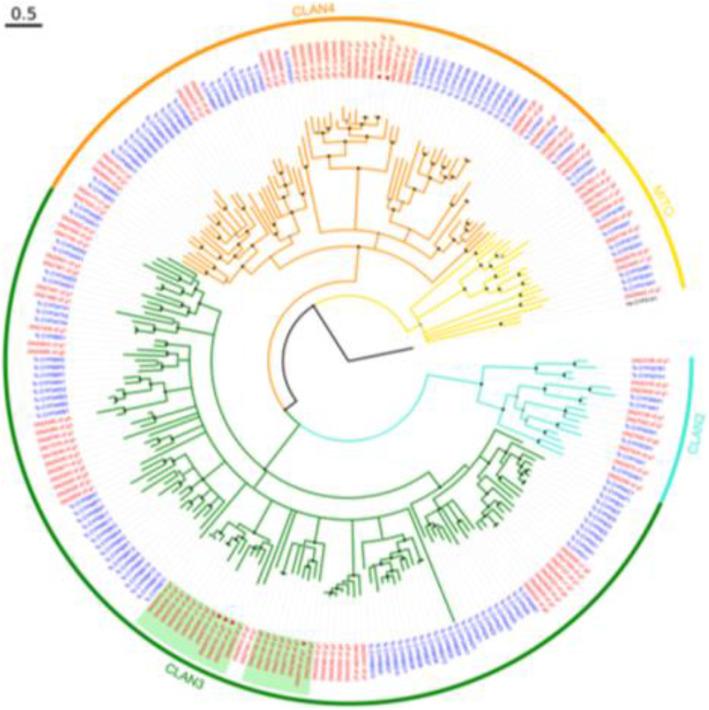
Transcriptome analysis of resistant and susceptible strains of this pest species identified a set of differentially expressed genes related to cytochrome P450s, indicating their potential role in resistance to s-methoprene. Laboratory bioassays were performed with s-methoprene treated wheat grains in presence and absence of piperonyl butoxide (PBO), a cytochrome P450 inhibitor. The results indicate that PBO, when applied alone, at least at the concentration tested here, had no effect on R. dominica adult emergence, but has a clear synergistic effect to s-methoprene. The number of produced progeny decreased in presence of the inhibitor, especially in the resistant strain. In addition, we also identified CYP complement (CYPome) of R. dominica, annotated and analysed phylogenetically, to understand the evolutionary relationships with other species.
CONCLUSIONS
The information generated in current study suggest that PBO can effectively be used to break resistance to s-methoprene in R. dominica.
背景
谷蠹是一种严重的储粮害虫,在全球范围内,熏蒸和接触性杀虫剂在防治这种害虫方面发挥着重要作用。虽然昆虫对化学物质的遗传抗性不断发展,但类似保幼激素的激素类似物在降低一般害虫压力以及管理对熏蒸剂和神经毒接触性杀虫剂具有抗性的害虫种群方面发挥着关键作用。然而,已经有报道称谷蠹对保幼激素产生了抗性,一些报道显示出了显著的高抗性,这使得人们对这种化合物以及其他相关类似物在谷物保护中的使用产生了质疑。本研究试图确定可能导致谷蠹对保幼激素产生抗性的分子机制。
结果
对该害虫物种的抗性和敏感品系进行的转录组分析鉴定了一组与细胞色素 P450 相关的差异表达基因,表明它们在对保幼激素的抗性中可能发挥作用。在有和没有增效醚(一种细胞色素 P450 抑制剂)的情况下,用保幼激素处理的小麦进行了实验室生物测定。结果表明,增效醚单独使用时,至少在本试验中测试的浓度下,对谷蠹成虫的出现没有影响,但与保幼激素有明显的增效作用。在抑制剂存在的情况下,产生的后代数量减少,尤其是在抗性品系中。此外,我们还鉴定了谷蠹的 CYP 基因(CYPome),并对其进行了注释和系统发育分析,以了解与其他物种的进化关系。
结论
本研究提供的信息表明,增效醚可有效用于打破谷蠹对保幼激素的抗性。


 Zotero 插件