EpiChron Research Group on Chronic Diseases, Aragón Health Sciences Institute (IACS), IIS Aragón, Miguel Servet University Hospital, Zaragoza, Spain.
Aragón Healthcare Service, San Pablo Health Centre, Zaragoza, Spain.
Int J Equity Health. 2021 Jan 20;20(1):41. doi: 10.1186/s12939-020-01373-3.
There is little verified information on global healthcare utilization by irregular migrants. Understanding how immigrants use healthcare services based on their needs is crucial to establish effective health policy. We compared healthcare utilization between irregular migrants, documented migrants, and Spanish nationals in a Spanish autonomous community.
This retrospective, observational study included the total adult population of Aragon, Spain: 930,131 Spanish nationals; 123,432 documented migrants; and 17,152 irregular migrants. Healthcare utilization data were compared between irregular migrants, documented migrants and Spanish nationals for the year 2011. Multivariable standard or zero-inflated negative binomial regression models were generated, adjusting for age, sex, length of stay, and morbidity burden.
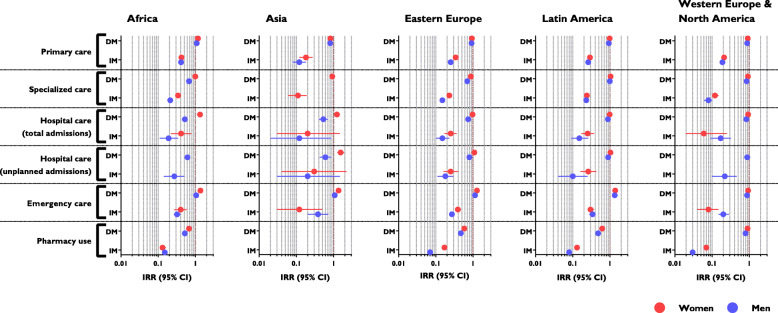
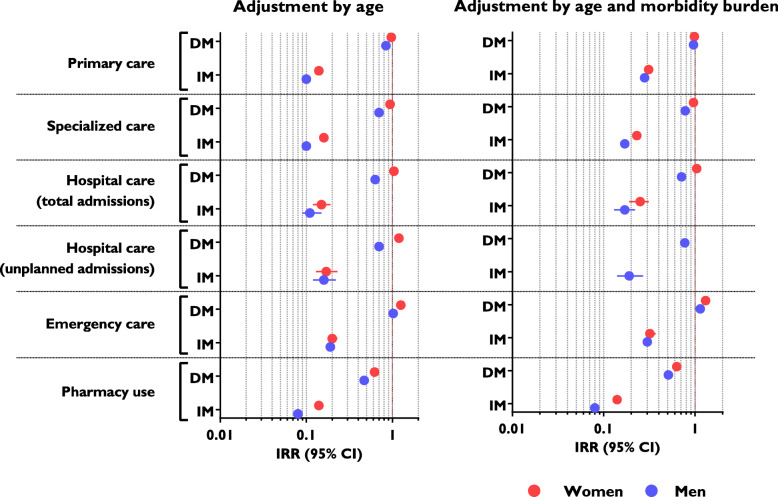
The average annual use of healthcare services was lower for irregular migrants than for documented migrants and Spanish nationals at all levels of care analyzed: primary care (0.5 vs 4 vs 6.7 visits); specialized care (0.2 vs 1.8 vs 2.9 visits); planned hospital admissions (0.3 vs 2 vs 4.23 per 100 individuals), unplanned hospital admissions (0.5 vs 3.5 vs 5.2 per 100 individuals), and emergency room visits (0.4 vs 2.8 vs 2.8 per 10 individuals). The average annual prescription drug expenditure was also lower for irregular migrants (€9) than for documented migrants (€77) and Spanish nationals (€367). These differences were only partially attenuated after adjusting for age, sex, and morbidity burden.
Under conditions of equal access, healthcare utilization is much lower among irregular migrants than Spanish nationals (and lower than that of documented migrants), regardless of country of origin or length of stay in Spain.
关于非正规移民在全球范围内的医疗保健利用情况,目前信息有限。了解移民如何根据自身需求使用医疗保健服务对于制定有效的卫生政策至关重要。我们比较了西班牙一个自治区的非正规移民、有文件记录的移民和西班牙国民的医疗保健利用情况。
这是一项回顾性、观察性研究,包括西班牙阿拉贡自治区的所有成年人口:930131 名西班牙国民;123432 名有文件记录的移民;17152 名非正规移民。比较了 2011 年非正规移民、有文件记录的移民和西班牙国民的医疗保健利用数据。针对所有分析的医疗保健级别,生成了多变量标准或零膨胀负二项回归模型,调整了年龄、性别、居留时间和发病负担。
在所有分析的医疗保健级别中,非正规移民的年平均医疗保健服务使用量均低于有文件记录的移民和西班牙国民:初级保健(0.5 次比 4 次比 6.7 次);专科保健(0.2 次比 1.8 次比 2.9 次);计划住院(0.3 次比 2 次比每 100 人 4.23 次);非计划住院(0.5 次比 3.5 次比每 100 人 5.2 次);急诊就诊(0.4 次比 2.8 次比每 10 人 2.8 次)。非正规移民的年平均处方药支出也较低(9 欧元),低于有文件记录的移民(77 欧元)和西班牙国民(367 欧元)。这些差异在调整了年龄、性别和发病负担后仅部分减弱。
在同等获得医疗保健服务的条件下,非正规移民的医疗保健利用率远低于西班牙国民(也低于有文件记录的移民),无论其原籍国或在西班牙的居留时间如何。