EpiChron Research Group on Chronic Diseases, Aragón Health Sciences Institute (IACS), IIS Aragón, Miguel Servet University Hospital, Zaragoza, Spain.
Aragón Healthcare Service, San Pablo Health Centre, Zaragoza, Spain.
Int J Equity Health. 2020 Jul 6;19(1):113. doi: 10.1186/s12939-020-01225-0.
There is little verified information on the global health status of undocumented migrants (UMs). Our aim is to compare the prevalence of the main chronic diseases and of multimorbidity in undocumented migrants, documented migrants, and Spanish nationals in a Spanish autonomous community.
Retrospective observational study of all users of the public health system of the region of Aragon over 1 year (2011): 930,131 Spanish nationals; 123,432 documented migrants (DMs); and 17,152 UMs. Binary logistic regression was performed to examine the association between migrant status (Spanish nationals versus DMs and UMs) and both multimorbidity and individual chronic diseases, adjusting for age and sex.
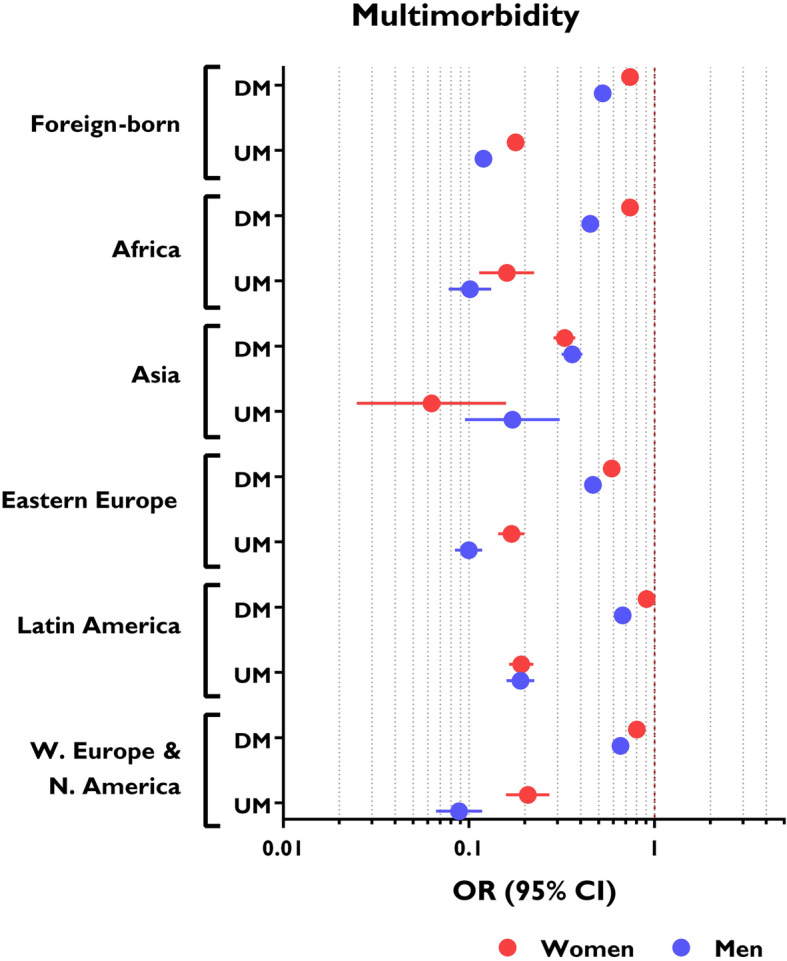
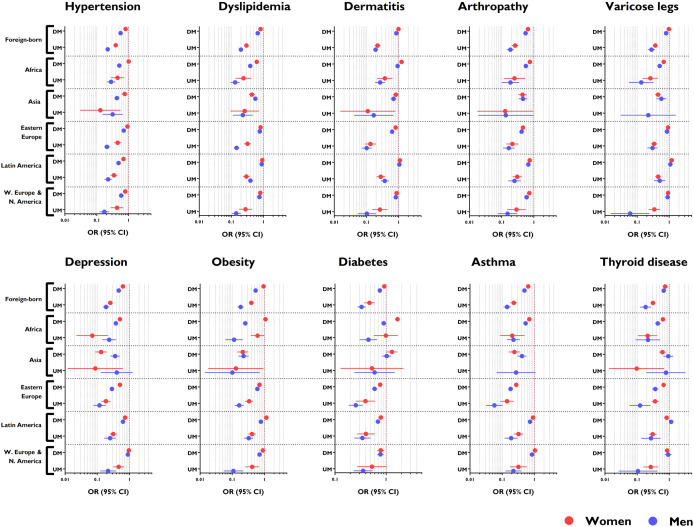
The prevalence of individual chronic diseases in UMs was lower than in DMs and much lower than in Spanish nationals. Comparison with the corresponding group of Spanish nationals revealed odds ratios (OR) of 0.1-0.3 and 0.3-0.5 for male and female UMs, respectively (p < 0.05 in all cases). The risk of multimorbidity was lower for UMs than DMs, both for men (OR, 0.12; 95%CI 0.11-0.13 versus OR, 0.53; 95%CI 0.51-0.54) and women (OR, 0.18; 95%CI 0.16-0.20 versus OR, 0.74; 95%CI 0.72-0.75).
Analysis of data from a health system that offers universal coverage to all immigrants, irrespective of legal status, reveals that the prevalence of chronic disease and multimorbidity is lower in UMs as compared with both DMs and Spanish nationals. These findings refute previous claims that the morbidity burden in UM populations is higher than that of the native population of the host country.
关于无证移民(UMs)的全球健康状况,我们掌握的验证信息很少。我们的目的是在西班牙一个自治区内,比较无证移民、有证移民和西班牙国民的主要慢性病患病率和多种疾病患病率。
这是一项回顾性观察性研究,纳入了该地区公共卫生系统在 1 年内(2011 年)的所有使用者:930131 名西班牙国民、123432 名有证移民(DMs)和 17152 名无证移民。采用二元逻辑回归分析方法,研究移民身份(西班牙国民与 DMs 和 UMs)与多种疾病和个体慢性病之间的关联,调整了年龄和性别因素。
UMs 个体慢性病的患病率低于 DMs,远低于西班牙国民。与相应的西班牙国民组相比,男性和女性 UMs 的比值比(OR)分别为 0.1-0.3 和 0.3-0.5(所有病例均 p<0.05)。与 DMs 相比,UMs 的多种疾病患病风险较低,男性(OR,0.12;95%CI,0.11-0.13 与 OR,0.53;95%CI,0.51-0.54)和女性(OR,0.18;95%CI,0.16-0.20 与 OR,0.74;95%CI,0.72-0.75)均如此。
对一个向所有移民提供普遍覆盖的卫生系统的数据进行分析后发现,与 DMs 和西班牙国民相比,UMs 的慢性病和多种疾病患病率较低。这些发现驳斥了先前有关 UM 人群发病率负担高于东道国本地人口的说法。