The Galilee Society, the Arab National Society for Health Research & Services, PO, Box 330, 20190200, Shefa-'Amr, Israel.
Department of multidisciplinary studies, Ben-Gurion University of the Negev, Be'e Sheva, Israel.
Isr J Health Policy Res. 2021 Jan 20;10(1):3. doi: 10.1186/s13584-021-00439-z.
Psychological distress is a problem strongly associated with socio-economic conditions. This study aims to assess rates of psychological distress and 'poor' self-rated health among Palestinian citizens of Israel, who constitute 21% of the population and nearly 50% live in poverty, and compare their psychological distress scores with those of the general Israeli population.
The Health and Environment Survey among Palestinian citizens of Israel (HESPI-2015), included a representative sample of this minority; 2018 individuals aged ≥18 were interviewed. The questionnaire included socio-demographic and health-related information, the General Health Questionnaire-12, (GHQ-12) and Self-rating of health (SRH).
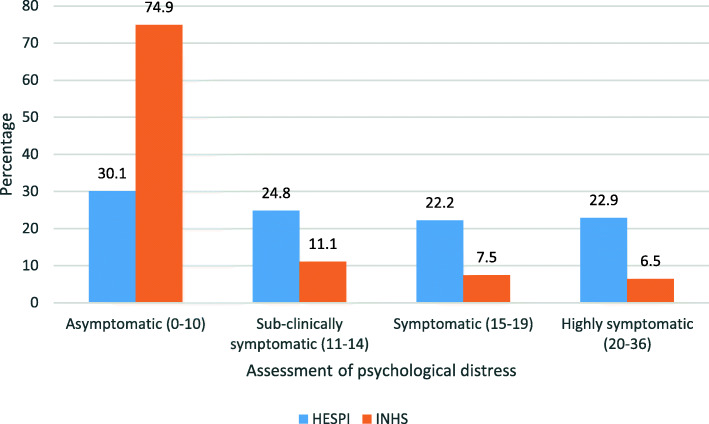
Subjects with GHQ-12 global scores of ≥17 were considered to have high distress. Low education, female gender, obesity and the presence of chronic diseases were significantly associated with high psychological distress over and above the effect of the other variables. Poor SRH was strongly associated with having a chronic disease and additional risk factors were older age group, low education and high psychological distress. Comparing psychological distress scores of Arabs in Israel with those of the general population showed that 30% of the former were classified as asymptomatic, as compared to 75% in the general population while the proportion of symptomatic or highly symptomatic was 14% in the latter as compared with 45% in the former.
It appears that the burden of poverty, chronic disease and low education in this population, which suffers from multiple stressors, is disproportionate and should be addressed by the authorities, together with concrete plans to improve the education of the younger generations. Clearly, the association between discriminating policies and deprivation with psychological distress is not unique to the case of the Palestinian minority in Israel and therefore this study will allow for the examination and generalization of the current findings to other discriminated and disadvantaged minorities.
心理困扰是与社会经济状况密切相关的问题。本研究旨在评估以色列巴勒斯坦公民的心理困扰率和“较差”的自我报告健康状况,他们占人口的 21%,近 50%生活贫困,并将他们的心理困扰评分与以色列一般人口进行比较。
以色列巴勒斯坦公民健康和环境调查(HESPI-2015)纳入了该少数群体的代表性样本;2018 年对≥18 岁的个体进行了访谈。问卷包括社会人口统计学和与健康相关的信息、一般健康问卷-12(GHQ-12)和自我报告的健康状况(SRH)。
GHQ-12 全球评分≥17 的受试者被认为有高度困扰。低教育程度、女性、肥胖和慢性病的存在与其他变量的影响相比,与高度心理困扰显著相关。较差的 SRH 与患有慢性病密切相关,其他风险因素为年龄较大、教育程度较低和高度心理困扰。将以色列阿拉伯人的心理困扰评分与一般人群进行比较,发现前者有 30%被归类为无症状,而后者有 75%;后者有 14%被归类为有症状或高度有症状,而前者有 45%。
看来,在这个遭受多种压力的人群中,贫困、慢性病和低教育程度的负担不成比例,当局应与改善年轻一代教育的具体计划一起解决这一问题。显然,歧视政策和贫困与心理困扰之间的关联并非以色列巴勒斯坦少数民族所独有,因此,本研究将允许对当前发现进行审查和推广,以适用于其他受歧视和处于不利地位的少数民族。