
荷兰新诊断外周动脉疾病的血小板聚集抑制剂处方:一项队列研究。
Platelet aggregation inhibitor prescription for newly diagnosed peripheral arterial disease in the Netherlands: a cohort study.
作者信息
Brand Aarent Rt, Houben Eline, Bezemer Irene D, Visseren Frank L J, Bots Michiel L, Herings Ron Mc, de Borst Gert-Jan
机构信息
Department of Vascular Surgery, University Medical Center Utrecht, Utrecht, The Netherlands.
PHARMO Institute, PHARMO Institute for Drug Outcomes Research, Utrecht, The Netherlands.
出版信息
BMJ Open. 2021 Jan 20;11(1):e041715. doi: 10.1136/bmjopen-2020-041715.
OBJECTIVES
Pharmacological treatment of peripheral arterial disease (PAD) comprises of antiplatelet therapy (APT), blood pressure control and cholesterol optimisation. Guidelines provide class-I recommendations on the prescription, but there are little data on the actual prescription practices. Our study provides insight into the prescription of medication among patients with PAD in the Netherlands and reports a 'real-world' patient journey through primary and secondary care.
DESIGN
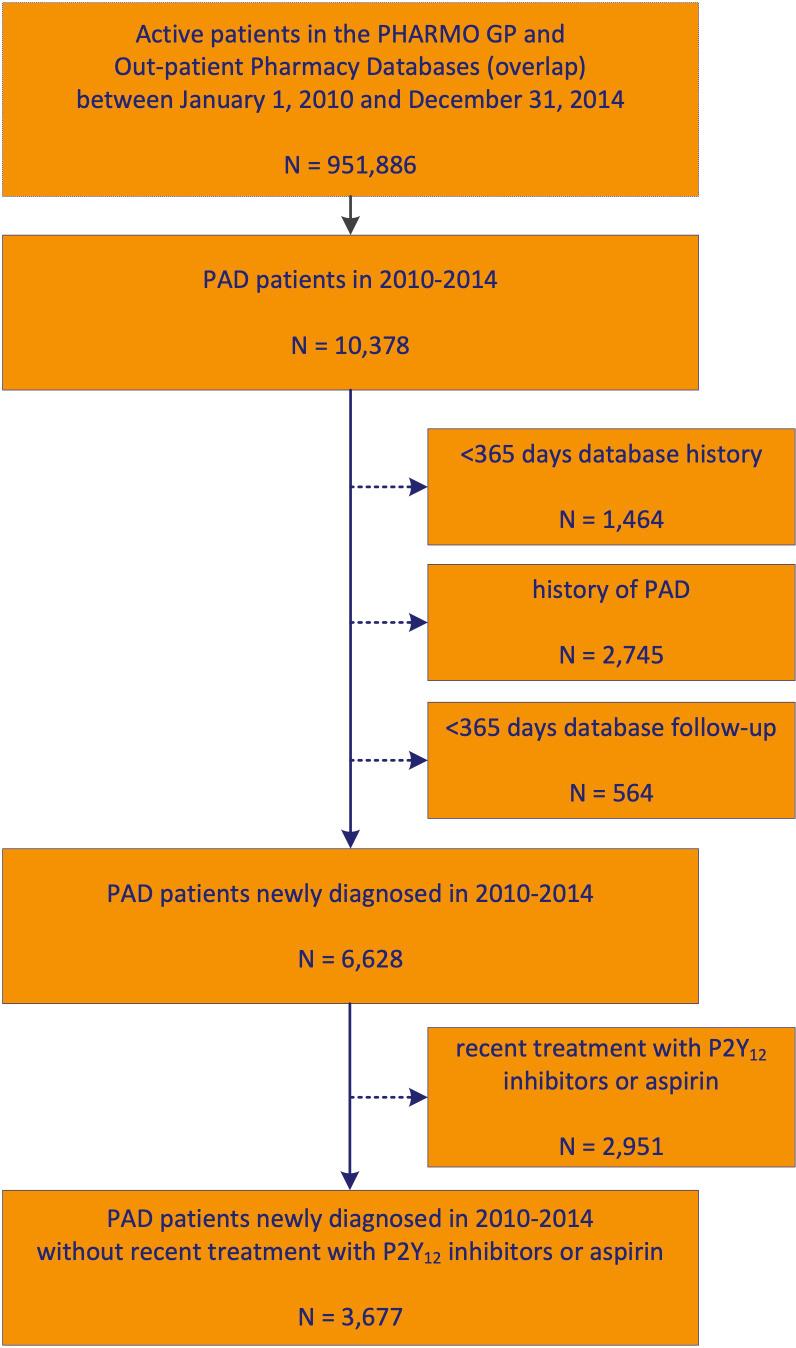
We conducted a cohort study among patients newly diagnosed with PAD between 2010 and 2014.
SETTING
Data were obtained from the PHARMO Database Network, a population-based network of electronic pharmacy, primary and secondary healthcare setting records in the Netherlands. The source population for this study comprised almost 1 million individuals.
PARTICIPANTS
'Newly diagnosed' was defined as a recorded International Classification of Primary Care code for PAD, a PAD-specific WCIA examination code or a diagnosis recorded as free text episode in the general practitioner records with no previous PAD diagnosis record and no prescription of P2Y12 inhibitors or aspirin the preceding year. The patient journey was defined by at least 1 year of database history and follow-up relative to the index date.
RESULTS
Between 2010 and 2014, we identified 3677 newly diagnosed patients with PAD. Most patients (91%) were diagnosed in primary care. Almost half of all patients (49%) had no APT dispensing record. Within this group, 33% received other anticoagulant therapy (vitamin K antagonist or direct oral anticoagulant). Mono-APT was dispensed as aspirin (40% of patients) or P2Y12 inhibitors (2.5% of patients). Dual APT combining aspirin with a P2Y12 inhibitor was dispensed to 8.5% of the study population.
CONCLUSION
Half of all patients with newly diagnosed PAD are not treated conforming to (international) guideline recommendations on thromboembolism prevention through APT. At least 33% of all patients with newly diagnosed PAD do not receive any antithrombotic therapy. Evaluation and improvement of APT prescription and thereby improved prevention of (secondary) cardiovascular events is warranted.
目的
外周动脉疾病(PAD)的药物治疗包括抗血小板治疗(APT)、血压控制和胆固醇优化。指南对用药处方给出了I类推荐,但关于实际处方情况的数据却很少。我们的研究深入了解了荷兰PAD患者的药物处方情况,并报告了患者在初级和二级医疗保健中的“真实世界”就医历程。
设计
我们对2010年至2014年间新诊断为PAD的患者进行了一项队列研究。
背景
数据来自PHARMO数据库网络,这是一个基于荷兰人口的电子药房、初级和二级医疗保健记录网络。本研究的源人群包括近100万人。
参与者
“新诊断”定义为记录有PAD的国际初级保健分类代码、特定于PAD的WCIA检查代码,或在全科医生记录中作为自由文本事件记录的诊断,且前一年没有PAD诊断记录且未开具P2Y12抑制剂或阿司匹林处方。患者就医历程定义为相对于索引日期至少1年的数据库历史记录和随访。
结果
2010年至2014年间,我们确定了3677例新诊断的PAD患者。大多数患者(91%)在初级医疗保健中被诊断。几乎一半的患者(49%)没有APT配药记录。在这一组中,33%接受了其他抗凝治疗(维生素K拮抗剂或直接口服抗凝剂)。单一APT以阿司匹林(40%的患者)或P2Y12抑制剂(2.5%的患者)的形式配药。将阿司匹林与P2Y12抑制剂联合使用的双重APT配发给了8.5%的研究人群。
结论
所有新诊断的PAD患者中有一半未按照(国际)指南关于通过APT预防血栓栓塞的建议进行治疗。所有新诊断的PAD患者中至少33%未接受任何抗血栓治疗。有必要评估和改进APT处方,从而更好地预防(继发性)心血管事件。



 Zotero 插件