Michel Margaret C, Thal Arielle, Sparks Andrew D, Zapanta Philip E
Fourth-Year Medical Student, George Washington University School of Medicine and Health Sciences.
Fourth-Year Resident, Department of Otolaryngology, Montefiore Medical Center.
MedEdPORTAL. 2021 Jan 15;17:11065. doi: 10.15766/mep_2374-8265.11065.
A quarter of all complaints seen in adult primary care and half of all complaints seen in pediatric primary care are otolaryngology related. Even though half of all medical students enter primary care fields, there is no standardized curriculum for otolaryngology during medical school. Due to increasing limitations on specialty teaching during general medical education, computer-assisted instruction has been suggested as a format for increasing exposure to otolaryngology.
We designed a computer-based learning module for teaching high-yield otolaryngology topics for third- and fourth-year medical students during their primary care clerkship at our institution from 2016-2018. We evaluated students' prior otolaryngology knowledge with 11 case-based, multiple-choice questions and then evaluated the efficacy of the module by a similar posttest.
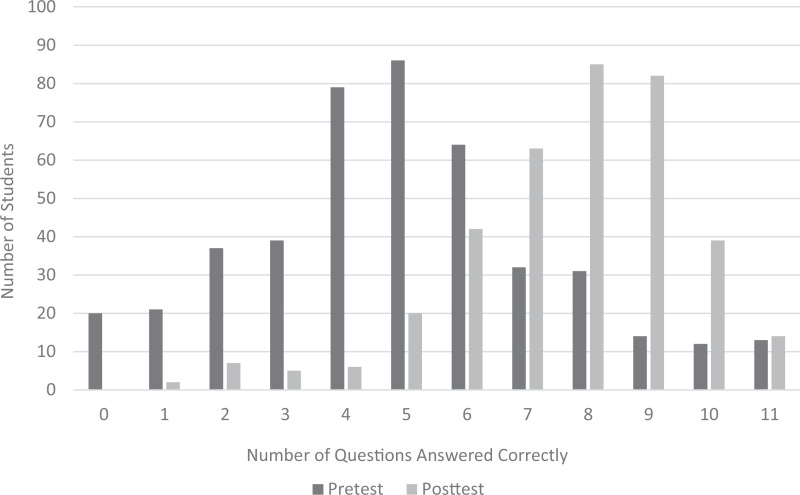
Three-hundred and sixty-five students completed the module. The average pre- and posttest scores were 44% ( = 21%) and 70% ( = 17%), respectively, showing that the module resulted in significantly increased scores ( < .01).
The improvement of test scores indicates that this module was an effective educational intervention at our institution for increasing exposure and improving otolaryngology knowledge in third- and fourth-year medical students. As medical schools shift toward adult learning principles such as independent and self-directed learning, computer-assisted instruction is an alternative to classroom-based didactics. Creating resources for independent study will allow more time for otolaryngology faculty and residents to teach clinical exam skills and interactive case-based discussions, which are less suitable to teach via computer-assisted instruction.
在成人初级保健中出现的所有投诉中,四分之一与耳鼻喉科相关;在儿科初级保健中出现的所有投诉中,一半与耳鼻喉科相关。尽管有一半的医学生进入初级保健领域,但医学院期间并没有标准化的耳鼻喉科课程。由于普通医学教育中专科教学的限制日益增加,有人建议采用计算机辅助教学的形式来增加对耳鼻喉科的接触。
我们设计了一个基于计算机的学习模块,用于在2016 - 2018年期间,为我校三、四年级医学生在初级保健实习期间教授耳鼻喉科的高收益主题。我们用11个基于病例的多项选择题评估了学生之前的耳鼻喉科知识,然后通过类似的后测评估了该模块的效果。
365名学生完成了该模块。前测和后测的平均分数分别为44%(标准差 = 21%)和70%(标准差 = 17%),表明该模块使分数显著提高(P <.01)。
考试分数的提高表明,该模块在我校是一种有效的教育干预措施,可增加三、四年级医学生对耳鼻喉科的接触并提高其耳鼻喉科知识。随着医学院校转向成人学习原则,如自主和自我导向学习,计算机辅助教学是基于课堂教学的一种替代方式。创建自主学习资源将使耳鼻喉科教师和住院医师有更多时间教授临床检查技能和基于病例的互动讨论,而这些不太适合通过计算机辅助教学来教授。