Shen Xin, Song Jun, Meng Xueping, Tian Mei, Yan Binlun, Cheng Hanliang, Cai Yuling, Zhao Jun
Jiangsu Key Laboratory of Marine Biotechnology, Jiangsu Institute of Marine Resources, Lianyungang, P.R. China.
College of Marine Science, Huaihai Institute of Technology, Lianyungang, P.R. China.
Mitochondrial DNA B Resour. 2016 Jul 23;1(1):525-527. doi: 10.1080/23802359.2016.1197064.
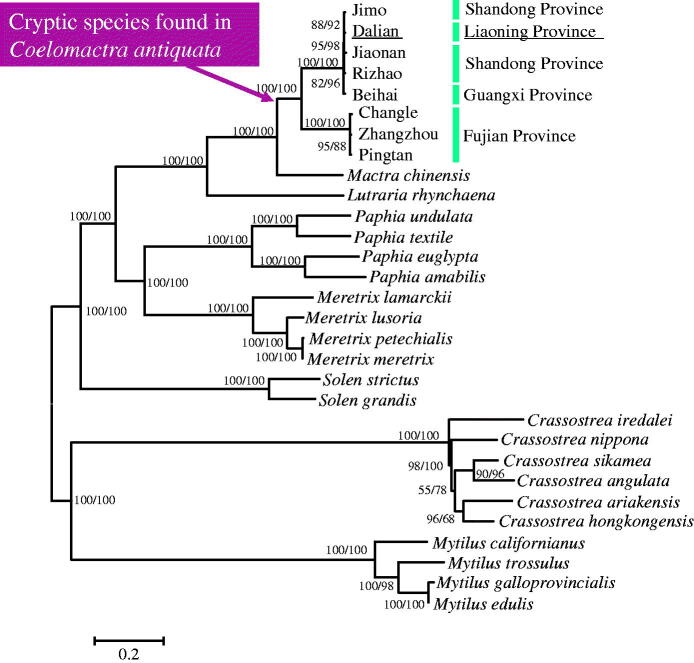
is a famous delicacy and a promising new candidate for aquaculture, which belongs to the family Mactridae (Mollusca: Veneroida). The complete mitochondrial genome of (Liao Ning province, in China, LN) was finished, which is the first representative from this province. The results showed that the total length of LN-mtDNA sequence is 16,797 bp and the content of A + T is 65.01%. It encodes 35 genes, including 12 protein-coding genes, 21 transfer RNA genes and two ribosomal RNA genes. All coding genes are encoded on the heavy strand. Compared with the typical gene content of animal mitochondrial genomes, and genes are missing in the mitochondrial genome. The complete mitochondrial genome contains 26 non-coding regions (1598 bp), one major non-coding region consists of 1046 bp in which 4.9 tandem repeat sequences (99bp per sequence) was observed. The phylogenetic tree showed that Liaoning population was clustered into one clade with Shandong (Rizhao, Jiaonan and Jimo) and Guangxi (Beihai) populations, meanwhile all of them are far from the Fujian populations (Pingtan, Zhangzhou and Changle). So, Liaoning, Shandong and Guangxi populations have a close relationship. Actually, Fujian is located between Liaoning, Shandong and Guangxi. So, the result challenges the previously assumed relevance between geographic distance and genetic distance. The genetic distance of Liaoning and Fujian (Changle, Zhangzhou and Pingtan) (0.176-0.177) is greater than the genetic distance between and (0.160). The genetic difference of Liaoning population and Fujian populations has reached species level.
是一种著名的美食,也是水产养殖中一个有前景的新候选品种,属于蛤蜊科(软体动物门:帘蛤目)。完成了(中国辽宁省,辽宁)的完整线粒体基因组测序,这是该省的首个代表性样本。结果表明,辽宁线粒体DNA序列全长16797 bp,A+T含量为65.01%。它编码35个基因,包括12个蛋白质编码基因、21个转运RNA基因和两个核糖体RNA基因。所有编码基因都在重链上编码。与动物线粒体基因组的典型基因组成相比,线粒体基因组中缺少和基因。完整的线粒体基因组包含26个非编码区(1598 bp),一个主要非编码区长1046 bp,其中观察到4.9个串联重复序列(每个序列99 bp)。系统发育树显示,辽宁种群与山东(日照、胶南和即墨)和广西(北海)种群聚为一个分支,同时它们都与福建种群(平潭、漳州和长乐)相距较远。所以,辽宁、山东和广西种群关系密切。实际上,福建位于辽宁、山东和广西之间。因此,这一结果挑战了先前假设的地理距离与遗传距离之间的相关性。辽宁与福建(长乐、漳州和平潭)的遗传距离(0.176 - 0.177)大于与之间的遗传距离(0.160)。辽宁种群与福建种群的遗传差异已达到种级水平。