Department of Nutrition and Movement Sciences, NUTRIM School for Nutrition and Translational Research in Metabolism, Maastricht University Medical Centre+, Maastricht, The Netherlands.
Department of Animal Sciences, Division of Human and Animal Physiology, Wageningen University, Wageningen, The Netherlands.
Physiol Rep. 2021 Jan;9(2):e14692. doi: 10.14814/phy2.14692.
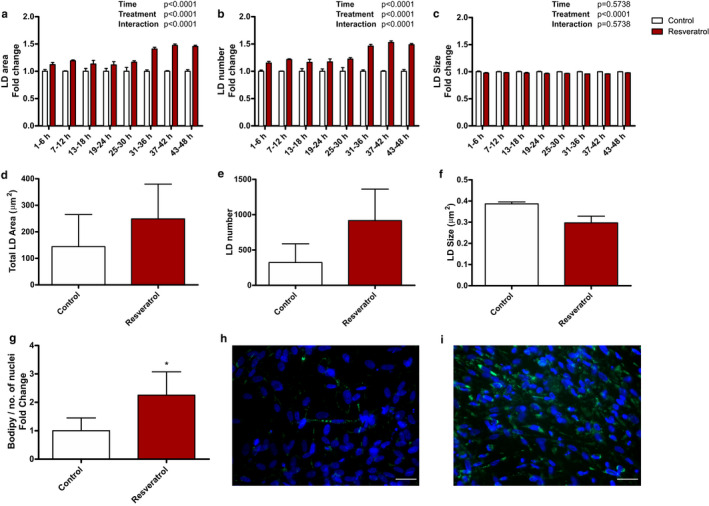
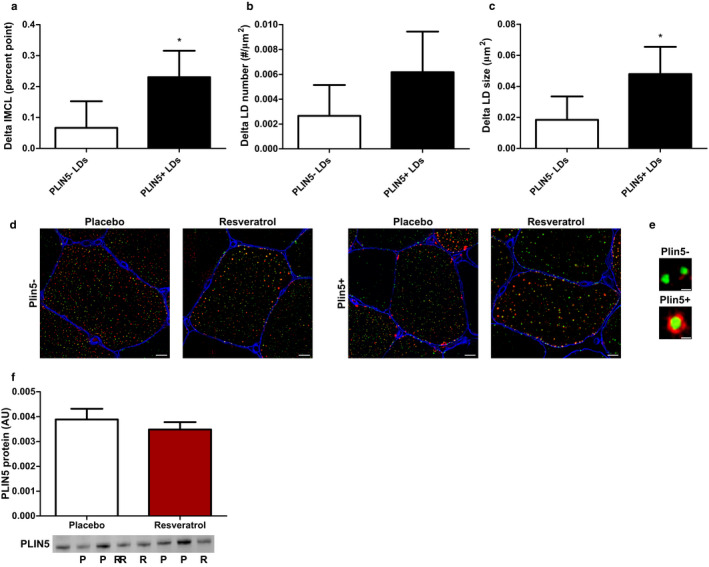
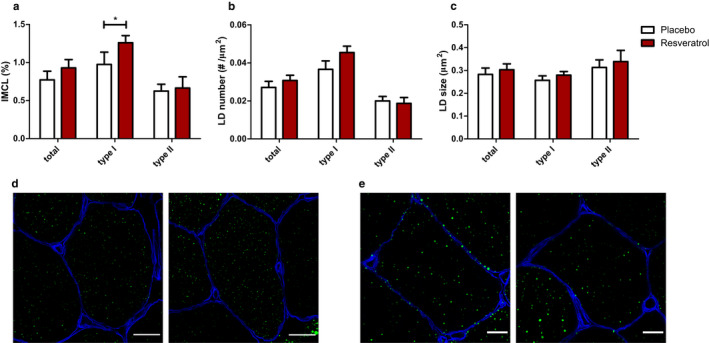
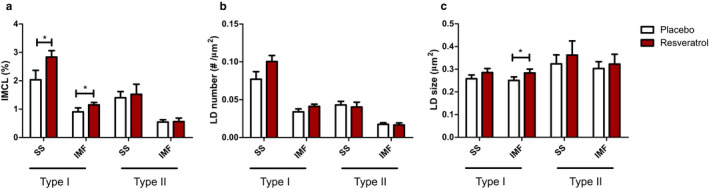
In non-athletes, insulin sensitivity correlates negatively with intramyocellular lipid (IMCL) content. In athletes, however, a pattern of benign IMCL storage exists, which is characterized by lipid storage in type I muscle fibres, in small and numerous lipid droplets (LDs) preferable coated with PLIN5, without affecting insulin sensitivity. Administration of resveratrol has been promoted for its beneficial effects on glucose homeostasis. We observed that 30 days of oral resveratrol administration (150 mg/day) in metabolically compromised individuals showed a 33% increase in IMCL (placebo vs. resveratrol; 0.86 ± 0.090 AU vs. 1.14 ± 0.11 AU, p = 0.003) without impeding insulin sensitivity. Thus, the aim of the present study was to examine if a resveratrol-mediated increase in IMCL content, in metabolically compromised individuals, changes the LD phenotype towards the phenotype we previously observed in athletes. For this, we studied IMCL, LD number, LD size, subcellular distribution and PLIN5 coating in different fibre types using high-resolution confocal microscopy. As proof of concept, we observed a 2.3-fold increase (p = 0.038) in lipid accumulation after 48 h of resveratrol incubation in cultured human primary muscle cells. In vivo analysis showed that resveratrol-induced increase in IMCL is predominantly in type I muscle fibres (placebo vs. resveratrol; 0.97 ± 0.16% vs. 1.26 ± 0.09%; p = 0.030) in both the subsarcolemmal (p = 0.016) and intermyofibrillar region (p = 0.026) and particularly in PLIN5-coated LDs (p = 0.024). These data indicate that administration of resveratrol augments IMCL content in metabolically compromised individuals towards a LD phenotype that mimics an 'athlete like phenotype'.
在非运动员中,胰岛素敏感性与肌内脂质(IMCL)含量呈负相关。然而,在运动员中,存在良性的 IMCL 储存模式,其特征是脂质储存在 I 型肌纤维中,小而多的脂质滴(LD)最好被 PLIN5 包裹,而不影响胰岛素敏感性。白藜芦醇的应用因其对葡萄糖稳态的有益影响而受到推崇。我们观察到,在代谢受损的个体中,30 天口服白藜芦醇(150mg/天)治疗可使 IMCL 增加 33%(安慰剂与白藜芦醇相比;0.86±0.090AU 与 1.14±0.11AU,p=0.003),而不影响胰岛素敏感性。因此,本研究旨在探讨在代谢受损的个体中,白藜芦醇介导的 IMCL 含量增加是否会使 LD 表型向我们之前在运动员中观察到的表型转变。为此,我们使用高分辨率共焦显微镜研究了不同纤维类型的 IMCL、LD 数量、LD 大小、亚细胞分布和 PLIN5 包裹。作为概念验证,我们观察到在培养的人原代肌肉细胞中,白藜芦醇孵育 48 小时后,脂质积累增加了 2.3 倍(p=0.038)。体内分析表明,白藜芦醇诱导的 IMCL 增加主要发生在 I 型肌纤维中(安慰剂与白藜芦醇相比;0.97±0.16%与 1.26±0.09%;p=0.030),无论是在肌小节下(p=0.016)还是在肌纤维间区域(p=0.026),特别是在被 PLIN5 包裹的 LD 中(p=0.024)。这些数据表明,在代谢受损的个体中,白藜芦醇的应用可使 IMCL 含量增加,使其 LD 表型类似于“运动员样表型”。