Keck Graduate Institute, Claremont, California, USA.
Molecular Genomics Core, University of Southern California, Los Angeles, California, USA.
Hum Mutat. 2021 Mar;42(3):237-245. doi: 10.1002/humu.24166. Epub 2021 Feb 2.
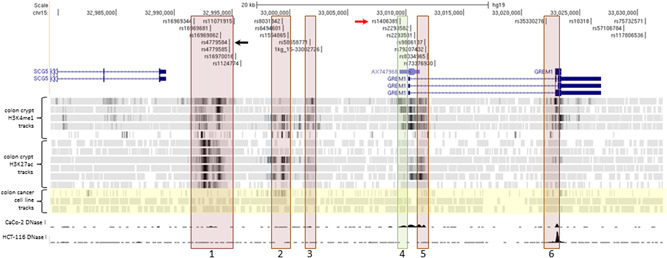
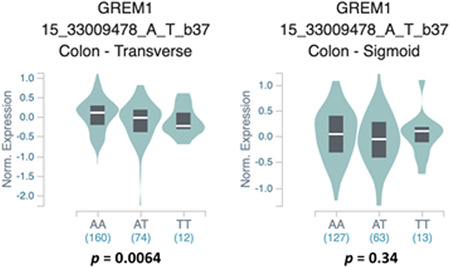
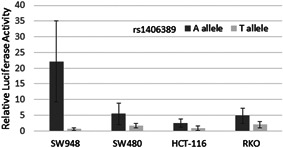
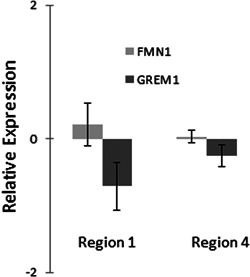
Several genome wide association studies of colorectal cancer (CRC) have identified single nucleotide polymorphisms (SNPs) on chromosome 15q13.3 associated with CRC risk. To identify functional variant(s) underlying this association, we investigated SNPs in linkage disequilibrium with the risk-associated SNP rs4779584 that overlapped regulatory regions/enhancer elements characterized in colon-related tissues and cells. We identified several SNP-containing regulatory regions that exhibited enhancer activity in vitro, including one SNP (rs1406389) that correlated with allele-specific effects on enhancer activity. Deletion of either this enhancer or another enhancer that had previously been reported in this region correlated with decreased expression of GREM1 following CRISPR/Cas9 genome editing. That GREM1 is one target of these enhancers was further supported by an expression quantitative trait loci correlation between rs1406389 and GREM1 expression in the transverse but not sigmoid colon in the Genotype-Tissue Expression dataset. Taken together, we conclude that the 15q13.3 region contains at least two functional variants that map to distinct enhancers and impact CRC risk through modulation of GREM1 expression.
几项结直肠癌(CRC)的全基因组关联研究已经确定了位于 15q13.3 染色体上与 CRC 风险相关的单核苷酸多态性(SNP)。为了确定该关联背后的功能变异,我们研究了与风险相关的 SNP rs4779584 连锁不平衡的 SNPs,这些 SNP 重叠了在结肠相关组织和细胞中特征化的调控区域/增强子元件。我们鉴定了几个含有 SNP 的调控区域,这些区域在体外表现出增强子活性,包括一个 SNP(rs1406389),其与增强子活性的等位基因特异性效应相关。该增强子或该区域先前报道的另一个增强子的缺失与 CRISPR/Cas9 基因组编辑后 GREM1 的表达降低相关。该增强子的一个靶点是 GREM1,这进一步得到了在 Genotype-Tissue Expression 数据集中转肠而非乙状结肠中 rs1406389 与 GREM1 表达之间的表达数量性状基因座相关性的支持。综上所述,我们得出结论,15q13.3 区域至少包含两个功能变体,这些变体映射到不同的增强子上,并通过调节 GREM1 的表达来影响 CRC 的风险。