Lin Yiting, Amornkitbamrung Lunjakorn, Mora Phattarin, Jubsilp Chanchira, Hemvichian Kasinee, Soottitantawat Apinan, Ekgasit Sanong, Rimdusit Sarawut
Research Unit in Polymeric Materials for Medical Practice Devices, Department of Chemical Engineering, Faculty of Engineering, Chulalongkorn University, Bangkok 10330, Thailand.
Department of Chemical Engineering, Faculty of Engineering, Srinakharinwirot University, Nakhonnayok 26120, Thailand.
Polymers (Basel). 2021 Jan 18;13(2):289. doi: 10.3390/polym13020289.
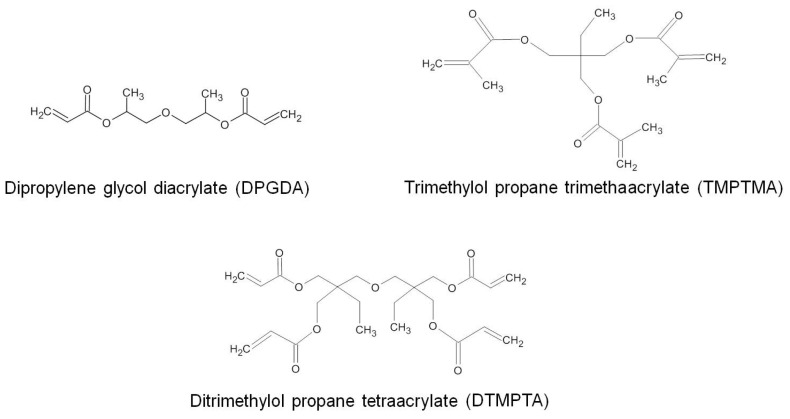
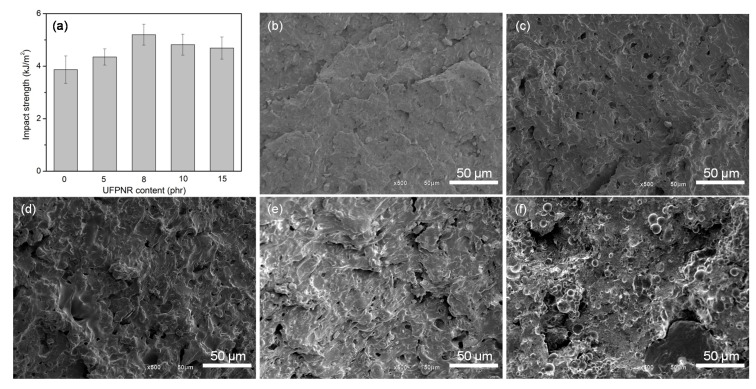
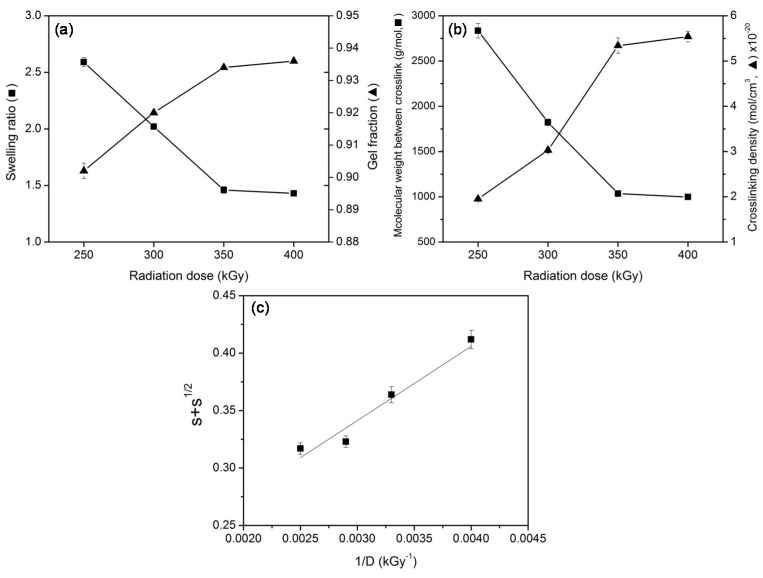
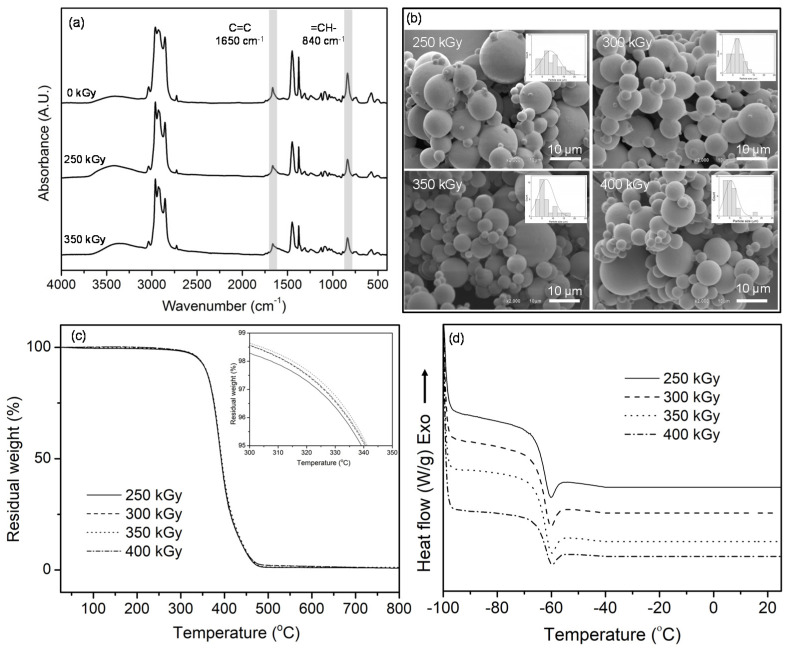
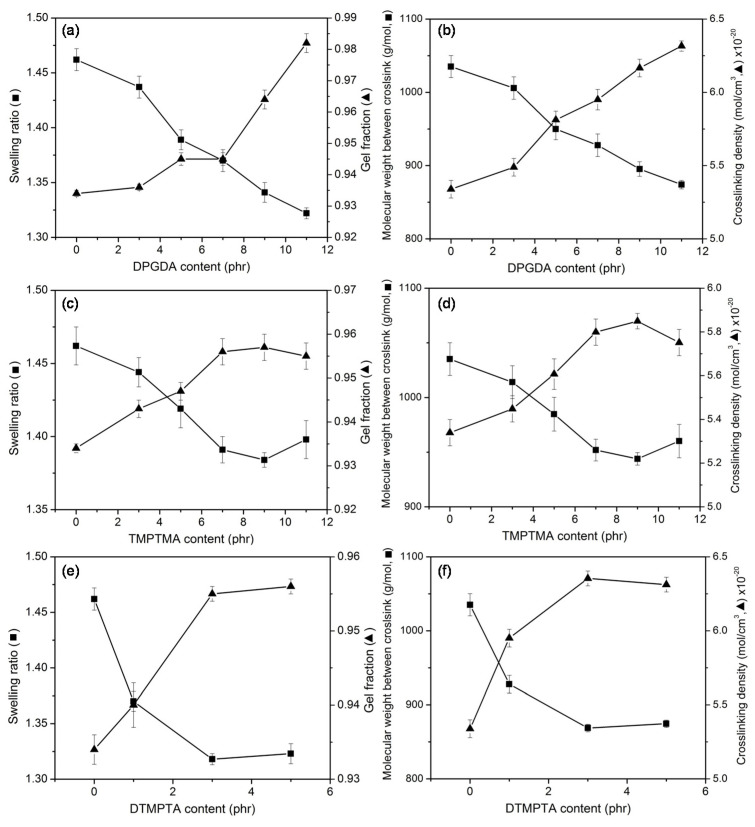
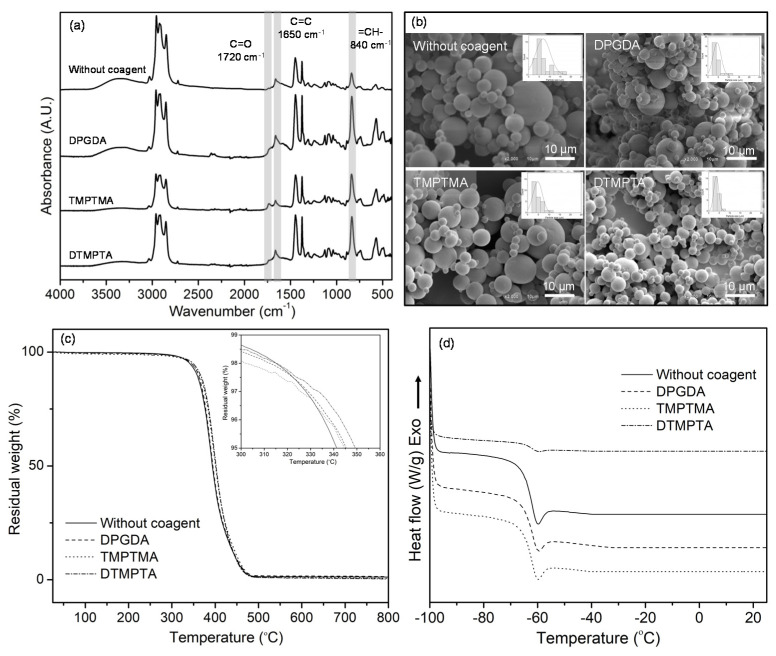
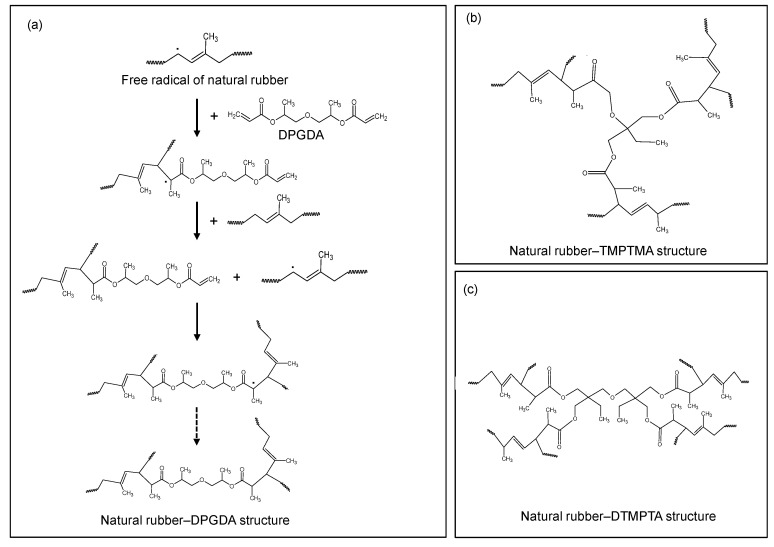
Ultrafine fully vulcanized powdered natural rubber (UFPNR) has a promising application as a renewable toughening modifier in polymer matrices. In this work, the effects of acrylate coagents, which had different amounts of functional groups, on properties of UFPNR produced by radiation vulcanization and spray-drying was systematically investigated for the first time. Dipropylene glycol diacrylate (DPGDA), trimethylol propane trimethaacrylate (TMPTMA), and ditrimethylol propane tetraacrylate (DTMPTA) were used as coagents with two, three, and four acrylate groups, respectively. The radiation in the range of 250 to 400 kGy and coagent contents of up to 11 phr were used in the production process. Physical, chemical, and thermal properties of the UFPNR were characterized by swelling analysis, scanning electron microscopy, infrared spectroscopy, thermogravimetric analysis, and differential scanning calorimetry. The properties of UFPNR produced by using different type and content of coagents were compared and discussed. The results revealed that UFPNR with the smallest particle size of 3.6 ± 1.1 μm and the highest thermal stability (Td5 = 349 °C) could be obtained by using DTMPTA, which had the highest amount of functional group. It was proposed that the coagent with the greater number of acrylate groups enhanced the crosslinking of natural rubber as it had more reactive groups. Finally, an application of UFPNR as a toughening filler in rigid PVC was demonstrated with 34% improvement of impact strength.
超细全硫化粉末天然橡胶(UFPNR)作为聚合物基体中的可再生增韧改性剂具有广阔的应用前景。在本工作中,首次系统研究了具有不同官能团数量的丙烯酸酯类助交联剂对辐射硫化和喷雾干燥制备的UFPNR性能的影响。分别使用二丙二醇二丙烯酸酯(DPGDA)、三羟甲基丙烷三甲基丙烯酸酯(TMPTMA)和二(三羟甲基丙烷)四丙烯酸酯(DTMPTA)作为具有两个、三个和四个丙烯酸酯基团的助交联剂。生产过程中使用了250至400 kGy的辐射剂量和高达11 phr的助交联剂含量。通过溶胀分析、扫描电子显微镜、红外光谱、热重分析和差示扫描量热法对UFPNR的物理、化学和热性能进行了表征。比较并讨论了使用不同类型和含量助交联剂制备的UFPNR的性能。结果表明,使用官能团数量最多的DTMPTA可获得粒径最小为3.6±1.1μm且热稳定性最高(Td5 = 349°C)的UFPNR。提出丙烯酸酯基团数量较多的助交联剂由于具有更多的反应性基团而增强了天然橡胶的交联。最后,展示了UFPNR作为硬质PVC增韧填料的应用,冲击强度提高了34%。