Muz Barbara, Abdelghafer Anas, Markovic Matea, Yavner Jessica, Melam Anupama, Salama Noha Nabil, Azab Abdel Kareem
Department of Radiation Oncology, Cancer Biology Division, Washington University in St. Louis School of Medicine, St. Louis, MO 63108, USA.
Department of Pharmaceutical and Administrative Sciences, St. Louis College of Pharmacy, University of Health Sciences and Pharmacy in St. Louis, St. Louis, MO 63110, USA.
Cancers (Basel). 2021 Jan 18;13(2):335. doi: 10.3390/cancers13020335.
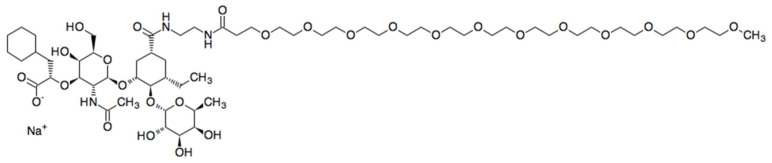
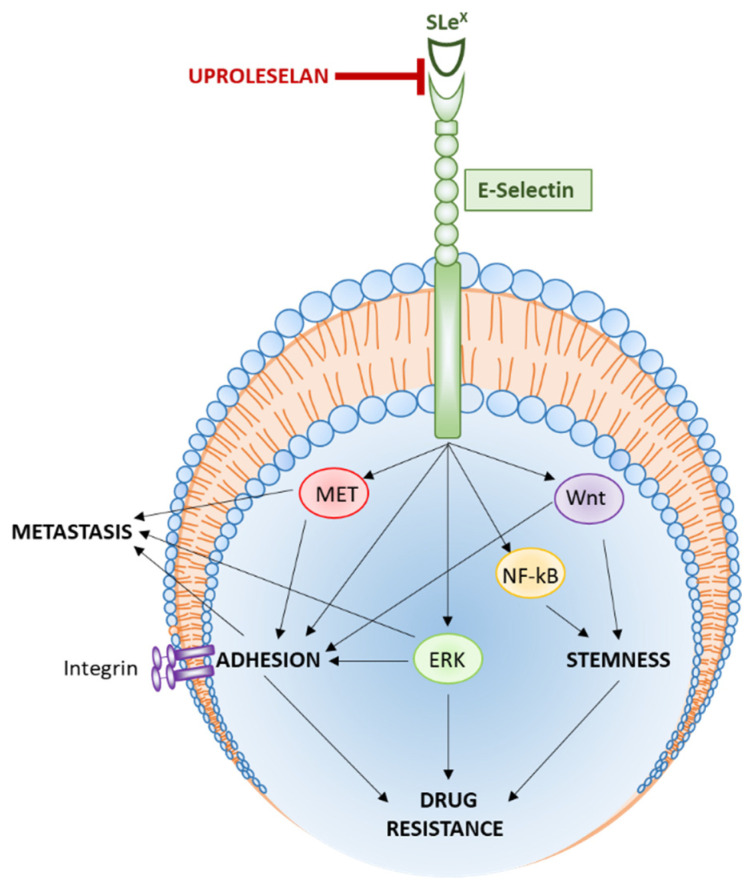
E-selectin is a vascular adhesion molecule expressed mainly on endothelium, and its primary role is to facilitate leukocyte cell trafficking by recognizing ligand surface proteins. E-selectin gained a new role since it was demonstrated to be involved in cancer cell trafficking, stem-like properties and therapy resistance. Therefore, being expressed in the tumor microenvironment, E-selectin can potentially be used to eradicate cancer. Uproleselan (also known as GMI-1271), a specific E-selectin antagonist, has been tested on leukemia, myeloma, pancreatic, colon and breast cancer cells, most of which involve the bone marrow as a primary or as a metastatic tumor site. This novel therapy disrupts the tumor microenvironment by affecting the two main steps of metastasis-extravasation and adhesion-thus blocking E-selectin reduces tumor dissemination. Additionally, uproleselan mobilized cancer cells from the protective vascular niche into the circulation, making them more susceptible to chemotherapy. Several preclinical and clinical studies summarized herein demonstrate that uproleselan has favorable safety and pharmacokinetics and is a tumor microenvironment-disrupting agent that improves the efficacy of chemotherapy, reduces side effects such as neutropenia, intestinal mucositis and infections, and extends overall survival. This review highlights the critical contribution of E-selectin and its specific antagonist, uproleselan, in the regulation of cancer growth, dissemination, and drug resistance in the context of the bone marrow microenvironment.
E选择素是一种主要在内皮细胞上表达的血管粘附分子,其主要作用是通过识别配体表面蛋白促进白细胞的细胞运输。自从被证明参与癌细胞运输、干细胞样特性和治疗抗性以来,E选择素获得了新的作用。因此,由于E选择素在肿瘤微环境中表达,它有可能被用于根除癌症。Uproleselan(也称为GMI-1271)是一种特异性E选择素拮抗剂,已在白血病、骨髓瘤、胰腺癌、结肠癌和乳腺癌细胞上进行了测试,其中大多数涉及骨髓作为原发性或转移性肿瘤部位。这种新型疗法通过影响转移的两个主要步骤——外渗和粘附,从而破坏肿瘤微环境,因此阻断E选择素可减少肿瘤播散。此外,uproleselan将癌细胞从保护性血管微环境中动员到循环中,使它们更容易受到化疗的影响。本文总结的几项临床前和临床研究表明,uproleselan具有良好的安全性和药代动力学,是一种破坏肿瘤微环境的药物,可提高化疗疗效,减少中性粒细胞减少、肠道粘膜炎和感染等副作用,并延长总生存期。这篇综述强调了E选择素及其特异性拮抗剂uproleselan在骨髓微环境背景下对癌症生长、播散和耐药性调节的关键作用。