Sima Michal, Rossnerova Andrea, Simova Zuzana, Rossner Pavel
Department of Nanotoxicology and Molecular Epidemiology, Institute of Experimental Medicine CAS, Videnska 1083, 142 20 Prague, Czech Republic.
Department of Genetic Toxicology and Epigenetics, Institute of Experimental Medicine CAS, Videnska 1083, 142 20 Prague, Czech Republic.
J Pers Med. 2021 Jan 19;11(1):60. doi: 10.3390/jpm11010060.
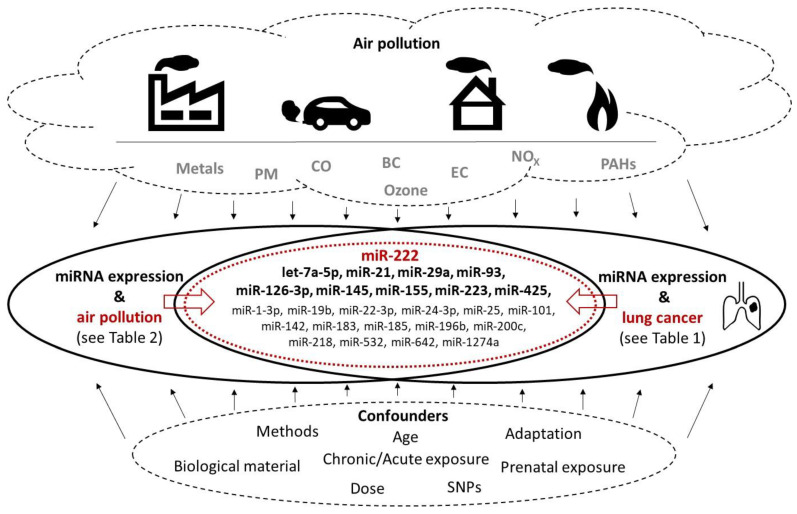
Small non-coding RNA molecules (miRNAs) play an important role in the epigenetic regulation of gene expression. As these molecules have been repeatedly implicated in human cancers, they have been suggested as biomarkers of the disease. Additionally, miRNA levels have been shown to be affected by environmental pollutants, including airborne contaminants. In this review, we searched the current literature for miRNAs involved in lung cancer, as well as miRNAs deregulated as a result of exposure to air pollutants. We then performed a synthesis of the data and identified those molecules commonly deregulated under both conditions. We detected a total of 25 miRNAs meeting the criteria, among them, miR-222, miR-21, miR-126-3p, miR-155 and miR-425 being the most prominent. We propose these miRNAs as biomarkers of choice for the identification of human populations exposed to air pollution with a significant risk of developing lung cancer.
小非编码RNA分子(miRNA)在基因表达的表观遗传调控中发挥着重要作用。由于这些分子反复与人类癌症相关,它们已被提议作为该疾病的生物标志物。此外,已表明miRNA水平会受到环境污染物的影响,包括空气传播污染物。在本综述中,我们检索了当前文献中涉及肺癌的miRNA,以及因接触空气污染物而失调的miRNA。然后,我们对数据进行了综合分析,并确定了在这两种情况下通常失调的那些分子。我们总共检测到25种符合标准的miRNA,其中,miR-222、miR-21、miR-126-3p、miR-155和miR-425最为突出。我们提议将这些miRNA作为首选生物标志物,用于识别暴露于空气污染且患肺癌风险显著的人群。