Jansen Mylène P, Maschek Susanne, van Heerwaarden Ronald J, Mastbergen Simon C, Wirth Wolfgang, Lafeber Floris P J G, Eckstein Felix
Department of Rheumatology & Clinical Immunology, University Medical Center Utrecht, Utrecht University, Heidelberglaan 100 (G02.228), 3584CX Utrecht, The Netherlands.
Department of Imaging & Functional Musculoskeletal Research, Institute of Anatomy & Cell Biology, Paracelsus Medical University Salzburg & Nuremberg, 5020 Salzburg, Austria.
J Clin Med. 2021 Jan 19;10(2):368. doi: 10.3390/jcm10020368.
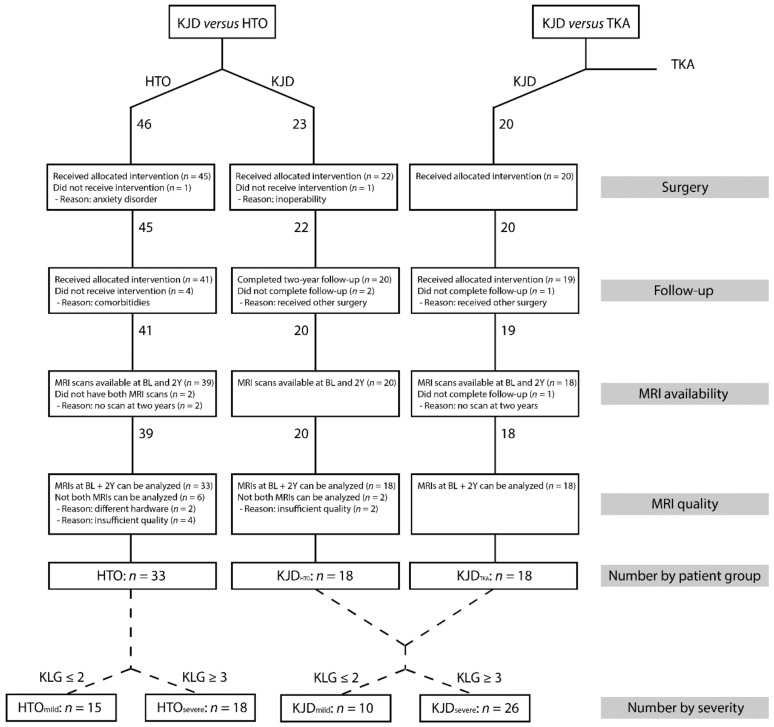
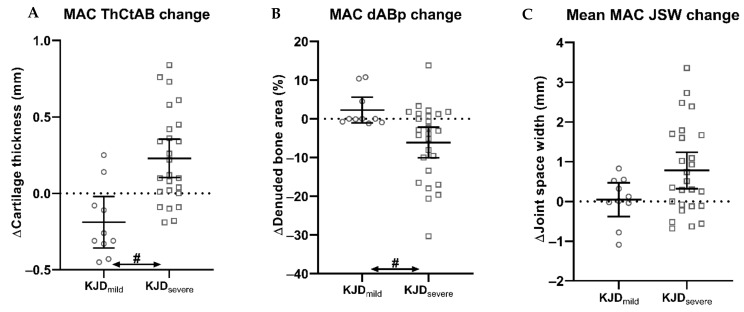
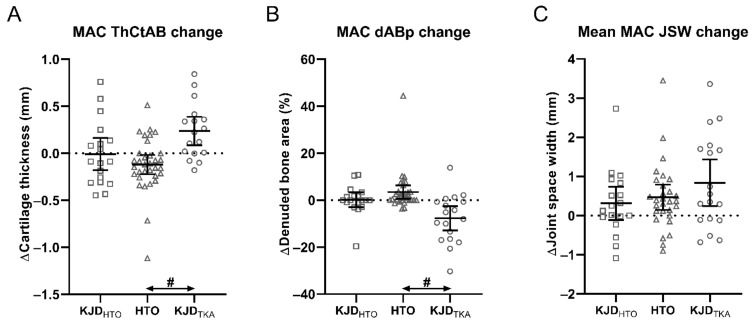
High tibial osteotomy (HTO) and knee joint distraction (KJD) are joint-preserving treatments that unload the more affected compartment (MAC) in knee osteoarthritis. This post-hoc study compares two-year cartilage-thickness changes after treatment with KJD vs. HTO, and identifies factors predicting cartilage restoration. Patients indicated for HTO were randomized to KJD (KJD) or HTO treatment. Patients indicated for total knee arthroplasty received KJD (KJD). Outcomes were the MRI mean MAC cartilage thickness and percentage of denuded bone area (dABp) change two years after treatment, using radiographic joint space width (JSW) as the reference. Cohen's d was used for between-group effect sizes. Post-treatment, KJD patients ( = 18) did not show significant changes. HTO patients ( = 33) displayed a decrease in MAC cartilage thickness and an increase in dABp, but an increase in JSW. KJD ( = 18) showed an increase in MAC cartilage thickness and JSW, and a decrease in dABp. Osteoarthritis severity was the strongest predictor of cartilage restoration. Kellgren-Lawrence grade ≥3 showed significant restoration ( < 0.01) after KJD; grade ≤2 did not. Effect sizes between severe KJD and HTO patients were large for MAC MRI cartilage thickness (d = 1.09; = 0.005) and dABp (d = 1.13; = 0.003), but not radiographic JSW (d = 0.28; = 0.521). This suggests that in knee osteoarthritis patients with high disease severity, KJD may be more efficient in restoring cartilage thickness.
高位胫骨截骨术(HTO)和膝关节撑开术(KJD)是用于膝关节骨关节炎中卸载病变更严重关节间室(MAC)的保关节治疗方法。这项事后分析研究比较了KJD与HTO治疗后两年的软骨厚度变化,并确定了预测软骨恢复的因素。符合HTO手术指征的患者被随机分为KJD组(KJD)或HTO治疗组。符合全膝关节置换术指征的患者接受KJD治疗(KJD)。以影像学关节间隙宽度(JSW)为参考,观察指标为治疗后两年的MRI平均MAC软骨厚度和裸露骨面积百分比(dABp)变化。使用Cohen's d来衡量组间效应大小。治疗后,KJD组患者(n = 18)未显示出显著变化。HTO组患者(n = 33)MAC软骨厚度降低,dABp增加,但JSW增加。KJD组(n = 18)MAC软骨厚度和JSW增加,dABp降低。骨关节炎严重程度是软骨恢复的最强预测因素。Kellgren-Lawrence分级≥3的患者在接受KJD治疗后显示出显著的恢复(P < 0.01);分级≤2的患者则没有。重度KJD组与HTO组患者之间,MAC MRI软骨厚度(d = 1.09;P = 0.005)和dABp(d = 1.13;P = 0.003)的效应大小较大,但影像学JSW的效应大小不显著(d = 0.28;P = 0.521)。这表明,在疾病严重程度较高的膝关节骨关节炎患者中,KJD在恢复软骨厚度方面可能更有效。