Department of Gastrointestinal Surgery, Union Hospital, Tongji Medical College, Huazhong University of Science and Technology, 1277 JieFang Avenue, Wuhan, 430022, Hubei, China.
Department of Gastrointestinal Surgery, The Central Hospital of Wuhan, Tongji Medical College, Huazhong University of Science and Technology, Wuhan, China.
BMC Cancer. 2021 Jan 21;21(1):85. doi: 10.1186/s12885-021-07805-9.
Serum bilirubin and total bile acid (TBA) levels have been reported to be strongly associated with the risk and prognosis of certain cancers. Here, we aimed to investigate the effects of pretreatment levels of serum bilirubin and bile acids on the prognosis of patients with colorectal cancer (CRC).
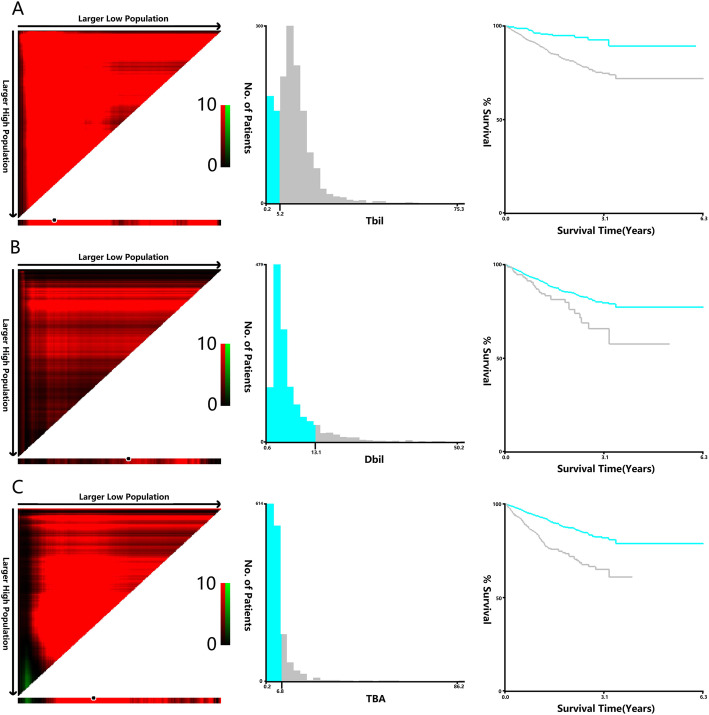
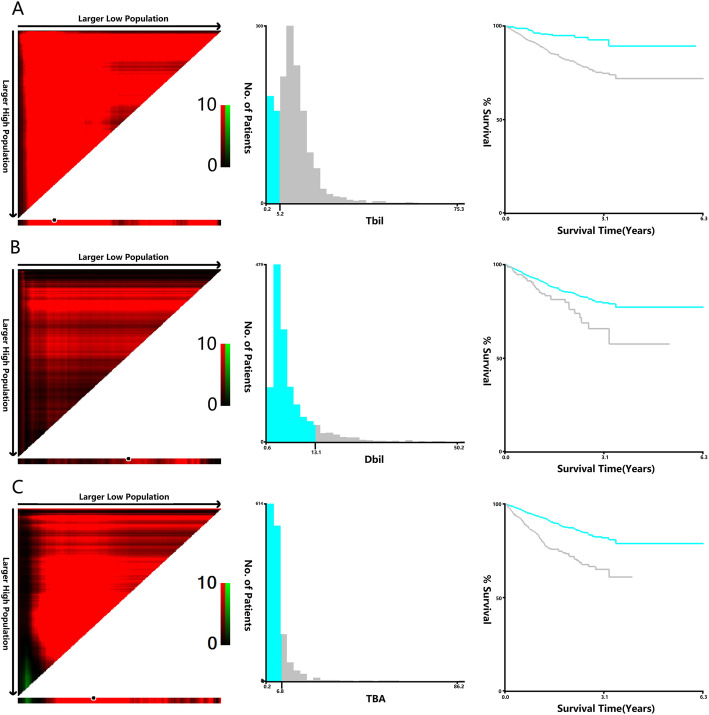
A retrospective cohort of 1474 patients with CRC who underwent surgical resection between January 2015 and December 2017 was included in the study. Survival analysis was used to evaluate the predictive value of pretreatment levels of bilirubin and bile acids. X-Tile software was used to identify optimal cut-off values for total bilirubin (TBIL), direct bilirubin (DBIL) and TBA in terms of overall survival (OS) and disease-free survival (DFS).
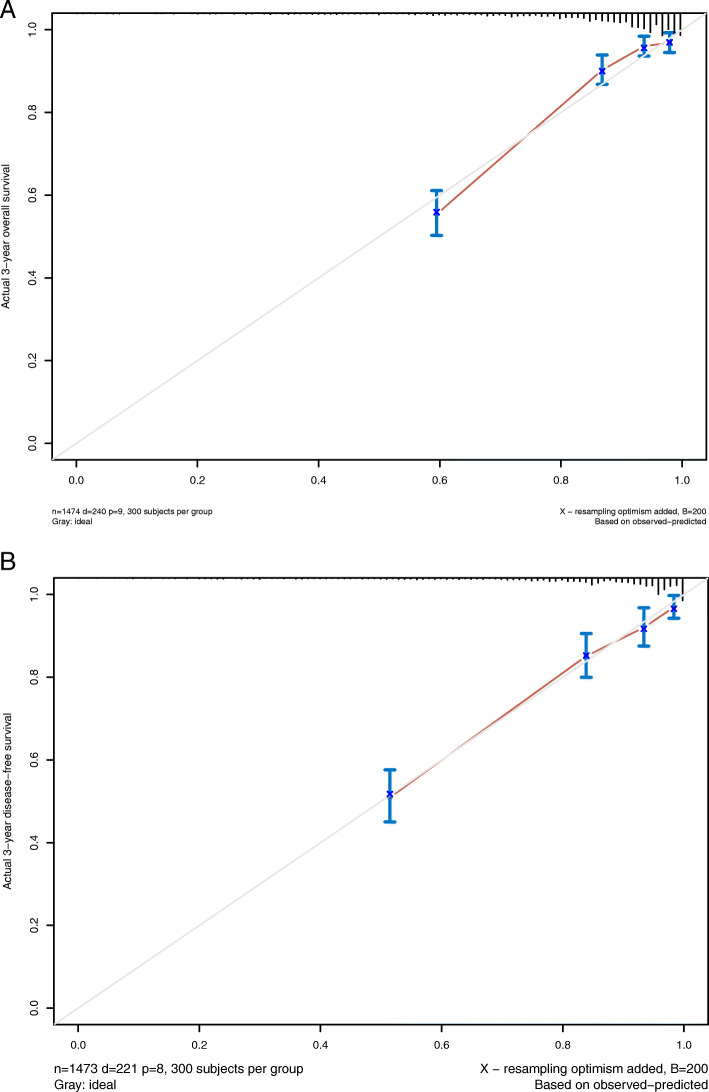
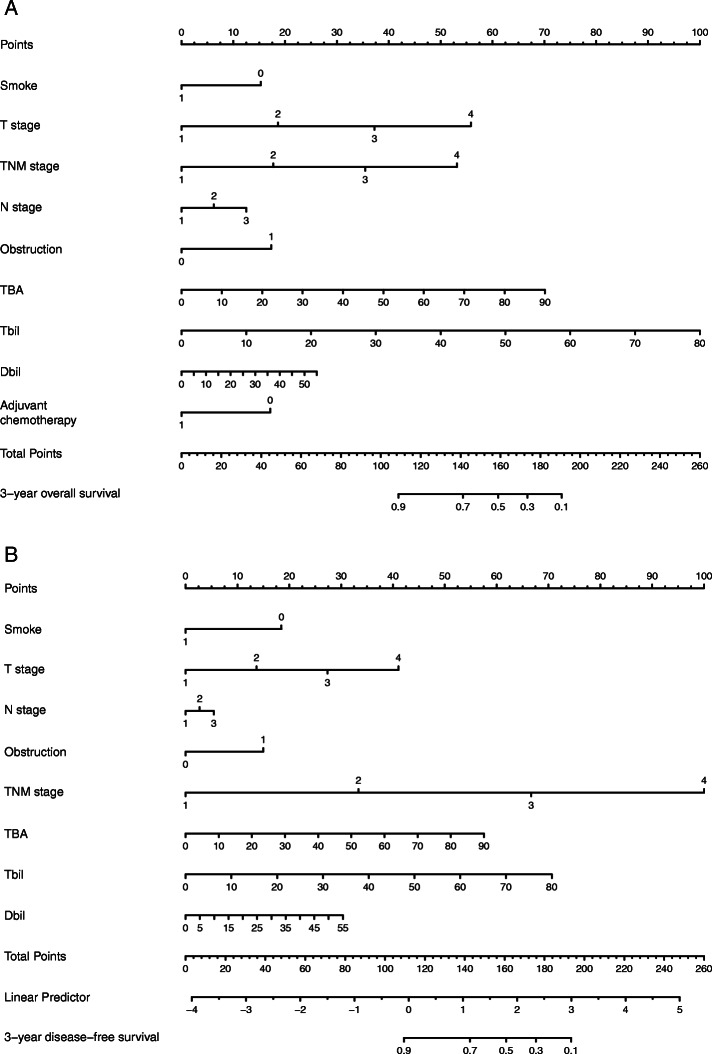
DBIL, TBIL, and TBA were validated as significant prognostic factors by univariate Cox regression analysis for both 3-year OS and DFS. Multivariate Cox regression analyses confirmed that high DBIL, TBIL and TBA levels were independent prognostic factors for both OS (HR: 0.435, 95% CI: 0.299-0.637, P < 0.001; HR: 0.436, 95% CI: 0.329-0.578, P < 0.001; HR: 0.206, 95% CI: 0.124-0.341, P < 0.001, respectively) and DFS (HR: 0.583, 95% CI: 0.391-0.871, P = 0.008; HR:0.437,95% CI: 0.292-0.655, P <0.001; HR: 0.634, 95% CI: 0.465-0.865, P = 0.004, respectively). In addition, nomograms for OS and DFS were established according to all significant factors, and the c-indexes were 0.819 (95% CI: 0.806-0.832) and 0.835 (95% CI: 0.822-0.849), respectively.
TBIL, DBIL and TBA levels are independent prognostic factors in colorectal cancer patients. The nomograms based on OS and DFS can be used as a practical model for evaluating the prognosis of CRC patients.
血清胆红素和总胆汁酸(TBA)水平与某些癌症的风险和预后密切相关。本研究旨在探讨术前血清胆红素和胆汁酸水平对结直肠癌(CRC)患者预后的影响。
回顾性纳入 2015 年 1 月至 2017 年 12 月期间接受手术切除的 1474 例 CRC 患者。采用生存分析评估术前胆红素和胆汁酸水平的预测价值。X-Tile 软件用于确定总胆红素(TBIL)、直接胆红素(DBIL)和 TBA 对总生存(OS)和无病生存(DFS)的最佳截断值。
单因素 Cox 回归分析显示 DBIL、TBIL 和 TBA 是 3 年 OS 和 DFS 的显著预后因素。多因素 Cox 回归分析证实,高 DBIL、TBIL 和 TBA 水平是 OS(HR:0.435,95%CI:0.299-0.637,P<0.001;HR:0.436,95%CI:0.329-0.578,P<0.001;HR:0.206,95%CI:0.124-0.341,P<0.001)和 DFS(HR:0.583,95%CI:0.391-0.871,P=0.008;HR:0.437,95%CI:0.292-0.655,P<0.001;HR:0.634,95%CI:0.465-0.865,P=0.004)的独立预后因素。此外,根据所有显著因素建立了 OS 和 DFS 的列线图,C 指数分别为 0.819(95%CI:0.806-0.832)和 0.835(95%CI:0.822-0.849)。
TBIL、DBIL 和 TBA 水平是结直肠癌患者的独立预后因素。基于 OS 和 DFS 的列线图可作为评估 CRC 患者预后的实用模型。